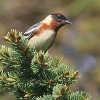
Digital photography has improved in remarkable ways during the past 20 years, and so has photo editing. Some people resist any editing of photographs, and that’s fine; but a few simple editing options can help appreciably, and even salvage a photo you may otherwise deem trash. My suggestion is to keep any edits simple, keep the image as natural-looking as possible, and don’t edit unnecessarily. But if a photo needs some darkroom editing, give it a try, and improve your image with a minimum of changes.
PHOTOGRAPHY
Recently, I’ve been surprised when I noticed that many good photographers aren’t doing any photo editing. Some simple editing techniques can do much to improve the composition and even the magnification of many photographs. The simplest and best way to improve any photo is to crop it. That is, you essentially cut the sides, top and bottom of the image to reduce the extraneous portions of the photograph to better highlight the subject of the photo.
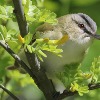
The fall migration of songbirds, flycatchers, swallows and other neotropical migrants has already begun. How have you faired so far photographing them? Many of these small birds migrate in loose flocks, some among mixed-species waves of migrants. They may only stop for a few minutes, a couple hours or a number of days, so you need to be in touch when they appear, and take advantage of them with your camera as long as they stay.
Documentary photography isn’t the same as most uses for your camera. There doesn’t need to be great lighting, high resolution or thoughtful composition; you just want to document a rare bird, or an interesting sighting, an unusual plumage feature or a special behavior. First, I can’t emphasize enough how helpful a photo is when you encounter a bird that makes you think twice about your identification.
Our success as bird photographers can be tied to the level of trust an individual bird provides us. Birds have individual personalities just like people. Some flush at the slightest sign of motion from a person or vehicle, while others are wary, but they may permit you to approach them to a point, to the edge of a “flight zone” let’s call it. When you approach within the flight zone, they make a hasty escape.
Lighting is so important for photography that I mostly limit my birding sessions to prime late afternoon hours; last week the best lighting was available between 5pm and 7pm Central Time – the days the sun was shining, that is. It’s also a period when birds are very active, especially if the wind is subdued. If you have those factors in your favor, all you need is a worthy subject to photograph.
The key to taking photos of most birds is a good telephoto lens. During my decades of bird photography, a 400mm lens has made all the difference – in the quality of the images, and the fun I have when photographing.
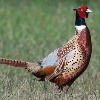
For decades I’ve hoped to photograph a colorful Ring-necked Pheasant crowing. I’ve seen males crow many times and it’s a spectacular behavior to witness, but it’s another thing to be in position to photograph the action. So I’m always on the alert when I’m close to a beautiful rooster in season. This spring I was surprised when a strutting Ring-neck permitted me to approach it closely as it walked gallantly across a grassy opening in an overgrown wooded area.
Have you heard about the mobile blind for bird photography? It’s a car, truck or van – any of which make a great mobile photo blind.
When people ask “What is the essential element for taking a good bird photo,” I always reply “Lighting;” but a better answer might be “the direction of the sunlight.” A simple rule to follow is to keep the bird in front of you, and the sun behind you. That way the sunlight will illuminate the elusive bird in before you.