Wednesday, December 3, 2025

Join the Editor for Weekly Birding Highlights

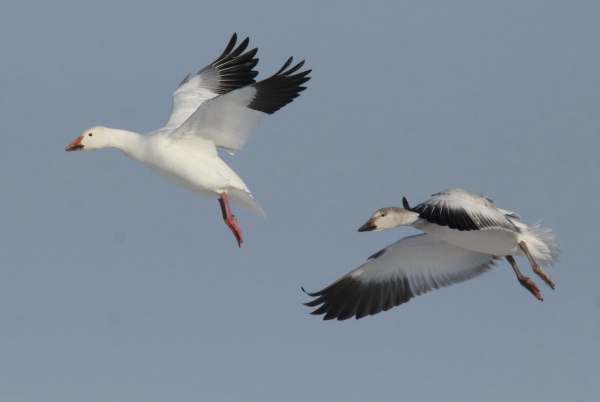
An adult Snow Goose and a juvenile in landing flight above a large flock of geese feeding in a snowbound cornfield on Thanksgiving morning was emblematic of “the week of big change.”
Momentarily alerted during a feeding session, a small portion of a large flock of Snow Geese provides a closer look at their snowy feeding site.
A lone Lapland Longspur foraged on a windswept hilltop during a frigid Saturday afternoon. Flocks of Lapland Longspurs, Snow Buntings, and Horned Larks have been filtering into and through the area the past week.
A Red-breasted Nuthatch paused on a birch branch, perhaps resting before advancing to a feeder, similar to a male Downy Woodpecker that preferred to visit the suet feeder (below).

Mowing lawn one day, shoveling snow the next; and 3 days later I was shoveling again as the temperature dipped into the teens for a high Saturday that seemed to be the last straw for the geese migrating high overhead, directly south, flock after flock. There was 10 inches of snow and only one lake remained ice-free. Even so, at least 3 huge Snow Goose flocks persisted relatively close to home, along with a few small flocks of Canada Geese numbering 25 or less – until Saturday night, when I heard what turned out to be the last geese migrating overhead from inside my warm home.

Thanksgiving morning, as I began my drive to share the day with family in Fargo, I had the best chance to photograph geese in the snow as the sun poked out a minute before I saw the first feeding flock. And my home range continued to show it was the center of waterfowl activity, as I only saw 3 small flocks of Canada Geese during the remaining 130-mile drive. Friday I did a more thorough search of my home area and saw the 30 remaining Tundra Swans that lingered nearby had evacuated since Thanksgiving morn, and in addition to the aforementioned geese in the area, I observed a male Northern Harrier, a flock of about 80 Snow Buntings, and a very late American Kestrel that I thought might be a Merlin until it began hovering and I made a definite ID with binoculars.

As the sun broke through the snow clouds during mid-afternoon, I had a chance to photograph a lone Lapland Longspur and saw a flock of 11 Horned Larks, also down from the Arctic no doubt. But the biggest surprise was seeing a Morning Dove a couple months after almost all of its kind left the area. Oh, and I also caught the distant flights of 3 Bald Eagles at the remaining lake with open water, Carlson Lake. Always the last stronghold for a big concentration of Snow Geese, the deeper snow in the cornfields may have been the last straw for the geese, not to mention the single-digit temperature overnight. It’s been a dramatic change from the previous Saturday when the high was 60ish!

In the midst of frigid single-digit temperatures, late Sunday morning the bright sunlight and clear sky made me scurry to my car to drive 7 miles north to assess the condition of the last lake with open water. Two miles in advance of reaching Carlson Lake a young Bald Eagle broke the still morning with its determined flight, a good sign there might be more eagles ahead. Within a half-mile of the big lake, I was especially surprised to see 3 Tundra Swans flying southeast from the direction of the lake – hmm.

As I slipped over the snow-covered hilltop, the lake was mostly covered with ice, but the remaining open water was primarily populated by swans, standing or swimming behind a light veil of rising steam, with their unique calls emanating lightly from within. They stood among a few small flocks of Canada Geese and fewer flocks of White-fronted Geese and Snow Geese. Common Goldeneyes dotted open water areas, and a flock of a couple hundred Mallards were feeding in a field adjacent to the far western shore – what an exciting mix of waterfowl on this last November morn.

A flew small flocks of the big white swans were on the wing, mostly circling, but a long string of Tundra Swans began flying toward me, catching the morning light while slicing through the brightest light-blue sky. I stepped out of my car and from my standing position in the crisp 6 degree morning freeze, almost 40 Tundra Swans swept their wings elegantly as only swans can in a performance of beauty and splendor, as if to emphasize the last day of open water as a beautiful memory. I figured the first day of December would find the lake’s surface closed for swimming with a cover of ice – and the swans would have escaped via the winter sky.

But when I checked on December 1st, there was still a bit of open water on the far west side of the lake where the hundred or so Mallards were still active. And that’s when I actually watched the last flock of about 25 Tundra Swans take flight to the southeast – eventually heading for Chesapeake Bay or an adjacent wintering site nearer the mid-Atlantic Coast. There were also 7 Bald Eagles on hand, so despite the dramatic evacuation of most waterfowl a week earlier, a trickle of late stragglers made it to December this fall. But there were New birds from the Arctic on hand too – a flock of 22 Snow Buntings and a similar-sized flock of Lapland Longspurs.

Yard Birds – During the short period I was home Thursday morning I happened to see a Dark-eyed Junco at my platform feeder, another welcome surprise, along with 3 Blue Jays at once. Friday morning a male Downy Woodpecker fed on suet, the first male in a month or more; and the semi-regular female Downy also made an appearance with the male stopping by 3 times – but neither was to be seen Saturday. There was a Dark-eyed Junco at my platform feeder again though, working the seeds that fell to the snow – the ground beneath my feeders was now carpeted with a bit of a snow drift that reached toward my bay windows.

While 3 or 4 different Red-breasted Nuthatches are visiting my feeders regularly, along with the Blue Jays, House Finches, at least 1 White-breasted Nuthatch, and the male Hairy Woodpecker, Monday a female and a male Downy Woodpecker fed on suet. And any daytime minute a new bird or even a new species may arrive – it’s that time of year.

The “big freeze” definitely happened a week ago Tuesday (November 25), but the “big change” lingered until Monday (December 1st), symbolically affirmed by the flyby of the last flock of Tundra Swans evacuating that morning. Now it’s on to winter birding mode – and oh what fun and excitement that will bring. Enjoy this first week of meteorological winter, hopefully with some fine bird sightings and insights – Good Luck.

Article and Photos by Paul Konrad

Share your bird sightings and photographs at editorstbw2@gmail.com