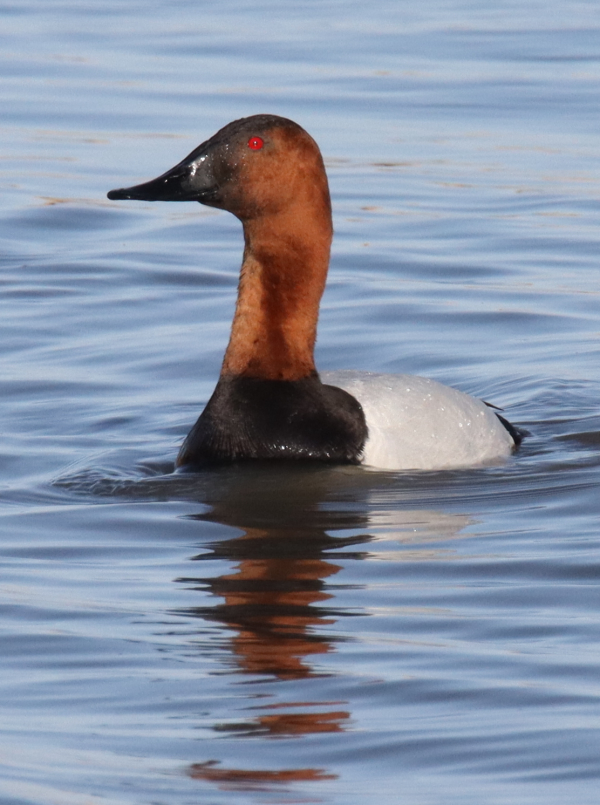
This week’s illustrations are a selection of some of Paul’s favorite photographs that he took this year, starting with this regal-looking Canvasback drake surrounded by the prettiest water color, reflected from the clear plains sky (April photo).
The sunlight, colors, and feather details make this photo of a soaring Bald Eagle that looks like it was taken from above all the more interesting. Bald Eagles seemed to be fairly common photo subjects for Paul in 2025 (January photo).
A springtime first sighting of a flock of American Golden Plovers in the area led to observations of 4 flocks of the Arctic nesting species. Other rare shorebird flocks included Buff-breasted Sandpipers, Hudsonian Godwits, Black-bellied Plovers, and Ruddy Turnstones (May photo).
During a half-hour photo session with Ruby-throated Hummingbirds in the yard, a few flight photographs stood out. It’s hard to tell how long individual hummingbirds utilized the nectar feeder during migration stops, but each day when hummingbirds were present were special days – during spring and fall (September photo).
Often overshadowed by the even more striking markings of the males, this tiny female Magnolia Warbler shows a level of cute that is hard to beat among birds. She was among a variety of warblers that made brief migration stopovers at nearby Melody’s Grove (May photo).
Just a couple days out of an egg, 2 broods of Killdeer hatchlings were already picking tiny foods from the shallows of a local marsh, with attentive adults on hand too (June photo).
A pleasing portrait of a Burrowing Owl benefitted from a moody background color that accents the muted colors of the locally rare bird (May photo).
After photographing one of the cock pheasants crowing as it peered in the direction of the other, the crowing pheasant walked directly toward the other male and a springtime feasant fight ensued to create another exciting action photo opportunity (May photo).
A pair of blue morph Snow Geese is emblematic of the 5 species of geese that spend spring and fall migration stopovers nearby, including Cackling Geese, Canada Geese, White-fronted Geese, Ross’s Geese, and flocks of tens of thousands of Snow Geese (April photo).
Rarely sighted in this region during migration, Ruddy Turnstones visited the shallows on the edges of 2 local lakes. Although water levels were high, it probably concentrated shorebirds to the few available shallow shorelines that weren’t covered with tall cattails. This photo is interesting because the turnstone is approaching the photographer who is positioned low near the bird’s shoreline level (June photo).
A favorite species of native sparrow, this Harris’s Sparrow was the first and only Harris’s sighted in the area during winter. It spent extra time at my feeding station during its extended winter stopover (February photo).
Just a mile south of my office, I enjoyed watching this Short-eared Owl during hunting flights across a broad area about a mile across. Eventually it made a circling flight near my mobile blind as it searched for rodents in the dimming light before sunset (February photo).
|
A winter Merlin! At first it was a shadow, flying between 1 and 2 feet above the ground, barely discernable but I had a feeling as it dipped over the edge of a low hill just 20 feet away. Three Horned Larks suddenly flew up in reaction to the appearance of the little falcon that was right on their tails as they flew directly over the windshield of my car – with the silver-gray male Merlin spreading its tail broadly to show the alternating gray and white bands, and its long pointed primary wings feathers were clearly evident as it continued its lark pursuit. All this just 4 miles north of home on a morning when it was questionable to be on the road, and even more questionable for a bird to remain on the stormy northern plains.
What a start to my drive to Fargo – if the highways would permit me to continue to the big city after the previous day’s blizzard conditions. The roads were fine, but the birds were scarce, which was no surprise – just a flock of about 35 Snow Buntings 20 miles away, and 11 Wild Turkeys about 30 miles west of Fargo.
Foto Faire – Friday I began working on this final issue of the year, which made it a very special day because a major part of my input into the issue would be my selection of my best bird photos of the year – a very exciting activity for me. I worked my way through my 2025 photo files, picking out my favorites, working my way through the images I selected from the many photos I took in each month, and realized I was working my way through the year, season by season, which made it all the more interesting.
The top 11 horizontal photos illustrate the Bird Photography feature at the end of this issue, while the selected square or vertical photos illustrate this article. But as I worked through the edited photographs from each month, I realized there were many worthy “portrait photos” that were close-ups of birds, usually head and shoulders portraits of birds I encountered at close quarters, then cropped the very sharp original images to create avian portraits. This assortment of portraits is included in a second Bird Photography article entitled “Bird Portraits of 2025.” Hope you enjoy my 3 collections of photographs I managed to take during this year, and I encourage you to select a similar collection of your best photographs of 2025.
Frigid cold with a blasting wind, overcast sky, and blowing snow kept me at home Thursday and Friday, but sweet sunshine was the name of the game Saturday. Even though the wind was still roaring and the thermometer read –2 at high noon, I drove my warmed car south to retrace my winter route that yielded sightings of 2 Golden Eagles and 2 Bald Eagles the previous week. The white landscape was beautiful in its own way as long as I was in the car, but the 75 mile route only produced sightings of 2 male Ring-necked Pheasants and a bonus flock of a 11 Sharp-tailed Grouse.
I was surprised there were no songbirds along the way, but I decided to take advantage of the only sunshine expected in the area in some days, and sure enough I found a flock of about 20 Snow Buntings, followed by a flock of 7 Horned Larks. I continued along the entire northern route (12 miles), which yielded 4 flocks of Snow Buntings and 8 flocks of Horned Larks, and the last flock of buntings was the biggest I’ve seen this season – I’d bet nearly 200! Of course, I was on the lookout for eagles, Snowy Owls and Short-eared Owls, a hawk – maybe a Rough-legged Hawk – but no luck, even though the sunny day warmed to –1 (but the temperature would plunge to –13 overnight – woowee!).
Minus 13, plus 30mph wind gusts that is; but less than 2 days later, by Monday noon it was +35 degrees and warming, with a clear blue sky and the slightest hint of wind. The weather has been a real roller coaster of activity like that, and it’s predicted to continue in a similar fashion beyond Christmas. Anyway, Monday was a beautiful day to be birding, enjoying the views from a warm auto and finding a couple exciting raptors along the way. The first was a Rough-legged Hawk about a dozen miles north of my office, and after searching a considerable expanse of the area, the last bird of the day was what I imagined was another Rough-legged Hawk.
As I approached its perch, I was surprised to see it looked pure black upon my first close look, but the hawk repositioned a quarter-mile away on a snag – and that’s when I first questioned if it was a dark morph Rough-legged Hawk, or was it possibly a dark morph Harlan’s Red-tailed Hawk? I took a couple long-range photos of the hawk to try to get a documentary image that would positively identify the species. The hawk turned around, providing another photo view, and then took flight, headed closer, but farther south too.
When I left, I was pretty convinced it was a Harlan’s Red-tail, so checked my photos on the big screen of my computer where I could enlarge them a bit more, and that’s when it was clearly evident it was a dark morph Rough-legged Hawk, which clearly emphasizes the importance of photography as a tool for every birder to use. It was also interesting that after not seeing a Rough-leg for a few weeks, there were 2 the day after a severe cold and wind storm. It was great to see them either way. As for the roller coaster weather, the following day the temps climbed to +46, but with 30mph winds gusting to 45mph; with the temps dropping to below zero again late Thursday, with wind.
Yardbirds continue to be pretty unchanged in species and numbers, dominated by 3 Blue Jays, at least 2 Red-breasted Nuthatches, 2 White-breasted Nuthatch, and a few House Finches. But what happened to the male Hairy Woodpecker and Downy Woodpeckers?
I hope you enjoy the photos I selected to illustrate the editor’s article this week, and all the photos that are included in my weekly communiques. It’s a special opportunity to share my birding highlights, adventures, and photographs each week, which I’ve been doing since 2018. It's a personal joy to provide some insights about the impressive birding action from a little-visited part of the country, while sharing information and birding opportunities from throughout North America and far beyond. Thank you for joining me as often as you do, and I look forward to the year ahead and the excitement, surprises, and all the birds that will appear as the seasons of 2026 progress. Enjoy the holiday season, enjoy some extra birding time, and I look forward to sharing the next issue of The Birding Wire with you January 7th!
Article and Photos by Paul Konrad
Share your bird sightings and photographs at editorstbw2@gmail.com