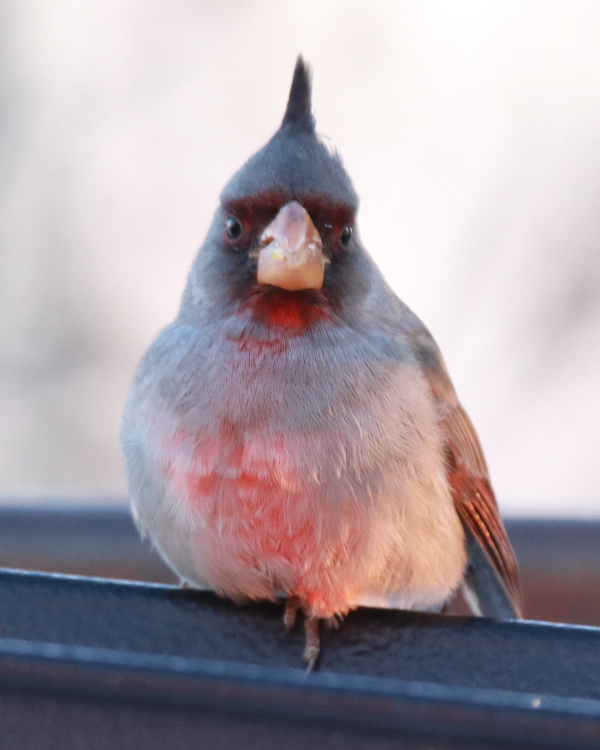
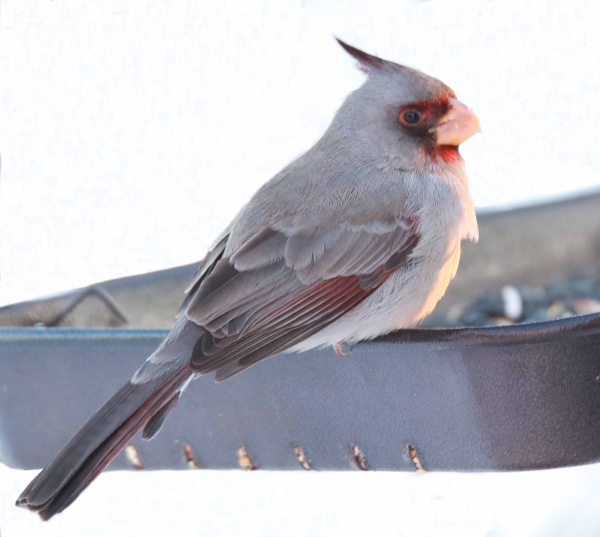
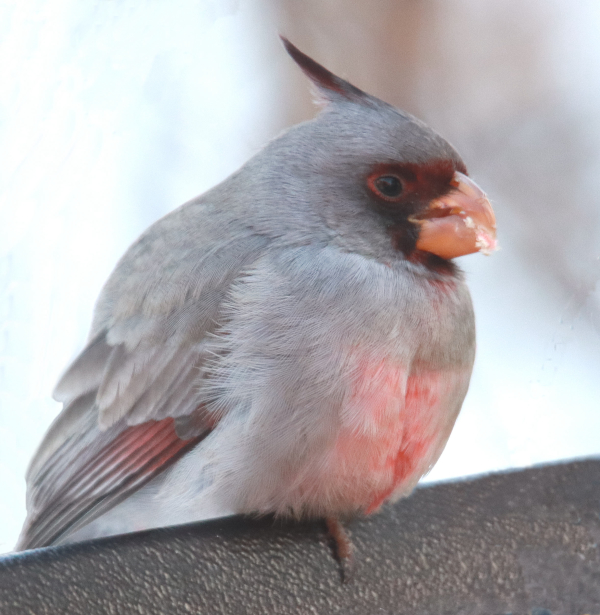
The chance to observe and photograph a First State Record bird, none other than a Pyrrhuloxia, provided an exciting start to the winter season – and it was a mighty cold photo session!
The chance to photograph the Pyrrhuloxia, likely originating in Mexico, Texas, or Arizona, was possible through the consideration and hospitality of Melinda, who shared access to the wayward visitor to her feeding station with many delighted birders.
A surprise second-year Golden Eagle showed especially extensive white coloration in the flight feathers of its wings and tail. An adult Golden was observed during the previous birding drive.
A lone female Ring-necked Pheasant foraged ever-closer as she foraged for kernels of corn on a rural gravel road where there was less snow cover.
The Blue Jays that visit my feeding station provided a nice series of action photos that illustrate the Bird Photography feature in this issue.
|
Pyrrhuloxia? Pyrrhuloxia in the center of North Dakota? Pyrrhuloxia!! Two hours away! The first Pyrrhuloxia, a cardinal-like non-migratory desert bird that normally ranges from central Mexico to central Arizona to central Texas – and now, since December 1, rural North Dakota! Even upon arriving at the feeding station and seeing the long-tailed cardinal-sized bird flying to a tree branch before me, it was grossly out of place, especially with snow covering evergreen boughs surrounding the feeders, and turning the ground white as far as I could see.
Yes indeed, it was the first of its kind ever seen before in the state – a First State Record – and it was very approachable and remarkably accessible once you get on site. Thanks to the consideration and hospitality of Melinda, the bird was available to everyone who drove to her ranch yard. Melinda is a relatively new birder, who at first asked for help in identifying the super-rare bird in the snowbound reaches of rural North Dakota. She was initially delighted to find that a female Northern Cardinal suddenly appeared at her feeding station, which was a good first impression, but after posting a photo of the bird at one of her feeders with a query about the bird to her fellow birders on the “North Dakota Birding” Facebook group, and that’s when the excitement began!
Personally, I’ve only seen a few Pyrrhuloxias – in Arizona near Tucson in Sonoran desert habitat with saguaros and other cacti, in open grasslands in southern New Mexico, and near the southern tip of Texas in the Rio Grande Valley on the edge of scrub woodlands. But in the snowy open landscape of North Dakota in December? It was a first for me and other birders who drove to the site 30 miles east of Bismarck, some to add a new life bird and all to add a new state bird to their lists, and many like me had a special opportunity to photograph the Dakota Pyrrhuloxia. Melinda embraced everyone’s arrival, even had a couple chairs set up near her feeders – and every visitor was delighted with the quick and easy opportunity to witness the newest visitor to the state.
A week before the high temperature was 60ish, but as I stood before the celebrated bird, the temperature was barely 1 degree above zero, soon to drop to minus 11, perhaps colder, but who could tell it was colder? Luckily, while photographing there was only a hint of a very light breeze; wind chill creates a whole other level of cold. I was thrilled to take some documentary photos of the impressive “finch” so far north of its normal range, but it was so uncomfortably cold that even with a full face mask, gloves, thick wool socks, and my regular winter jacket and parka on, after 20 minutes I had to return to my car to warm up again, especially my fingers, hands, toes, and feet, the bit of exposed face – and everything else.
That’s when Corey and Bill arrived from Bismarck; Corey had indirectly provided the information about the “first of state stakeout Pyrrhuloxia” on eBird, and as quickly as I deemed possible, I joined the guys and Melinda at the chairs (I stood for a better view). It was fun to share the experience with them all, and Pete joined us 10 minutes later, arriving from Bismarck too.
We all stayed until a few minutes after sunset, and acknowledged how important and how considerate it was of Melinda to share her sighting and her very rural but beautiful homestead and her “golden feeding station.” I’m not often big on chasing after a rare bird sighting, but this was such an off the wall record, and the bird was so close and accessible that it was quite a thrill to spend time with the Pyrrhuloxia in sight, and especially to photograph it. It was a thrilling experience before and after the encounter – one I’ll never forget.
In addition to the almost-unbelievable Pyrrhuloxia, Melinda’s feeders attracted Blue Jays and House Sparrows, but the Pyrrhuloxia seemed to intimidate the sparrows, and we human visitors probably made the Blue Jays more wary about visiting the feeding station; but the rarest bird in the state was mostly unaffected by we birders. On the way to the Pyrrhuloxia destination, there were a couple flocks of Snow Buntings, and at the frozen, goose-less lakes that attracted so many geese the previous weeks there were 22 Bald Eagles (17 at Wentz Lake and 4 at Napolean Lake, plus 1 south of the little town of Dawson.
Friday’s locally rare sightings: Even with light snow blowing across the highway, I was compelled to drive south to check for birds in the area, after all it warmed to 26 degrees, but the first half of my drive was pretty birdless – just 2 female Ring-necked Pheasants. But as I began a different route back to the office, I began seeing flocks of Snow Buntings, 8 flocks to be exact, including 2 flocks of more than 100 buntings. About mid-way toward home I encountered a flock of 6 colorful males and a female pheasant feeding, and then the biggest surprise – and it did surprise me.
Suddenly, an adult Golden Eagle was flying eye-high in front of my vehicle, slowly elevating and crossing before me into the wind and landing in a tree 60 yards to the west. It was rare because I haven’t seen a Golden in the area in more than a year. And Goldie wasn’t the only rare sighting: 2 miles farther north a trio of Gray Partridges appeared near the side of the road, and just another mile north there was a little covey of 5 partridges – a species I haven’t seen in the area for far more than a year, so I was glad to actually have a chance to take a couple photos. I must point out that I’m surprised I haven’t seen a Rough-legged Hawk in weeks, in spite of covering hundreds of miles of primo habitat. Are they farther south? Or farther north?
When the sky cleared to blue and the sunlight flashed the new snowfall bright white Monday afternoon, I decided to retrace Friday’s route. I really didn’t have much hope for bird sightings, but it turned out that at the 7 mile mark I spied an adult Bald Eagle winging along a line of cottonwood trees, then watched through binoculars as it landed in a cottonwood with branches covered in white hoarfrost. Many more miles along the route another adult Bald Eagle was standing on the ground feeding while surrounded by a pure white snow-covered landscape. There were also 3 flocks of Snow Buntings along the way, outnumbered by a dozen small flocks of Horned Larks that numbered less than 10.
As I drove north on my return route I couldn’t help but think about the adult Golden Eagle I observed Friday afternoon farther up the road. After a couple more miles of driving I saw a raptor-ish bird flying just above the road, and it perched atop a tall pole – could it be? As I approached, I saw there was a side road where I could pull off in just the right position for a photo, and that’s when I realized this was a young Golden Eagle as indicated by a broad white tail band and exceptionally long white wing markings – more white than I’ve seen before on a young Golden Eagle’s flight feathers. That said, it looked to be a second winter bird considering it was noticeably molting and replacing many feathers on its body, face, and the top of its wings.
Although I was parked relatively close to take photographs, the young Golden wasn’t obviously concerned – until a loud semitruck hauling grain passed by. A moment later the impressively large and dramatically colored eagle leaned forward, raised its wings and sprang into flight – what a bird! That meant I was able to find both of the eagle species native to the United States. I also observed 2 flocks of 6 Ring-necked Pheasants, along with a lone female that was foraging on widely scattered corn kernels on a gravel road, which kept her in shallower snow than the surrounding countryside. This pretty pheasant provided some nice photos as she foraged ever-closer as I watched her progress just before a giant cloud bank reclaimed the sky.
Yard Birds – It appears the 3 Blue Jays are the anchors of my feeding station now, with regular visits from a male Downy Woodpecker and the male Hairy Woodpecker, at least 2 White-breasted Nuthatches and 3 Red-breasted Nuthatches, plus House Finches. The only out of the ordinary sighting came Friday when a raptor flew above the trees in my bay window view about 100 yards to the south. It turned out to be a rare bird these days of winter – a Red-tailed Hawk – but initially I thought it was more likely to be an American Goshawk, although that would Really be a rare sighting here!
Actually, the Blue Jays became the stars of the Bird Photography feature in this issue, so perhaps you will be interested in checking out the action photos that illustrate that short article. I also want to remind you that last week I ended that Editor Afield article with this sentence: “And any daytime minute a new bird or even a new species may arrive – it’s that time of year.” A couple hours later, while checking on Snowy Owl sightings in the Grand Forks area of North Dakota, I ran across a report describing the fantastical sighting of the Pyrrhuloxia at Melinda’s feeding station – a remarkable case in point! Aren’t birds exciting! Enjoy the week ahead and the birds you encounter.
Article and Photos by Paul Konrad
Share your bird sightings and photographs at editorstbw2@gmail.com