
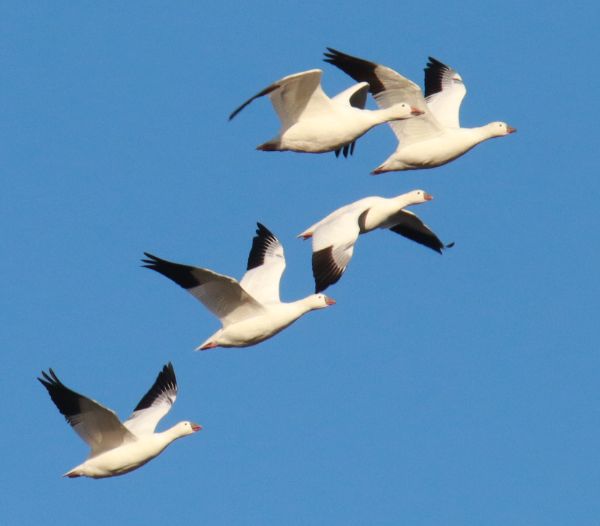
Just before midnight I could hear Snow Geese calling outside, and while that isn't unusual, it did draw me a few yards out the front door. The deep night sky was the darkest black save for bright stars beaming through – and then the goose calls returned. I zeroed in on the sound and was very surprised to see a tight flock of white geese flying a couple hundred feet above the tall ash trees. That was a revelation in itself, as I can't recall seeing such a vivid night view of Snow Geese before; but as I watched I realized the geese were flying across the brightly evident Milky Way – what an exciting view!
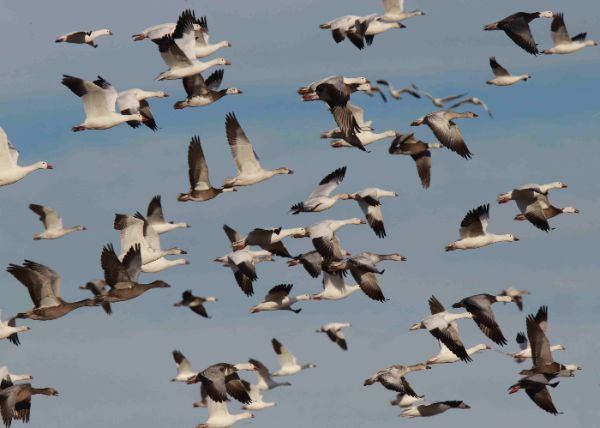
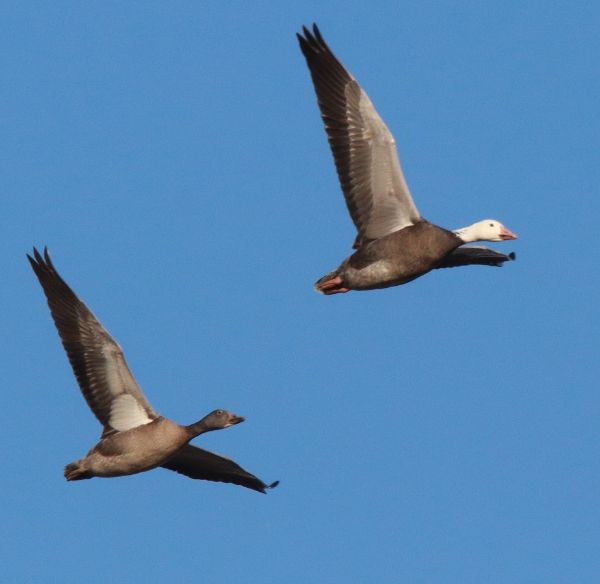
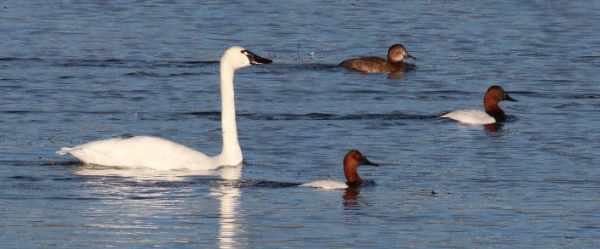
I followed the night flight a moment as the geese may have been headed for Dean's Lake, at least they were pointed in that direction; and with no other birds calling, the cold wind pressed me back inside – but what a memorable sighting that was. It seems as though I've been anticipating the big push of geese south for weeks, but it could happen any day. The following day (Thursday November 5th) there were 2 flocks of about 100 Snow Geese at Dean's Lake, a mile northeast of the office, with a few Tundra Swans at the far side of the big lake. A more exact count of 15 Tundra Swans was on hand at Bobby's Lake 2 miles north of home, and there was actually a White Pelican feeding in their company, which provided an interesting comparison of size – the pelican was a bit bigger than the swans.
A break in the clouds to the west dictated that I should drive that way instead of my intended south route that was still shaded by a cloud bank, and the impromptu change paid dividends when another small group of Tundra Swans was present about 9 miles west, and another small group of less than 10 Tundras were positioned 15 miles west. At Logan Lake about 40 Tundra Swans were present, with a few providing some long-range photos, but the biggest waterfowl concentrations were at Cindy's Lake (2 flocks of about 150 Snow Geese each, and 120 Tundra Swans) and Distant Lake (250 Snow Geese). I circled round to the east side of Cindy's Lake, and before I reached a vantage point, I sighted a small group of swans in a little marsh with 3 drake Northern Pintails attending them.
I was able to approach the swans for photographs, and the 5-some turned out to be a pair with 3 young. The family group swam beautifully across the still blue water and provided a classic that initiates the Bird Photography features in this issue. Lesser Scaup and Northern Shovelers were the most common ducks sighted along my drive, with Buffleheads, Canvasbacks, and Mallards next in line, plus a few American Wigeons were still on hand. I only saw one Northern Harrier to represent raptors, and a Western Meadowlark rounded out the songbirds that showed. By the way, as I write this Friday noon, a flock of Snow Geese is flying overhead, their calls filtering to my ears as I work at my desk.
Friday afternoon I left the office early enough to reach Sand Lake Refuge, but was forced to stop short less than a mile south of home where a nice group of Canada Geese caught my attention at Melody's Marsh. As I took a couple photographs a pair of Cackling Geese stood out in a small way – the first Cacklers of fall and the 5th species of geese in the area. I checked Charo Marsh on the way and was happy to find about 75 Tundra Swans, plus a like number of White-fronted Geese was feeding in their company. At the northwest corner of the marsh, where I like to photograph, 13 swans and about 20 White-fronts were present, but they began swimming directly away when I stopped the car, so I kept moving to let them get back to feeding. There were ducks with the geese and swans too – a few Mallards, Lesser Scaup, and Gadwalls.
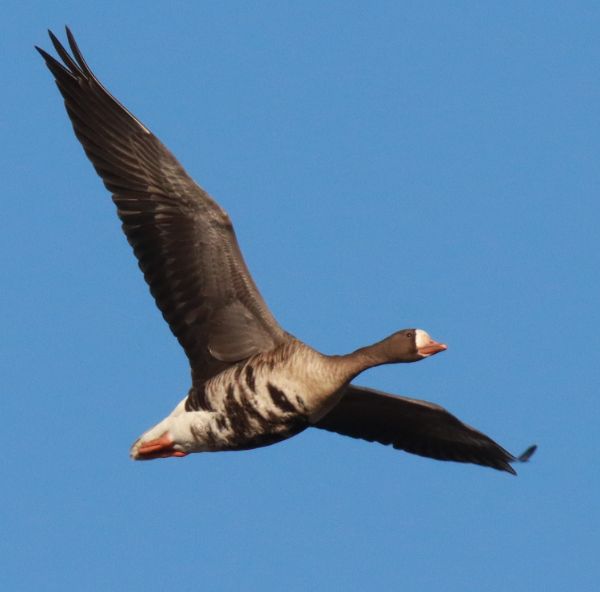
Across the border in South Dakota, Erickson Marsh was all but empty compared to a couple weeks earlier – with just 2 resting American Avocets present and a separate small flock of feeding Northern Pintails. At Sand Lake National Wildlife Refuge, all 5 Dakota geese species were present, starting with a couple flocks of Canada Geese, then a parade of flocks of White-fronted Geese flying west as if heading out to feed. Some flocks of Canada Geese with a few Cackling Geese mixed among them followed, and flocks of Snow Geese eventually passed by too. This was the most goose action I've experienced this fall, but not the kind of numbers I would expect to see – most Arctic-nesting geese were definitely running late. Considering the numbers of Tundra Swans in my area of the Coteau region northwest of Sand Lake, I expected to see some swans at the refuge and surrounding area, but didn't see any swans, pelicans, or cormorants, which was a surprise. I did see 1 adult Bald Eagle, and another about 5 miles south of the border; plus 1 Northern Harrier in each of the Dakotas.
Locally Saturday, there were many more geese at Dean's Lake; about 400 White-fronted Geese and 500 Snow Geese – plus 140 Tundra Swans! Charo Marsh's swans continued at about 80 but they were more spread out across the marsh for a change; and there was a flock of about 150 White-fronts in the middle. For the first time this fall, Herb's Lake held 16 Tundra Swans along with 'bout 50 Canada Geese; and nearby Swan Marsh had 7 Tundras resting on a sandbar. Closer to the office, Bobby's Lake had 19 Tundra Swans and some scattered Canvasbacks.
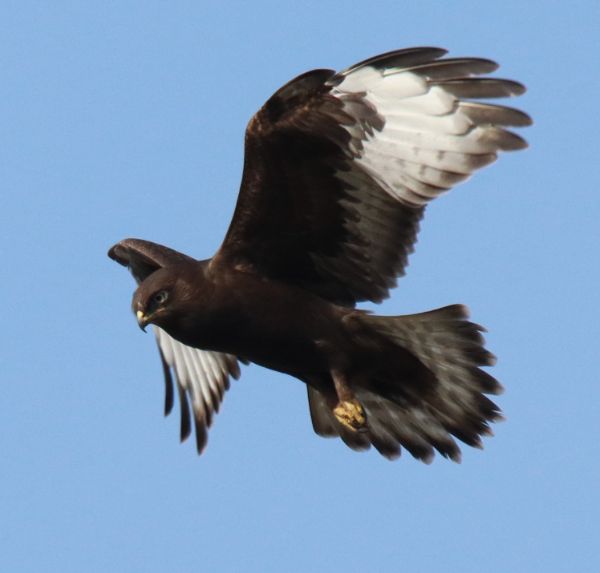
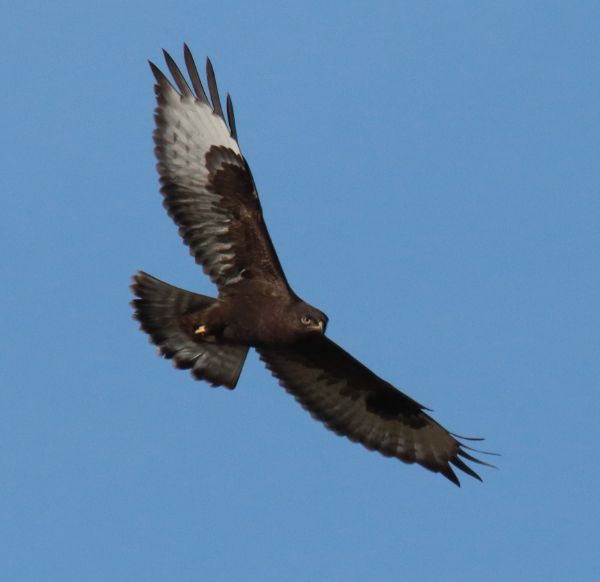
With beautiful sunny weather to behold Sunday, I made a pilgrimage to the Missouri River with the very remote hope of finding Whooping Cranes, but it was a fine black morph Rough-legged Hawk that stopped me 17 miles west of home. I photographed as it hover-hunted above an expansive grassland. It was only my second Rough-leg sighting of the season, but I would see 3 more hunting within a mile of each other near the little town of Hazelton to the west. Along the way, huge concentrations of Snow Geese were present at Wentz Lake and Napolean Lake, as well as about 150 Tundra Swans at Cindy's Lake. I began to see Red-tailed Hawks in the Missouri River Valley, which was a first for November I think, along with an adult Bald Eagle, a first-fall eagle and an older immature Bald Eagle.
Other birds included 6 Sharp-tailed Grouse, 3 male Ring-necked Pheasants, and the first Northern Shrike of the season. The timing was prime to see Whooping Cranes along the river, and having checked with my friend Chris, he saw 2 adult Whooping Cranes 8 days earlier on a river sandbar west of the Glencoe Church. But finding a Whooping Crane during a migration stop is kinda like finding a chunk of meteor on the ground – but I did hope to see some Sandhill Cranes or flights of geese along the riverway – but maybe they are late migrants too this year.
Back in my home territory, Monday afternoon there was a huge addition of Snow Geese that I estimated at 3,000 with a surprising number of Ross's Geese among them, plus a few flocks of White-fronted Geese at Dean's Lake, where there were lots of Mallards, with some Lesser Scaup, Canvasbacks, and Green-winged Teal. At nearby Bobby's Lake there were 11 Swans close to the road that permitted some photo ops of a family group with 3 young. Until then, local Tundra Swans in the area have been distant, but populous. Two dozen Canada Geese were present, and a Northern Harrier winged by in the distance.
Week Two with the Editor
Due to a communications breakdown to notify me in time to let you know that no issue of The Birding Wire would be published on Veteran's Day (last Wednesday), here I begin the second week of birding action with you: Last Thursday I hit the road for an overnight birding trip to Lakes Country of Minnesota, which provided looks at all the usual suspects, except Wood Ducks and Green-winged Teal, which seemed to have fled south after the cold snap – or maybe it was just that time of the season according to their innate migration timing. On my way to my friend Andy's lake home, Trumpeter Swans, Canada Geese, and Mallards were still active, and a look at 2 Common Mergansers was a first in quite some time.
As I waited for Andy to finish a woodworking project, I enjoyed a walk around the peninsula with Little Pelican Lake along the east side and the little Pelican River to the south and southwest. Always alert to finding loons, I wasn't sure if any would still be in the area on November 12th, but sure enough, I spied a Common Loon across the lake, along with a couple Ring-billed Gulls. Alas, all of Andy's watercraft were on drydock for the winter, so we wouldn't be getting closer by boat during this visit, but it would have been a very cold hour or so on the lake. Instead, Andy joined me as road captain as we drove south to search for woodpeckers (Pileated wishfully), raptors, swans, and any other wildlife.
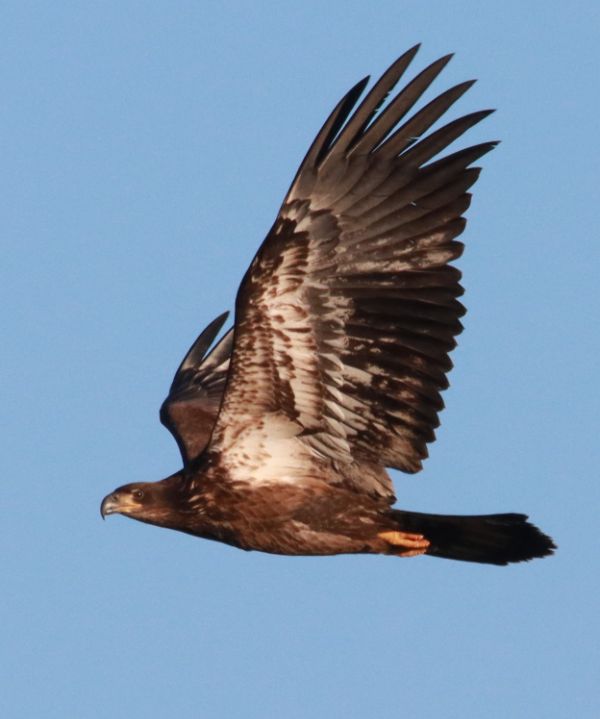
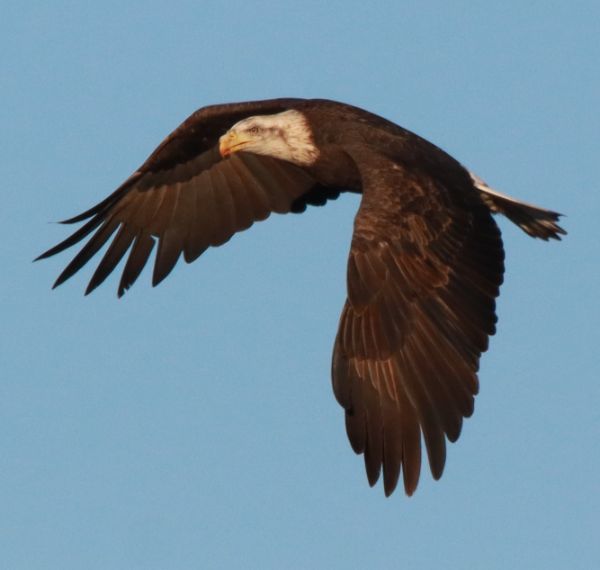
A couple Dark-eyed Juncos revealed themselves, and as I was about to turn southwest, I caught sight of what may have been an eagle flying low across a break in the tree cover. As we passed an impressive house and a classic big old barn, I spied an adult Bald Eagle standing on a grassy hill, then 2 more standing in the tall yellow grass. One adult was feeding on a hidden carcass with the others waiting. It was a great episode to share with Andy, and before we left a total of 6 Bald Eagles were in sight around the food source – 4 adults, 1 first-fall eagle, and a 3rd- or 4th-year bird that was mostly adult-looking (see photo). I enjoyed chances to photograph several of the eagles, on the ground, in flight, and perched in trees – what a fun opportunity that arose from a chance sighting from quite a distance.
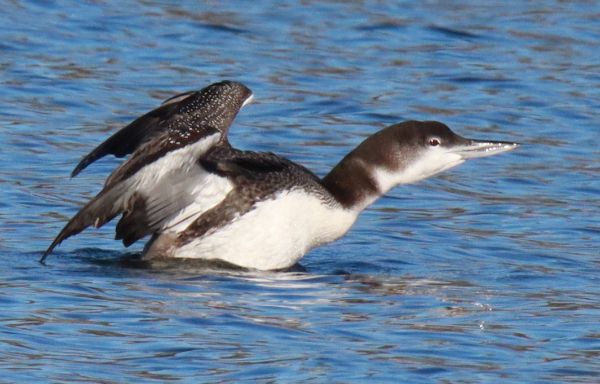
Without water access this late in the season, it was exciting to take some long-distance photos of a young Common Loon after a preening session.
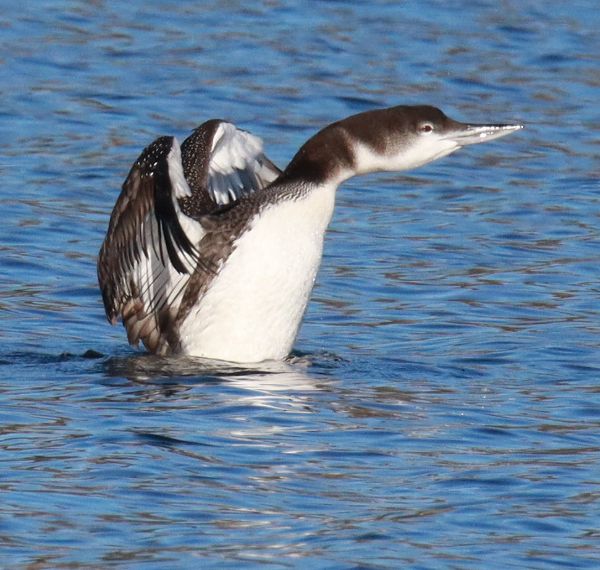
A freezing night led to a morning sun veiled by mist rising off the lake, but it warmed quickly and although Andy had a busy day ahead in Fargo, I stayed behind and enjoyed a morning hike through the leafless woodlands where White-breasted Nuthatches, Black-capped Chickadees, and a Hairy Woodpecker added feathered sounds to the quiet beauty of the Northwoods. The lakes in the area provided looks at 3 Common Loons, including 1 that I was able to get some long-range photos of from shore as it rose up to flap its wings after preening on the water a half-mile north of Andy's place. Other significant sightings included a surprise Bonaparte's Gull, a late Belted Kingfisher, 3 solo Common Ravens, scattered American Crows and Blue Jays, many Trumpeter Swans including family groups, and 9 Bald Eagles, including 3 repeats at the aforementioned location.
Back to Work: By Saturday, there were probably 4,000 geese north of the office, with another 3,000 south, as many of the southern concentration centered at Melody's Marsh, just a half-mile south of the office. Actually, most of the northern concentration was feeding in a field adjacent to Karen's Lake, only about ¾ of a mile from my desk. Although I checked areas far north and far south, the geese were concentrated within 3 miles (mostly within 2 miles). As usual, most geese are Snows, but I was surprised by the numbers of Ross's Geese involved now, and there were scattered flocks of White-fronted Geese – but I didn't see Canada Geese or Cackling Geese during my observations.
Considering my home was centered in the midst of the recently assembled goose concentration, Sunday I didn't drive farther than 3 miles north or south, 'cuz that's where the birds were – with new birds arriving among them. First, as I was planning my approach to photograph a group of 13 Tundra Swans near the road on the southwest side of Bobby's Lake, a flock of about 10 Snow Buntings provided the first fall look at these Arctic-nesting songbirds. The buntings also flew up as I approached the swans, providing a more positive ID. Within the next half-hour, another flock of Arctic-nesting passerines landed on the lakeshore close to my position – a flock of about 25 Lapland Longspurs alighted and took a quick drink as I was photographing under a goose flyway between 2 huge feeding flocks a mile northwest of the office. As I was photographing geese on the wing, a flock of 16 Bonaparte's Gulls also began hunting along the lake edge too - ain't it wonderful when the birds come to you!
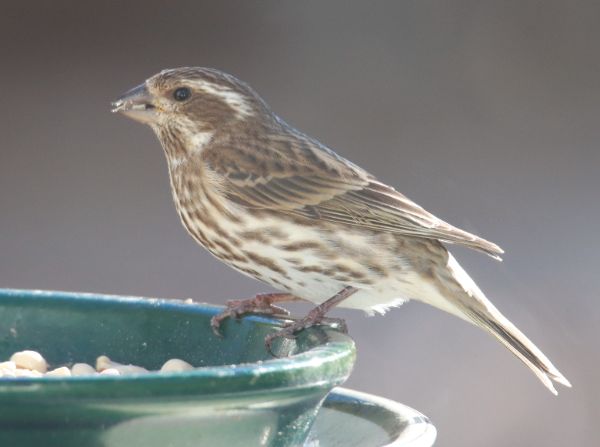
Yard Fun: Speaking of birds coming my way, while the birds at my feeding station are active daily, last Wednesday an exciting variety of birds arrived, including a Red-breasted Nuthatch, 3 American Goldfinches, 5 Pine Siskins, and Blue Jays that sometimes number 5 at a time; along with White-breasted Nuthatches, Downy Woodpeckers, Hairy Woodpeckers, up to 8 House Finches, and a lone Dark-eyed Junco that fed on the ground. A female Purple Finch presented herself Saturday, and you never know what new bird might add to the feeder mix any given day. (Actually, an hour after writing the previous sentence, the first Brown Creeper of fall appeared on the trunk of the ash tree outside my bay windows.)
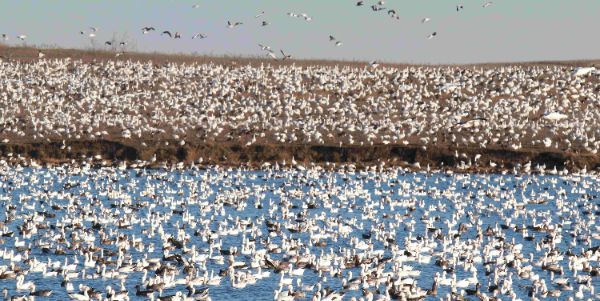
Monday morning yard birds included hundreds of Snow and Ross's Geese flying overhead as it appeared the thousands of geese north of my office combined with the mega-concentration feeding immediately south of home in a flock that stretched at least a mile from east to west, eventually expanding to within 200 yards of my desk. After an absence of the species, a little Red-breasted Nuthatch found my feeders that afternoon as did 2 American Goldfinches among the other visitors – all operating with the backdrop of excited goose music. At about 10:20, a huge flight of geese lifted up from the field to the southwest, which caused me to leave my work and stand in the bay window addition as the sky filled with flocks of geese and their combined sound changed from goose music to a crescendoed roar – always amazing! Thousands of Snows, and hundreds of Ross's and White-fronted Geese settled in at Melody's Marsh, even expanding into the surrounding grassland to feed and rest during the afternoon to my surprise.
Well, the geese have finally caught up with the calendar, and it's hard to convey the energy that thousands of geese encircling your home, flying overhead, and filling the crisp November air with goose music creates as they produce the sounds, the sights, and the energy of nature at its finest – all as 11 interesting species enliven my feeding station! Exciting is the best word I can use to describe this special period of fall. Enjoy any time you have to do some birding as the entire continent is alive with interesting birds on the go!
Article and Photos by Paul Konrad
Share your bird sightings and photographs at editorstbw2@gmail.com