
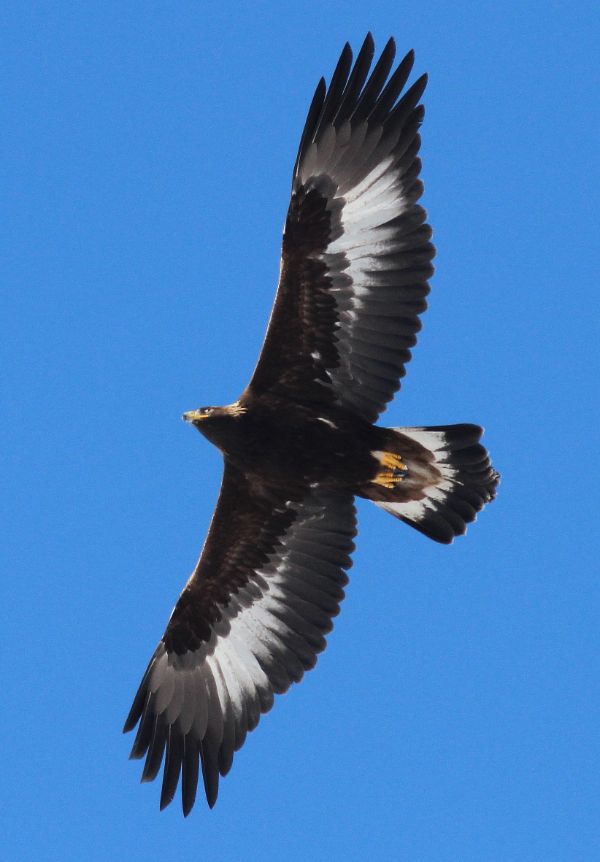
It became quickly apparent that there was a change among the local and regional birds as I began my drive to Bismarck last Wednesday afternoon. Waterfowl were the first indicators, especially Tundra Swans that were present in new wetlands within 2 miles and 90 miles, but way down in numbers at Cindy's Lake, where the biggest concentration was present the previous week. New fall sightings included the first Rough-legged Hawk, the first Ross's Geese, and a first of fall Golden Eagle, the rarest bird sighted in this area during the drive to the capitol city.
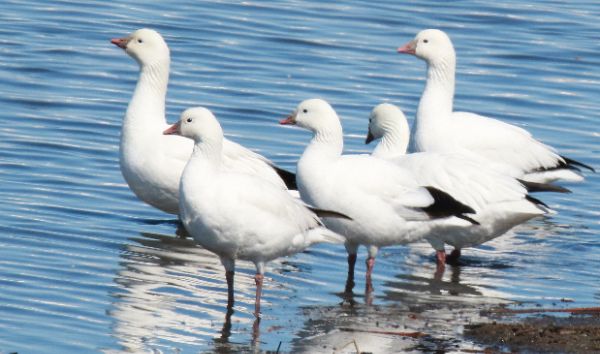
Although raptors have been rare in the area lately, and continue to be, during the Wednesday drive there was quite a variety to be seen. In addition to the Rough-legged Hawk and young Golden Eagle there were 2 Bald Eagles (an adult and an immature separately), a Merlin, a Red-tailed Hawk, and 2 male Northern Harriers. There were a few flocks of Snow Geese, including an especially large flight of several hundred; but White-fronted Geese were by far the most common geese on hand. With the observations of Ross's Geese mixed among White-fronts at Napolean Lake, only Cackling Geese have yet to make a fall appearance in my view. Almost every species of duck is on hand now, except Wood Ducks, Goldeneyes, Blue-winged Teal, and mergansers.
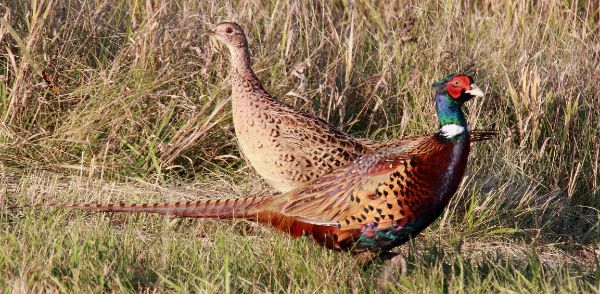
I expected that Sandhill Cranes would be on my observation list during this birding drive, but I didn't see or hear any cranes – even at Long Lake National Wildlife Refuge, where they are almost always on hand in the hundreds during this period of fall. I observed a couple flocks of Tundra Swans at the refuge, 1 swimming and 1 flying, and a late flock of White Pelicans was feeding in a corner of the big lake, along with a late Western Grebe and a few American Avocets and Greater Yellowlegs. Ducks were most evident, including Mallards, Gadwalls, Northern Shovelers, Ruddy Ducks, Northern Pintails, and Green-winged Teal; and there were some flocks of Double-crested Cormorants and American Coots too. A few widely scattered Ring-necked Pheasants were also encountered along the way, including a male and female that provided a nice photographic op.
Closer to Bismarck, birds were mostly limited to Ring-billed Gulls, a few American Avocets, American Coots, and small distant flocks of ducks at the mega-marsh, McKenzie Slough. Little did I know however, that earlier that day 4 Whooping Cranes made a rare migration stopover there, including a feeding session in an adjacent harvested cornfield (which may be where they were when I drove through the marsh area before sunset). Being a long-time resident of Bismarck and regular visitor to the region these days, this is the first Whooping Crane sighting I have ever heard of at McKenzie, although the world's most endangered cranes stopover regularly along the Missouri River shallows and adjacent harvested ag fields to the south. I only heard about the sighting 2 days later, but I'm certainly glad the tallest birds in North America are making their way into the state. Perhaps more will make an appearance so I can try to observe them again as they transit to the Gulf Coast of Texas.
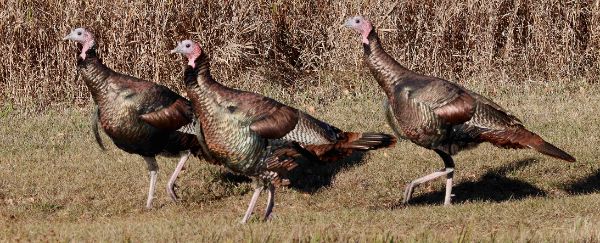
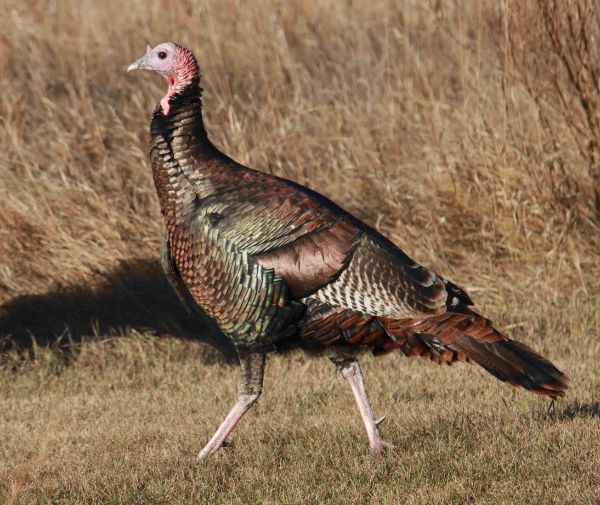
While approaching the Missouri River Valley, I was glad to see 6 Wild Turkeys with a trio of big males following a somewhat separate female with 2 half-grown young. The "toms" provided some attractive photo opportunities as their iridescent plumage caught the full force of the late afternoon sunlight.
To cap off the night, upon my return home long after dark, as I was unloading my car it was heartening to hear swans being quite vocal at Dean's Lake, fully a mile away. In the midst of the remarkable quiet and windless night, the swans' calls were golden. The following day I searched local wetlands to get an update on waterfowl and other birds, finding about 75 Tundra Swans at Dean's Lake, a mile northeast, along with at least 100 White-fronted Geese and Snow Geese that were beginning to fly to a harvested ag field to the east. A mile west of the office, there were 3 swans and about 50 White-fronts loafing on edge of Karen's Lake. Farther afield I counted 71 Tundra Swans at Charo Marsh, but just 3 Tundras at Swan Marsh. And upon my return home, a flock of White-fronted Geese was calling as they flew overhead at dusk.
Inclement weather was the rule the rest of the week, and it was so foggy throughout the day Saturday that I couldn't see the flocks of Snow Geese and White-fronts that flew above me as I did some yard work, but I could hear them for sure. Even though more than an inch of rain fell Monday, I made a cursory drive along paved roads within 4 miles of the office, but could only make out a couple flocks of Lesser Scaup and Gadwalls, even though there were other species of ducks on hand I'm sure – especially Canvasbacks and Mallards.
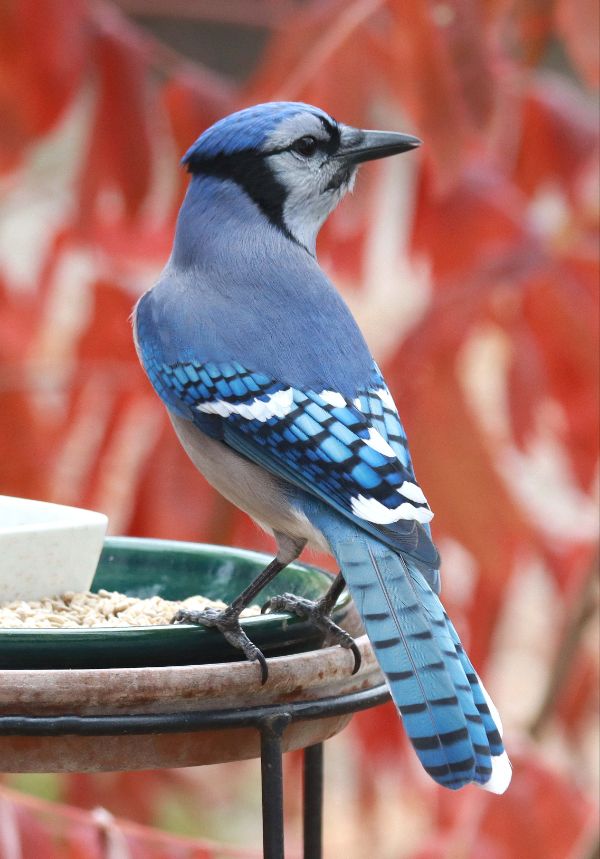
Feeder Excitement: Even though field birding turned nearly impossible Friday through Tuesday, the birds at my feeding station and within view of my bay windows were very active. Among the Blue Jays, American Goldfinches, Pine Siskins, House Finches, Hairy Woodpeckers, Downy Woodpeckers, White-breasted Nuthatches, a lone female Purple Finch looked beautiful through my binoculars. She wasn't the only new bird on hand though – a young Sharp-shinned Hawk suddenly appeared just 60 feet away, with the other birds disappearing in response. The Sharpie stayed in sight for about 10 minutes, even slipping into the cover of a tall juniper shrub in search of hiding birds. But seemingly in response to the hawk's visit, the other birds did not return for about 2 hours.
Thursday, the 2 goldfinches were noticeably absent, as was the Purple Finch, but as I prepared to walk out my front door, 4 Dark-eyed Juncos were foraging at the bottom of the front steps. My feeder birds dominate 2 articles in this issue, the Bird Photography feature and the Backyard Birding article, so please refer to them for more information and several more photographs colored with the red background of sumac leaves.
I don't know about you, but I am a bit overwhelmed by how quickly time has passed since fall migration began! During October I became caught up in the autumn colors and the new birds arriving and passing through week by week – but by November 4th, here in the North of Dakota, freeze-up is within sight, and that brings an entirely different level of birding excitement when tens of thousands of geese emphasize what a waterfowl mecca surrounds me. At the same time, there becomes a bit of a sense of desperation for late migrants arriving, some passing through, some staying perhaps. It's a thrilling time in my neighborhood, just as it is across North America and beyond! Stay especially aware of new birds arriving as well as their behaviors and interactions with the land and other birds. I'm convinced that November is going to be a dandy for birders from Canada to Mexico and beyond. Enjoy the action!
Article and Photos by Paul Konrad
Share your bird sightings and photographs at editorstbw2@gmail.com