
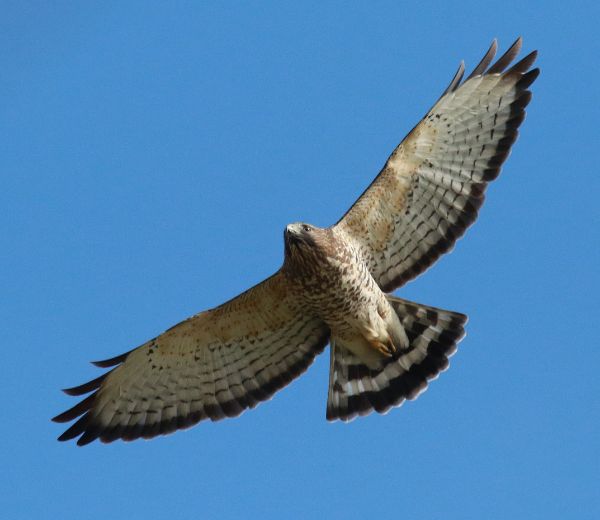
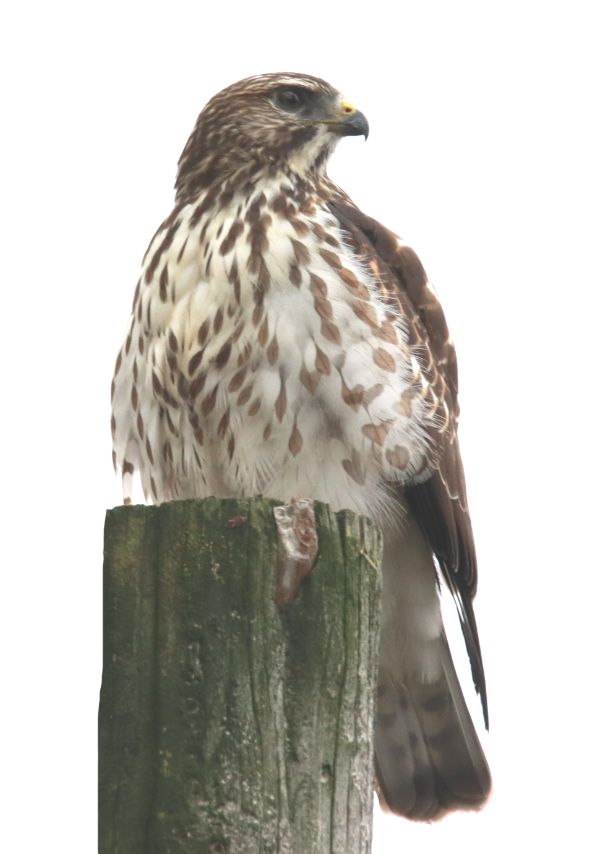
The first bird of the day was a hummingbird! After 15 days, a new female Ruby-throated Hummingbird was perched on my nectar feeder, but before I could really get a feel for the hummer, in the distance behind it a large hawk landed on a pole 175 feet outside my bay windows. Binoculars suggested a young Cooper's Hawk, and I grabbed my camera and hopped in my car to circle around to get into line with a better sunlight angle. Before I made a half-circle, another large hawk materialized perched on a bare tree branch, and another in the open on a top tree branch. Then one flew low behind the others and my binoculars revealed this was a group of Broad-winged Hawks!
That was just the start of a remarkable Tuesday shuffle, with another Broad-wing perched behind the first hawk sighted from my windows, and 2 more in low soaring flight a distance to the north. Wow, a rare Broad-wing stopover in the northern Great Plains, including my neighborhood! The hawks continued to materialize, and as I positioned just southeast of all the action, the sun began to break through morning clouds and the hawks began to take low flights, circling; even forming small "kettles" of Broad-wings that included 4 and 5 individuals – and some circled toward me, even right overhead! This was a truly dreamlike experience, partly due to the species and numbers it had an unreal feel, but especially because the Broad-wings were flying so low, and so close.
Most Broad-winged Hawk observations I have experienced have been at Hawk Ridge where there can be hundreds passing through in an hour, but 99 percent of them are dots in the sky – many, many dots. To have them so low and so close was a thrilling morning experience! There were also Accipiters in the mix, with a Sharp-shinned Hawk and a larger Cooper's Hawk on the wing too – low. And last but not least, a male Merlin was perched in the same big cottonwood tree as the 21st Broad-wing, which upped the raptor count to 24 in the neighborhood! And 1 Broad-winged Hawk provided a new First Yard Sighting. What an exciting 20 minutes that was!
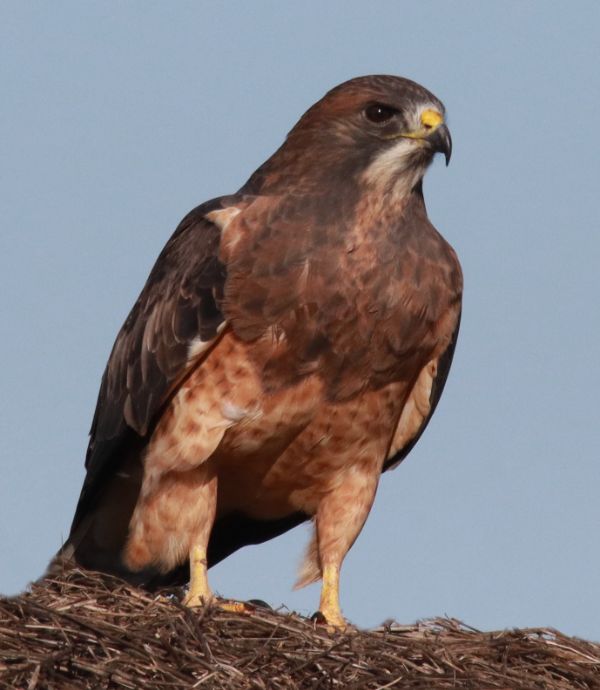
Keep in mind too that during the previous 5 days I had several raptor sightings within a few hundred feet of home: I observed and photographed the bathing Cooper's Hawk, a circling Sharp-shinned Hawk, an adult Swainson's Hawk, a Red-tailed Hawk, and another Cooper's Hawk. To see a single raptor – usually a Sharpie or a Coop – is rare, so the raptor action within sight of home over that 5 day period is truly extraordinary, punctuated by a monumental Broad-wing stopover! Keep 'em coming … !
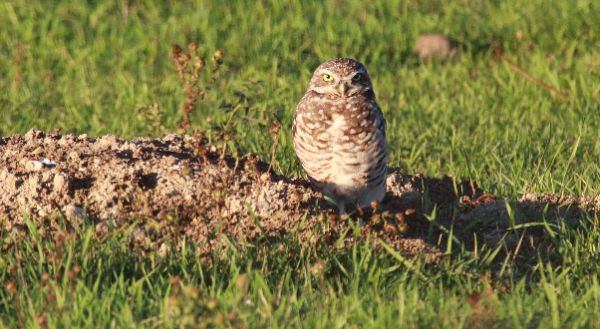
The day ended as I was photographing the Lost Road's lost Burrowing Owl, which was standing tall on the damp, green carpet of closely cropped native grasses. It was standing at a different burrow entrance, although near the other one; and the especially surprising thing was that the small owl was back to acting like it did initially rather than running quickly into the burrow when my car topped the hill 1/3 mile away. That meant that I was able to photograph the owl at its new green burrow entrance, and the new burrow is a little closer to the roadside where I can photograph from. I was a bit surprised the Burrowing Owl was still around as we approached the first days of October, but why not – the open prairie was buzzing with bugs that windless evening. And that wasn't the only owl I managed I documented that eve. Later, when I walked outside in the moonlight, I heard a distant owl hooting several times – a Great Horned Owl.
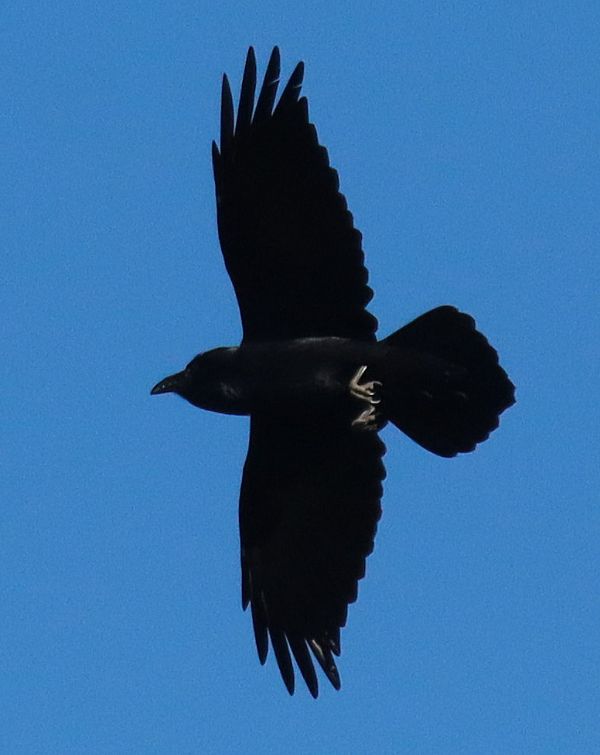
Minnesota Northwoods Blitz: The timing was right for what will be remembered as a classic fall Northwoods foliage drive to check the pulse of nature and especially bird migration in the region. When I awoke on the edge of Bad Medicine Lake in northcentral Minnesota Thursday morning, the first bird I observed was an immature Bald Eagle, followed by a Common Raven, Blue Jays, then another young eagle. A Northern Flicker and a Yellow-rumped Warbler were next to add motion to the forest, enriched by the beautiful colors of autumn maples, oaks, birch, and aspen leaves, and the sky blue water – all after a delightful visit with my friends Pat, Will, and Jessie. Next stop was nearby Itasca State Park where the Mississippi River begins, which was truly spectacularly colored and where the rarest birds of the day materialized – 7 Red Crossbills – a species I have rarely encountered before.
My auto-based adventure continued northeast to Bemidji and Bemidji Lake, south through Paul Bunyon State Forest to Leach Lake, and back westward to Tamarack National Wildlife Refuge. What a wonderful experience of fall colors, punctuated by an expected array of birds that included more Northern Flickers, Yellow-rumped Warblers, Blue Jays, American Robins, American Crows, Common Ravens, Turkey Vultures, Ring-billed Gulls, Mallards, a couple Wood Ducks in flight, and an array of raptors with Bald Eagles leading with a count of 6, an Osprey, a few Red-tailed Hawks, and a Sharp-shinned Hawk – but surprisingly, no Common Loons along the way.
A couple Trumpeter Swans were also part of the avifauna observed, but the photographic highlight of the day took place as the sun was low at a golden pond at Tamarack Refuge. A pair of Trumpeters with their 3 full-sized young were foraging in the shallows of the small pond that was surrounded by yellow-leaved trees, creating a yellow to golden reflection on the water surface, which turned to amber and orange-brown in some spots. It was a beautiful fall setting for such an abiding family of swans, and the adult female provided the best photographs, partly because of where she was positioned during my presence. What golden moments this time spent in the Northwoods provided – still, quiet, colorful, and now punctuated with the grace of swans.
Back Home: Returning home late Thursday night, after unpacking and settling in before bedtime, a (the) Great Horned Owl notably called a couple times from a distance; after which it called much closer. So close that I thought the big owl might be perched in one of my southside trees, but when I cautiously opened my front door to get a better read on the origin of the sound, I realized the great owl was calling from a tall tree on the other side of the road, about 120 feet to the southwest. The owl called fairly incessantly for about 35 minutes, with very short periods between calls – between 3 and 9 seconds. It seemed to give 2 calls, one with 3 syllables followed by 1 syllable; and another that had 2 syllables followed by 2 syllables (hoo-hoot, hoo-hoo). The first call was given during the first 2/3 of the calling period; and the second call followed until I went to bed, which was when the owl stopped calling and probably relocated.
The following day, the first group of 7 Yellow-rumped Warblers appeared in the ash tree and sumacs outside my bay windows, and I observed and heard single Yellow-rumps throughout the day. A flock of about 15 American Robins were active in my backyard chokecherry trees and some raspberry bushes, and the first 4 Ruby-crowned Kinglets were foraging midway up my tall spruce tree, with a flock of more than a dozen Chipping Sparrows on the ground with more robins and a Yellow-rumped Warbler. The abundance of songbirds, including the first of fall species, was undoubtedly the remaining crumbs of the huge overnight migration on October 1st, as documented by BirdCast.
Early afternoon Saturday, a mixed flock of mostly Yellow-rumped Warblers with a couple Ruby-crowned Kinglets foraged through my ash trees. A nearly completely molted male American Goldfinch visited my seed feeder a couple times too, as did a couple House Finches later. Sunday in my yard was a bust before and after a single avian episode: As I was refilling my birdbath with rainwater, a young male Cooper's Hawk flashed into view, flying just 7 feet high 40 feet away, zipping across the road and into a tangle of trees and bushes as it took an abrupt left turn just 4 feet above ground. I could see its continuing flight as it passed across openings in the vegetation and landed on a low branch, just as 2 robins burst into the open from the same location – probably even more surprised than I, and much more terrified.
Saturday was ultra-windy but I wanted to see what I could see on a drive to the south, partly to check if I could record my first October sighting of a Burrowing Owl in North Dakota along the Lost Road. The grass was lush and green as if it was spring, and the Lost owl was in position at a new burrow site during my mid-afternoon visit. This was the second new burrow position in 2 visits, the third burrow used overall, and the little owl permitted a few photographs as the wind battered the green grass surrounding the dirt burrow tailings. Along the way I also observed 2 lone Belted Kingfishers, 9 Blue Jays as singles and double birds, Northern Flickers numbering 7, 3, 2, 2, and 3, and a huge flock of foraging Barn Swallows that was foraging on the wing in spite of the gusts of strong wind.
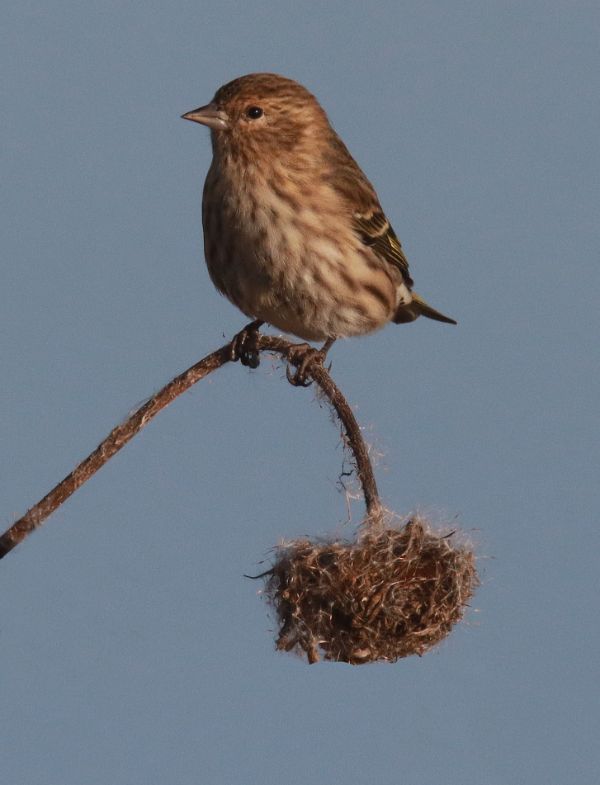
Sunday, the wind was less hostile and the sky was a beautiful shade of blue throughout my afternoon birding drive to Hecla Marsh, where hundreds of Double-crested Cormorants were assembled, along with 2 Bald Eagles, a group of 5 Greater Yellowlegs and 2 Long-billed Dowitchers, a flight of about 25 dowitchers, and a feeding flock of 8 more. A few scattered ducks were present, but the only birds that offered any hope of a photograph were a flock of 9 Pine Siskins, unexpected birds that were feeding on seeds they selected from the dried remnants of small sunflowers that grew along the side of the road. South of Hecla I found a couple small flocks of Cedar Waxwings that included many young birds and a scattering of American Robins.
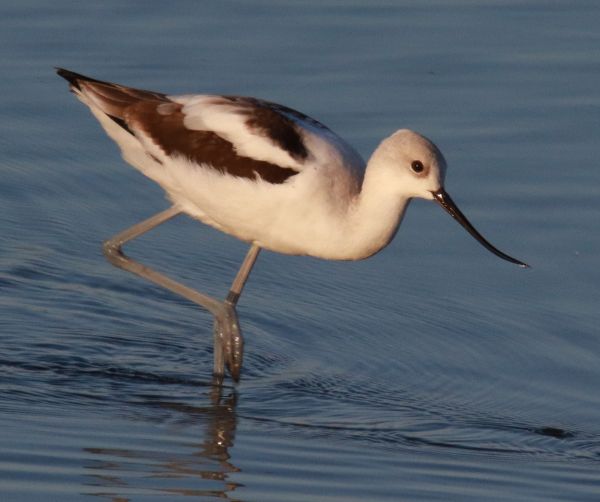
There were 4 lone male Ring-necked Pheasants foraging along the short grass lining the road to Sand Lake National Wildlife Refuge, and a huge flock of Barn Swallows was feeding above an expansive field while another flock foraged in flight above the James River. A couple Great Blue Herons and several Great Egrets were evident along refuge wetlands, as was a pair of Western Grebes that broke the silence with a few of their sharp calls. A large gathering of White Pelicans mixed among Ring-billed Gulls added an array of white accents to the prettiest shade of blue reflecting from an open pool along the river course. My last South Dakota stop was the Erickson Marsh where there were nearly 80 American Avocets, widely scattered as they rested along the sandy beaches and foraged from swimming postures in the shallow water as the light dimmed before sunset. The last bird of the day was a beautiful adult Bald Eagle perched on a bare branch in a white skeleton tree just before I crossed the border into the state to the North.
After enjoying such a wonderful Northwoods experience last week, I'm thinking that during my mid-week break – Wednesday and Thursday – I will return to the land of fall colors to search out birds among colored foliage – and just to enjoy the experience that only wild woodlands can provide at the peak of autumn's enchantment. Hope you enjoy some memorable time outdoors this week, and get some thrills during October Big Day this Saturday. Happy Birding!
Article and Photos by Paul Konrad
Share your bird sightings and photographs at editorstbw2@gmail.com