
As I began my intended drive to Bismarck via the Missouri River road, I only made it 150 feet before I braked to a halt at the sight of a large adult female Cooper's Hawk standing in the middle of a side road, just as she took a step into a rain puddle. I began photographing as it took a couple drinks, but I knew this looked like a prelude to a bathing session. I took a risk by re-starting my car and moving closer, and even though she was in the open, the Coop didn't flinch; and after turning off the engine and taking a first photo, she dipped low and began bathing – the first of 3 bathing sessions punctuated by her spread tail and half-spread flapping wings – the female Cooper's Hawk was into it.
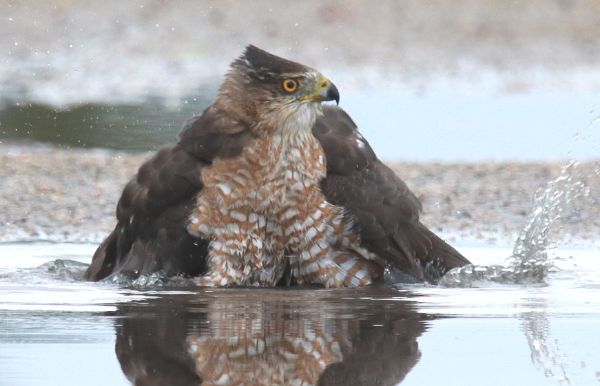
But after her last dip, she made a light ruffle, turned, and flew to the middle of the nearest tree. I repositioned again and took a quick trio of photos before she flew to the north – out of sight. I followed her flight path, but the only bird I saw was an even rarer migrant! It was the first Eastern Phoebe that I've seen in my neighborhood, about 200 yards north of home! What a start for my birding drive to the Missouri River Valley, Long Lake National Wildlife Refuge, McKenzie Slough, and Dogtown Marsh.
I had a pretty big wish list for the drive, trying to conjure up sightings and photo ops of a Prairie Falcon or Ferruginous Hawk, or even a Golden Eagle. But my more realistic interest was to see if the first of fall Sandhill Cranes had arrived. Indeed they had, but I only found 3 Sandhills feeding in a field adjacent to the refuge. For the most part it was a regular ole day as I crossed the Missouri Coteau and Missouri Slope geologic regions, with scattered raptors, widely scattered wading birds, waterbirds that were dominated by American Coots, a few shorebirds, and plenty of ducks, but nothing beyond the ordinary.
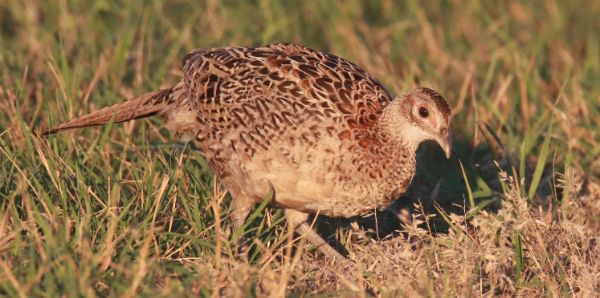
Raptor highlights were 30 Red-tailed Hawks, 6 Swainson's Hawks, 2 Northern Harriers, and 3 American Kestrels. There were lots of Mourning Doves along the way, a few huge flocks of Franklin's Gulls feeding on the wing, 7 Ring-necked Pheasants in the Long Lake Refuge area, 2 Blue Jays, and 3 Turkey Vultures. There was a scattering of Great Egrets, Great Blue Herons, and White-faced Ibis; and 2 groups of American Avocets that numbered about 10 each. On the contrary, I only saw a few Western Meadowlarks and no kingbirds along the way to Bismarck – the super-rare Eastern Phoebe in my neighborhood was the only flycatcher of the day's birding drive.
Beyond the Lost Road: Saturday afternoon, with the promise of the sun breaking through after 2 dreary but sweet fall days, I enjoyed a birding drive to the south and southeast. Many swallows were in the air, including a tight flock of about 80 Tree Swallows and Barn Swallows mixed together, some perched on a couple levels of wires that provided an interesting close view through binoculars. The Burrowing Owl did not show on the damp, now green carpet of native grass (but I will keep checking). There were 2 Red-tailed Hawks along the Lost Road, along with an adult Swainson's Hawk. Seeing 2 Swainson's Hawks along the way was a reminder that the rest of this species will soon depart on their long migration south to Argentina – few will remain in North Dakota after October 1st.
Northern Flickers and Savanah Sparrows were the only other birds along the infamous road, and flickers were scattered along the entire drive – some as singles, others in groups up to 6. American Kestrels were present in like fashion, and it was interesting to see 6 kestrels and 6 flickers perched near the top of some bare tree branches. There was a flock of about 8 American Robins at one point, and a Sharp-tailed Grouse flew up behind them. Mourning Doves were plentiful and some seemed to be in sight at all times. Like the trip to Bismarck, only a few Western Meadowlarks and no kingbirds were on hand in the region, and there was a scattering of Great Blue Herons and more Great Egrets. As I returned home, an adult Bald Eagle was ceremoniously standing on a prominent white rock atop the highest hill to the south, illuminated in a beam of light from the setting sun. And to top off the evening, about 100 feet north of my house there was a scattered flock of 19 ground-feeding American Robins.
Close to Home: I observed the female and male Hairy Woodpecker stop by for suet almost daily, but Monday brought the 2 to the adjacent ash tree at the same time. That added a little drama to the observation as the woodpeckers kept a distance of a couple feet. But the male pressed a dominance issue, and pressed the female to move to the opposite side of the tree trunk, and eventually up to a topside position before she repositioned to one of the big ash trees that create columns on each side of my front door. In a short time the male fed and left, and the female almost immediately returned to the feeder tree and fed on suet for an extended period during the short break in the soaking rain day.
While walking northeast of home Friday noon, about 175 feet away a few warbler-looking birds were flying from one treetop to another in warbler fashion. My first impression was they must be Yellow-rumped Warblers, even though they would be the first of that species this fall; but under the overcast, misty conditions I couldn't make out yellow rump plumage. It was one time I didn't take my binoculars cuz I was going to help some friends with some physical yard work as it sprinkled. But let that be a lesson to me – I missed identifying the flock of about 25 small songbirds, and I'm still not happy 'bout dat.
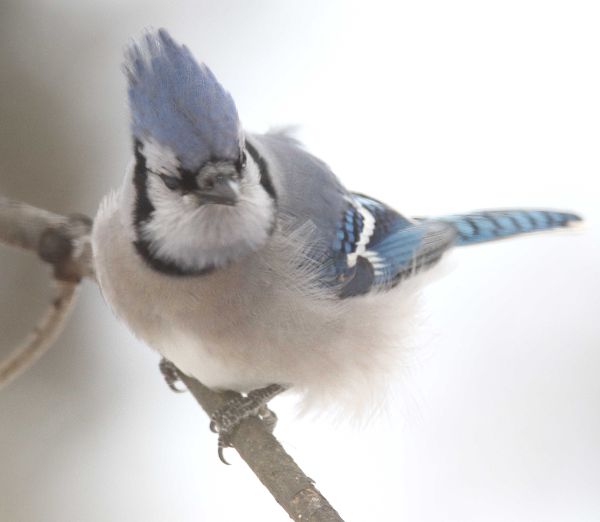
Blue Jays occasionally sounded off again Friday and I finally caught sight of one flying high above the tree canopy. There was a circling Sharp-shinned Hawk too; and after having the Cooper's Hawk bathing within 150 feet of my house Thursday, there was an adult Swainson's Hawk perched within 250 feet of home Friday – that's a first to have one that close. Sunday a Red-tailed Hawk was the next close raptor encountered near my yard, about 120 yards south-southwest. And as soon as I verified it was a Red-tail, a big Cooper's Hawk flew in as if it was going to address the perched Red-tailed Hawk, but it made a tight turn adjacent to the hawk and flew low below the tree canopy and out of sight to the east. Actually, the Coop was so large in flight that my first impression was of an American Goshawk; then I wondered if it might be the big female I photographed bathing near home Thursday. Keep in mind, if I see one raptor that close to home in a month it's impressive, but what a week of close encounters with local hawks – none in my yard, but 3 species and potentially 4 individuals were mighty close.
Under Saturday's full moon, the biggest overnight migration of birds this fall took place in the region according to BirdCast, so as the sky began clearing Sunday afternoon I planned a cross-county birding drive that also crossed the state line that divides the Dakotas, slipping south to Hecla Marsh and Sand Lake National Wildlife Refuge – all before another day and night of rain would follow Monday. I was excited for the opportunity! I gave the clearing sky an hour to advance farther east, but as I drove into the open I realized there was a distinct line of demarcation in the sky: To the north, the sky was clear and blue, but to the south and east – where I intended to drive – the sky was cloudy and gray.
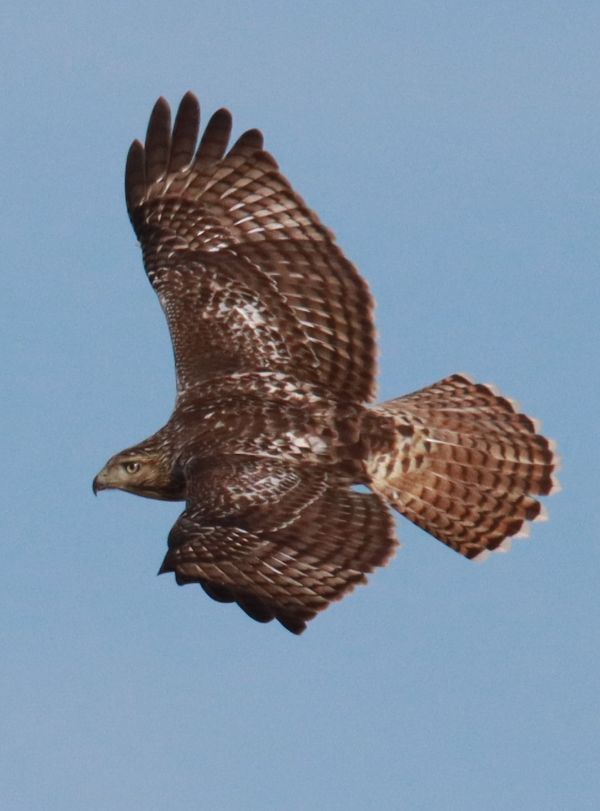
It took a moment to reconsider, but only a moment, because the Hecla–Sand Lake route would limit my photography ops to near nil, while heading northwest would ensure plenty of sunlight. I opted for the west then north route, but before I drove 7 miles, clouds made me realize I would need to adjust to drive north then west instead. I share the above 1 ½ paragraphs to show how when birding, we need to adjust to conditions, even if it means postponing an already "late" trip to favorite birding hotspots. As it turned out, after the first hour I found myself dodging clouds again, a sign of the prevailing unsettled period during the past 2 weeks, but I made the most of the sunshine on the landscape. Birding was good and raptors dominated my notes in typical fashion during early fall. Hawk counts included 18 Red-tailed Hawks including a young Krider's Red-tail, 3 Swainson's Hawks, 1 Cooper's Hawk, 6 Northern Harriers, and 5 American Kestrels.
A highlight was seeing a male Belted Kingfisher; and an increasingly rare view at this time of the season of 2 Black-crowned Night Herons mostly hidden among some cattails. American Coots were the most common waterbirds, and among ducks: Mallards, Blue-winged Teal, a few Gadwalls, and fewer Northern Pintails were scattered, with Northern Shovelers and Ruddy Ducks more common in area marshes. There was an abundance of Mourning Doves along the drive, 2 large flocks of Barn Swallows, and an especially huge flock of hundreds of Ring-billed Gulls in the middle of one wetland. There was a scattering of Great Egrets along the cattail-lined shores of several marshes, while 2 flocks of Cattle Egrets interacted with, but only a single flock of 10 White Pelicans circling to land was still to be seen.
After enjoying the first week of fall, we are about to enter the month of October, a period of drastic changes in my area in the center of North America. The landscapes will change from scenes with colored tree leaves to no leaves on trees, from warm days to cold days, and the new birds on hand will include tens of thousands of Snow Geese along with 4 other species of geese, hundreds of Tundra Swans and Sandhill Cranes, an abundant variety of ducks, and other exciting birds as they pass through the Northern Great Plains. What birds are you looking forward to searching out during October? From the New England Coast to the Desert Southwest, from the mountains of Montana and Washington to the Florida Panhandle, and across Canada and Alaska, I wish you an October of birding that you will remember as historic! Good Luck!
Article and Photos by Paul Konrad
Share your bird sightings and photographs ateditorstbw2@gmail.com