
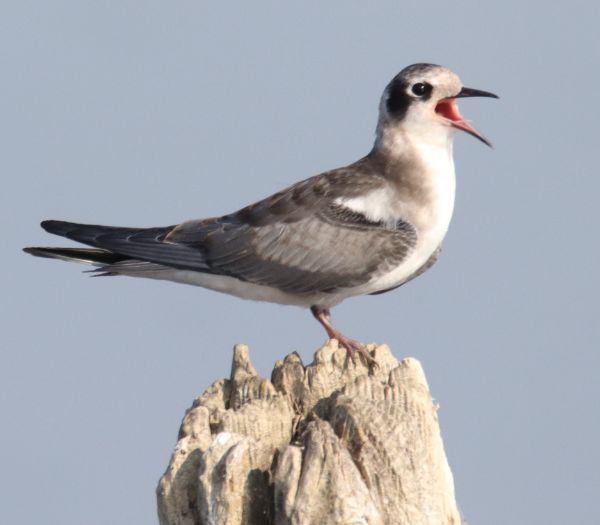
As often happens during prime birding periods, a 2-hour drive to Bismarck turned into a 6-hour birding extravaganza with a variety of photo opportunities – expected and unexpected. Actually, it was smooth sailing until I reached Long Lake National Wildlife Refuge, 25 miles southeast of the capitol city, which was the initial hangup in my schedule. The refuge provided flock and portrait photos of White Pelicans, flying Bald Eagles, 4 species of swarming swallows, a mix of Black Terns with Common Terns, and a mix of scattered Wilson's Phalaropes with Franklin's Gulls; along with Spotted Sandpipers, a variety of ducks, and a beautiful newly fledged Red-tailed Hawk.
The swallows included Bank Swallows, Cliff Swallows, Tree, and Barn Swallows, and a couple flocks numbered more than 100. In an eagle hangout in a little-visited corner of the refuge, 3 Bald Eagles were present among the cover of cottonwood leaves, including a heavily molting adult and a brown third-year bird with small white feathers dotting its plumage in a rather symmetrical underwing pattern with more white plumage coloring its head and tail feathers. The best part was that the younger eagle flew directly toward me, relatively low, then crossed in front of the road to catch the full beam of the late afternoon sun.
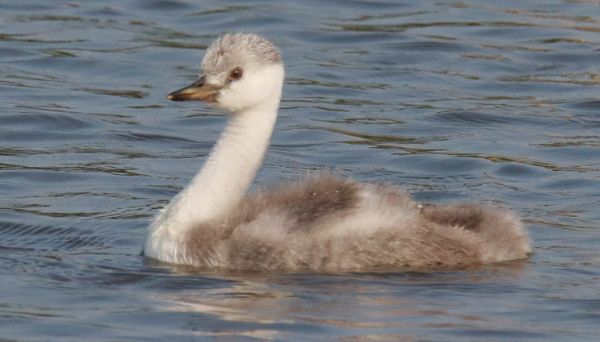
Next stop was McKenzie Slough, which had a variety of birds on hand including White-faced Ibis, Eared Grebes and Western Grebes, many American Coots, Ring-billed and Franklin's Gulls, Black Terns, White Pelicans, and a scattering of ducks including many Ruddy Ducks. The best photo op was provided by a large downy Western Grebe being attended to by the adult pair. The young grebe really attracted my attention, and owing to the fact that the family was swimming adjacent to the nest site where I photographed an incubating adult in early July, the active hatchling was probably the fruit of that nesting attempt.
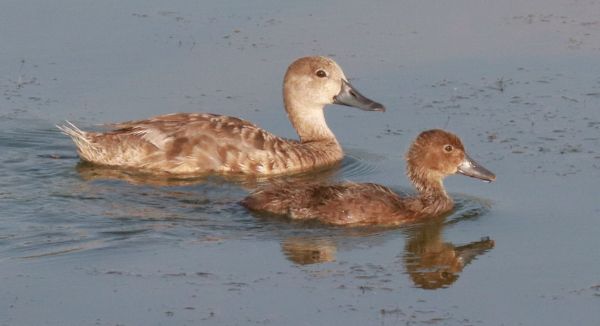
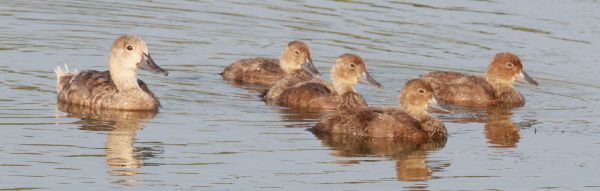
Always the final stop in my drive to Bismarck, owing to its location just 10 miles east of town, Dogtown Marsh was again filled with ducks and duck broods that held my attention until the sunlight was fading. The primary attraction was a very light-colored female Redhead with her brood of 4 brown-colored ducklings a couple weeks of age. The female was especially pretty, set off by her faded, probably sun-bleached plumage that gave her a very white appearance at times. The medium-sized ducklings were not the usually cute bright-yellow downies, having acquired a second down that was colored brown with some longer down strands showing on their neck and breast. The group was very trusting and provided ample opportunities to photograph their moments while foraging.
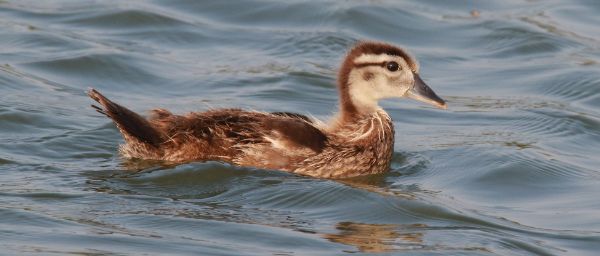
Wood Ducks were also a wonderful point of interest, with a distant brood of 3 with a female, and a few half-grown Woodies foraging on their own that provided some nice portrait photos. My last photo chance of the evening came when I was surprised to see a female Wood Duck leading her brood of 3 across the road in front of me. I figured that was my chance to get some quality species photos of the full brood, but I only managed a fleeting pair of photos before the ducklings dispersed in different directions to forage in a very independent manner. Other broods at Dogtown were Mallard broods numbering 3, 4, and 2 ducklings – smaller late broods that suggest they were second or even third nesting attempts for the Mallard hens. By contrast, Gadwalls nest later in the season than Mallards, and the lone Gadwall hen had a regularly large brood of 10 ducklings.
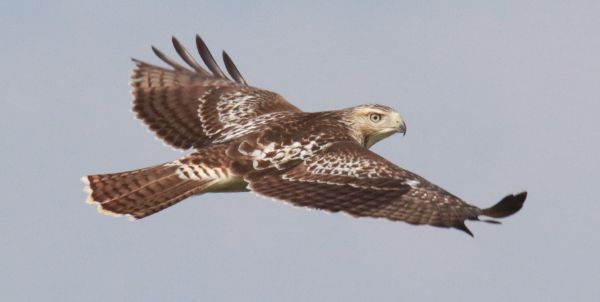
There was even a brood of Ring-necked Pheasants that stepped out of the tall grass with a female on the edge of the marsh, and there was a scattering of male pheasants across the region. The noticeable change among the avifauna along my route to Bismarck was the surprising number of Red-tailed Hawks, more as I progressed farther west. It was obvious by the increased number of Red-tails and the plumage of some individual birds that hawks from the north are filtering south now, while others in the area are no longer tied to their nesting territory, either due to a failed nesting attempt or the separation of family groups. Only a couple recent fledglings were among the Red-tails sighted, but they stood out with their new plumage almost gleaming in the sunlight while older birds were molting or showed worn or faded plumage. There were also a few Turkey Vultures evident for the first time this summer, numbering 1, 4, and 1 during 3 sightings.
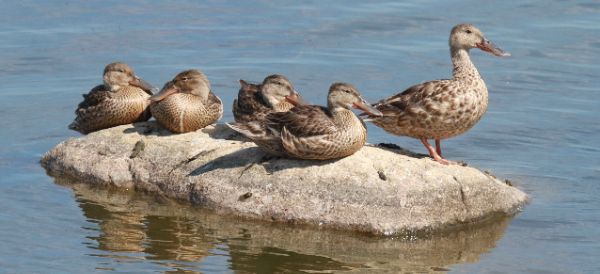
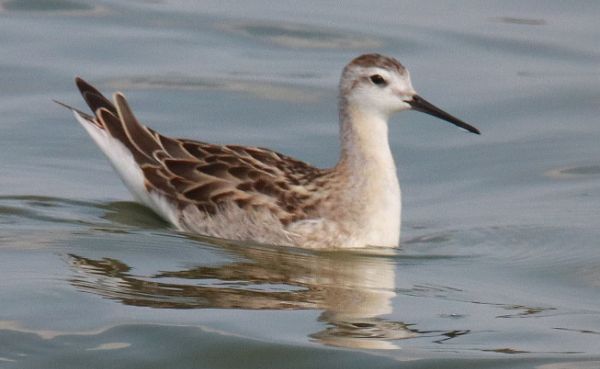
As expected, a few more diving ducks with broods have been evidenced the past week, namely 2 new broods of Lesser Scaup, number 2 and 10. Both were present closer to home at Charo Marsh, and I'm hoping to get some photos of the little dark chocolate-brown ducklings with a female. No Canvasback broods have showed yet, but I'm checking all the usual wetlands, and hoping for some newly hatched Redheads at close range for photos too. There were also a host of other ducks and duck broods at Charo that included 4, 6, and 5 Mallard ducklings, Shoveler broods numbering 4 and 9, and Gadwall broods of 6, 7, and 10. Shorebirds were also present at Charo Marsh, including 4 Pectoral Sandpipers, 2 Spotted Sandpipers, 3 Least Sandpipers, 1 Lesser Yellowlegs, 2 Greater Yellowlegs, 4 Wilson's Phalaropes, and more than a dozen Killdeer.
Charo has been a hotspot lately, and there was also a pair of Northern Harriers on the wing, plus 2 Swainson's Hawks and a Red-tailed Hawk active near the shore – along with a flock of 40ish Cliff Swallows and 20-plus Tree Swallows. On my way home, I saw the closest pair of nesting Bald Eagles standing on the tallest hill in the area (about 7 miles south of my office). They looked very impressive at the top of the prairie mount, with the female showing quite a bit larger than the male. I wondered if they raised 1 or 2 fledglings this year because their nest site is very remote and leaves have concealed the nest since early May, so I haven't been able to track the nestling or nestlings that hatched just before the leaf-out. On the edges of nearby White Lake, a pair of Bobolinks were active, and a Gray Catbird surprised me.
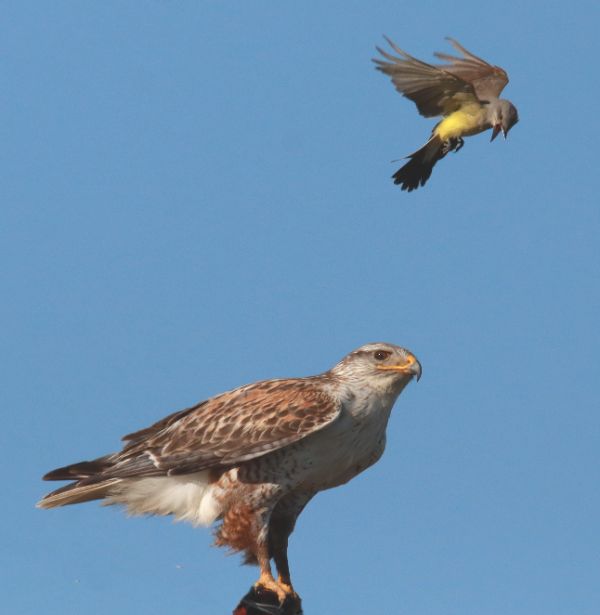
During the past week I checked on the Ferruginous Hawk family group 3 times, but didn't see any hint of the 2 adults and 3 fledglings in the nesting territory or surrounding area. This was expected, but it was a bit abrupt, which mostly suggests they left as a group rather than individually. I bid the Ferrug family good luck as they likely continue the post-fledging period as they expand their range beyond the nesting territory. I did see an adult Ferrug about 4 miles north of the nesting territory, but this was at a location where I observed an adult a couple weeks earlier, hunting in "the company" of a pair of Swainson's Hawks both times.
During a much-needed rainfall that dropped a quick half-inch of fresh rain Friday evening, I peered outside from my second-story doorway to the deck to see a bright rainbow in the eastern sky. Suddenly, 4 birds flew from the center of the colored illumination to be identified as Cedar Waxwings as they banked into the top of the tall blue spruce tree that towers beside my house. The waxwings were the first I've seen since May and I wondered if they were attracted to the ripening chokecherries that are hanging thick in my backyard. The sweet sighting made me repeat "timing is everything" for me to catch that quick rainbow-waxwing view.
At my feeding station, a new House Finch fledgling was begging for grape jelly from an adult Friday noon, and House Finches are the most common feeder birds now. The male Orchard Oriole persists but seems to be making fewer jelly feeder visits. I haven't seen young robins lately, suggesting the local fledglings have moved on, but at least 1 adult continues to stop for jelly, and I'm thinking a pair is in the midst of a rearing a second brood. The male Ruby-throated Hummingbird provides a spark of interest any time it arrives for up to 60 sips of nectar at a time. You may wonder how I know it's the same hummingbird each day, but I make it a point to try to be able to identify individual birds of interest, and this male has a small group of gray feathers that extend into the white plumage of its lower left flank. Soon, there should be new males, females, and recent fledglings stopping by as they begin their initial movements south. I always get the most hummingbird action at my nectar feeders during late August and early September.
With August just a few days away, I hope you are looking forward to seeing some interesting birds in your yard, your neighborhood, and the surrounding region. Perhaps you are even looking forward to a summer vacation or an extended weekend outing when you will search for new birds in another locale. Enjoy this week and next, and good luck in seeing some interesting new fledglings, broods, and early migrants – every week is different, which keeps birds and birding especially interesting.
Article and Photos by Paul Konrad
Share your bird sightings and photographs at editorstbw2@gmail.com