
It is always impressive to experience the dramatic change between the Great Plains of Dakota and the Northwoods of Minnesota, and at the peak of the green season it is always exciting to experience both during the same day. That's exactly what I did Wednesday, and again Thursday, as I drove from prairie and wetlands complex to-and-fro the woodlands and lakes country – leaving Northern Pintails, Eared Grebes, and Swainson's Hawks behind to appreciate the Wood Ducks, Common Loons, Trumpeter Swans, and Great Blue Herons of lakes country.
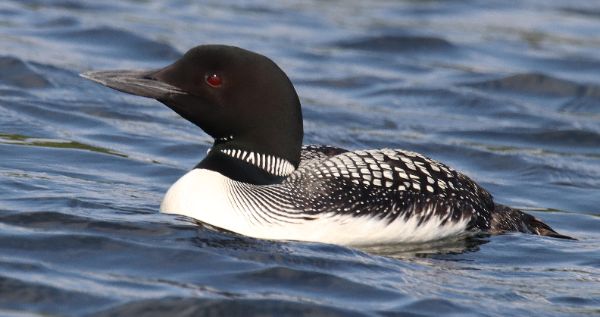
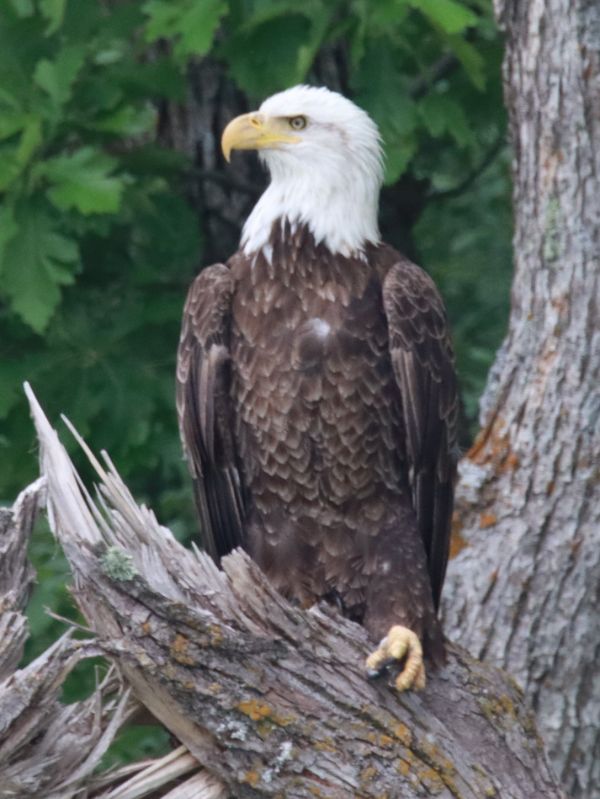
The birding highlight in the area, as always, was finding and photographing loons with my friend Andy, and during Thursday's pontoon excursion, our friend Craig was the pontoon captain. As we searched the north bay of the lake, Craig followed the shoreline until I suddenly realized we passed by a regal Bald Eagle, perched in a large tree that provided a shaded hollow that prevented us from seeing it in advance. Just as well though, considering that we were now in a good position to take a couple relaxed photos of the big guy. Our first loon sighting was actually of a loon on the wing, which is not a common observation in that area, but a water-based Common Loon sighting quickly followed. The resulting photo action is described and illustrated in my Bird Photography article in this issue, but there is more to this loon pontoon outing too.
After our initial loon photo action, we cruised along the little river to neighboring Pelican Lake, where we considered if we should check to see if we could find a newly hatched brood of loons. Although it was a week earlier than we observed the first loon hatchlings last year, a friend of Craig and Andy's shared a photo of 2 newly hatched downies with an adult 2 days earlier, so we were game to try to find an early hatched twosome. Just then, Craig said, "Look ahead, I see 3 loons!" They were quite a distance ahead, which was a testament to Craig's keen eyesight as I checked with binoculars just as a second adult brought food to the 2 new hatchlings with the other adult. We were careful not to disturb the family group, but enjoyed seeing them at what seemed to be an early date – the 4th of June – the earliest date we have encountered newly hatched Common Loons; a week before last year.
Our time on the lake is always a thrill among friends, but this outing was preceded by a big collection of comrades that assembled on Cormorant Lake for my friend Linda's birthday bash – more than 50 of us enjoyed the evening together that was graced by a double-rainbow with a unique golden center that stretched from horizon to horizon after a few sprinkles. Birds in the area included Wood Ducks, Trumpeter Swans, Eastern Bluebirds, Eastern Kingbirds, a White-breasted Nuthatch, Great Egrets, many solo Great Blue Herons in flight, a Red-bellied Woodpecker, Red-tailed Hawks, and a couple Bald Eagles. A couple standout birds in Andy's yard were an Eastern Wood Pee-wee, Gray Catbird, and yes, a Pileated Woodpecker! I was lucky enough to see the Pileated this time, but not lucky enough to photograph it – but just to hear it sound off with its deep drumming on a dead limb in one of Andy's big trees is always exciting.
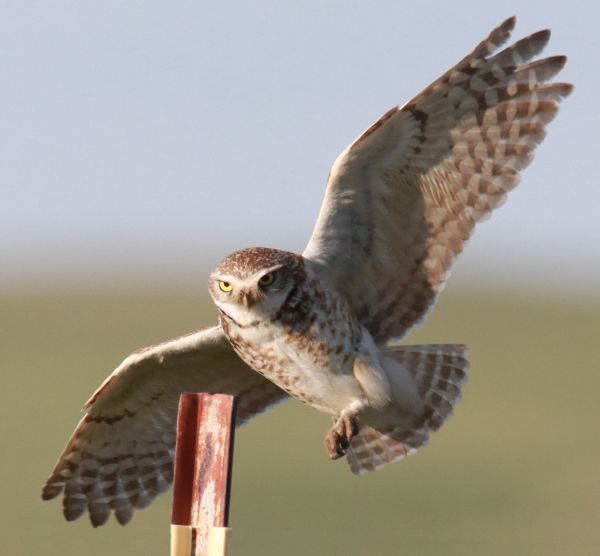
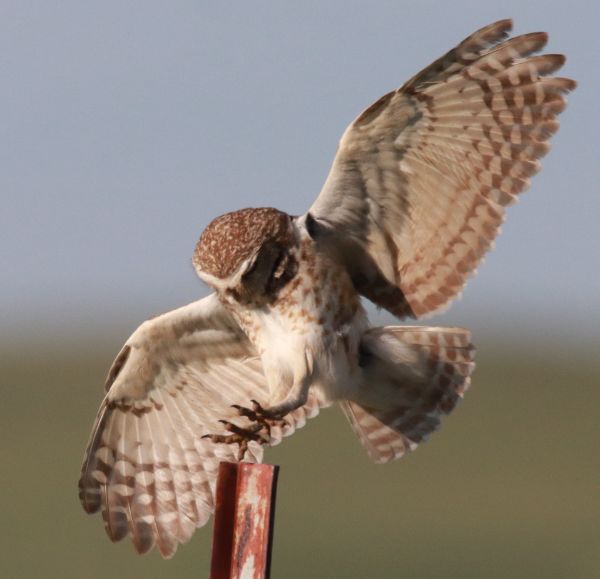
Dakota Owls: Back in my home region Friday, as the afternoon settled into evening I wanted to check on the Burrowing Owl I found at the longspur prairie the previous Monday. No luck for owls during my first driveby, but there was a lot of Chestnut-collared Longspur action along with sightings of Eastern and Western Kingbirds and a Song Sparrow. After checking on ducks and grebes at Wentz Lake, my return driveby was short-stopped when I was happy to see the Burrowing Owl perched on a post on the edge of the prairie. But not long after I stopped, I was surprised to see the owl leave its perch, thinking it was reacting to me parking nearby. But the owl only flew a few feet, and after a couple minutes (about the time I was about to leave) the Burrower flew up from the grass to the same perch – great. Now the thought came to mind about whether the owl retreated from sight because of my arrival, or to grab a big bug in the grass, or to visit a burrow?
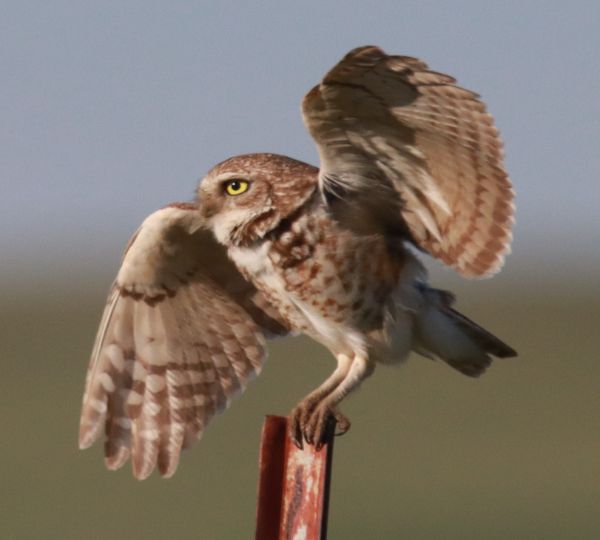
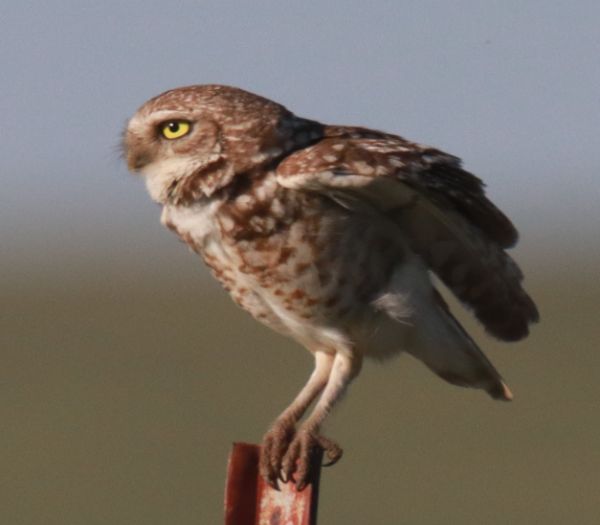
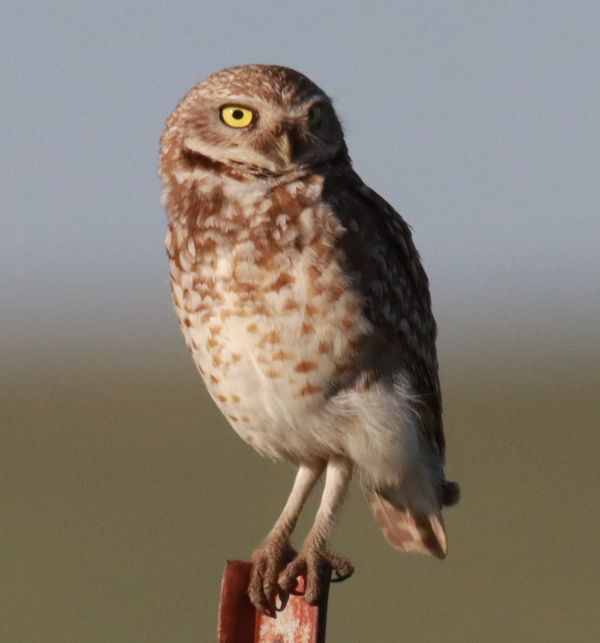
After a couple minutes, the Burrowing Owl returned to the same location in the grass, only about a dozen feet from its perch; and after a minute's time, it returned to the perch. During my observations, it repeated this process once more, which strongly suggested it was tied to a burrow and potential nesting site – how exciting! Almost as exciting was that I was prepared for the return of the owl to its perch during its second visit to the ground. I was pre-focused on the fence post and as soon as I noticed the first motion from the grass I instantly began the photo process as the Burrowing Owl flew toward the perch, wings spread and intent on landing. My main concern was whether I was able to auto-focus on the bird in the ultra-split second I had before it actually touched down. The photos looked good, but were they sharp?
I was also ready for the owl to return to its perch the third time, but that effort was a fraction of a second late, and I missed the entire sequence – a testament to how fast the sequence happened and how quickly I needed to respond. When I checked the resulting photographs from the potentially successful photo try, the camera's smallish LCD screen revealed that I may have a nice 3-photo sequence of the owl landing, but it was hard to tell if any of the photos were truly sharp. An hour later, when I checked the photographs on the big screen of my laptop, I was thrilled to see all 3 of the super-fast action photos were sharp – hooray!
It was such a beautiful evening that I extended my drive another half-hour to explore along a prairie road that I thought might yield another Burrowing Owl location during prime owling time. But a full 2 miles before I even reached the turn onto the side road, I sighted another Burrowing Owl, perched on a larger wooden fencepost near the top of one of the highest hills in the area. How exciting, and it was much closer to my office than the first owl. With 2 Burrowing Owls already sighted, I followed through with the hope of finding more along the very rural side road, but although the auto cruise revealed some new country, I didn't see any more owls during this drive. Even so, Burrowing Owls have been so rare in the region for so many years that it is exciting to have seen 2 within a half-hour's drive, including 1 that is just 15 minutes away from my office.
The Yard Birds: The initial male and female Baltimore Orioles that came to my feeding station continue to be regular grape jelly visitors, along with at least 1 male Orchard Oriole. American Robins and House Finches are regular grape jelly fans too. Since Friday a male Ruby-throated Hummingbird has been a regular nectar feeder visitor, and a female American Goldfinch stopped by as I was preparing this issue for publication yesterday (Tuesday afternoon).
Social Birding: Although it was quite windy Saturday evening, my friend Doug joined me for a birding drive that started at Bobby's Bay, where Doug enjoyed photographing a couple American Avocets and a Willet. And just as we were leaving I spied a new avocet hatchling, the first of the season. The downy hatchling with relatively long blue-gray legs was probably 2 or 3 days old, but appeared to be feeding well on its own in the shallows before retreating behind a cattail curtain after just a moment. Doug enjoyed a number of Marbled Godwits, Bobolinks, White Pelicans, and a variety of ducks during our drive, and my favorite sighting was a Red-headed Woodpecker at a location that attracts one or more nesting pairs each year.
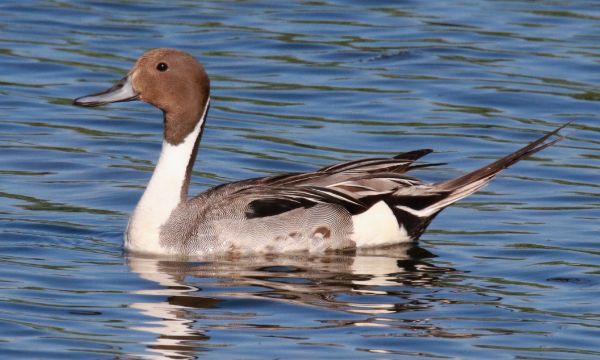
A big surprise Monday was an offer to go birding with my friend Kristine from San Jose, California, who was visiting her Mom and family in her hometown of LaMoure. During a so-so weather day, as soon as we hit the road from home the lakes and marshes calmed to become glassy mirrors of the sky, and as we passed by, the prairie was literally glowing. I was impressed with how much Kristine has improved as a birder since last year, and she shared stories about the birds she and her husband Jacques observed in parts of Spain, Portugal, and the Azores. Kristine also shared how much fun she had birding with your young nephew Brooks, who is becoming an impressive birder with good eyes in the field, which was exciting to hear too.
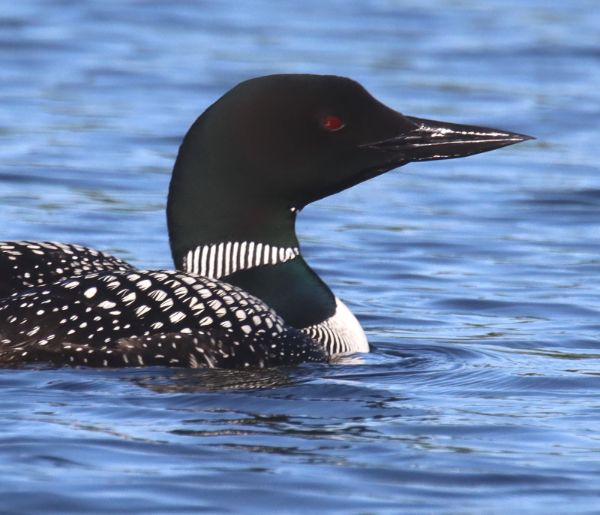
The highlight of the evening revealed itself just 6 miles north of home on the east side of Carlson Lake, where I spotted the silhouette of a Common Loon as I drove by – a new state bird for Kristine and the first June loon for me in the Dakotas. What was this fully colored adult Common Loon doing on Carlson Lake in the midst of the nesting season? Chestnut-collared Longspurs, Swainson's Hawks, Redheads, Canvasbacks, and Eared Grebes were among the favorite birds for Kristine among the many species we observed on such a beautiful evening where we saw fewer than 5 other vehicles during my drive through "the middle of nowhere filled with birds."
My week was punctuated by exciting birds and wonderful birding opportunities, but it stands out as one of the most social weeks I have enjoyed in some time – friends visited me and I visited friends, all punctuated by the double-rainbow birthday party with college friends like Andy, Mike, Mike, and Linda, as well as Nicki, Kristin, Craig, Kay, and meeting new people like Diedre and Maddie, along with reconnecting with Linda's children Quinn and Jenna. Then there was the loon pontoon expedition with Craig and Andy; plus a friend I met when we were 4 years old who stopped by my remote office with a friend – thanks Ryan and Fin. And a new friend, Daniel from Tennessee, spent 10 days improving the look of his family's farmstead, which is one of my favorite May birding hotspots – Melody's Grove (Daniel is Melody's son).
Birds were some part of a topic of conversation with all of them, and I had a great time birding with Doug for the first time, and with Kristine, who reminded me that we have been birding together for 23 years! Enjoy the people around you and invite them to go birding with you – or just share some of your recent bird sightings with enthusiasm and gusto as I did. Good Luck during your June birding opportunities.
Article and Photos by Paul Konrad
Share your bird sightings and photographs at editorstbw2@gmail.com