
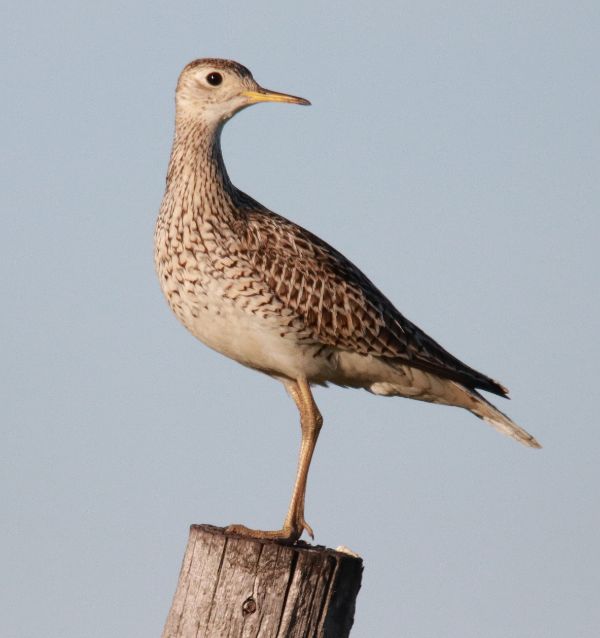
Due to road conditions and avian distractions, it was way late for me to venture down one of my favorite birding byways – The Lost Road – where I encountered my first Common Nighthawks and Dickcissels of the season, along with exciting prairie birds like Upland Sandpipers, Bobolinks, Orchard Orioles, Western Kingbirds and Eastern Kingbirds, Western Meadowlarks, Rusty Blackbirds, Wilson's Snipe, Marbled Godwits, a Krider's Red-tailed Hawk, and a somewhat out of place adult Bald Eagle perched on a fence post. I also checked on Red-headed Woodpeckers nearby, but sighted 3 single Northern Flickers instead.
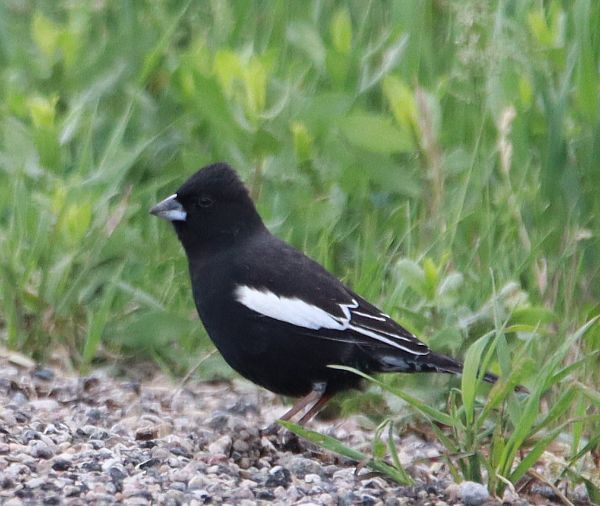
Speaking of prairie birds, finding a rare bird or a bird beyond its current range is always exciting, and last week my rare bird find was an adult male Lark Bunting, observed about 10 miles north of home on my way to Fargo last Wednesday. On the edge of the beautiful farmyard that my friends Dave and Carol have created I spied a black bird with a white wing crescent, which I knew immediately to be a Lark Bunting.
I was kind of surprised that I zeroed in on that bird considering the mix of black birds around it –Red-winged Blackbirds, Yellow-headed Blackbirds, Common Grackles, and Brown-headed Cowbirds – but my mind immediately noticed its importance among the others. As soon as I stopped the car, the black bunting crossed the road before me and I gingerly opened the door to get a documentary photo as it emerged from the roadside grass and foraged among the gravel edge.
The bunting brought back memories about when I was 9 years old and couldn't find the black bird with the white feathers on its upper wings among the blackbirds – hence, I referred to it as a White-winged Blackbird in my field notes. I eventually stumbled upon the page that concealed the Lark Bunting's image among the sparrows and buntings – and adopted the real name to my bird lists thereafter.
At that time, Lark Buntings and other dry prairie nesting birds were pretty common across the Missouri Coteau, but wet conditions that began during the late 90s made Lark Buntings search out drier areas farther west, along with species like Chestnut-collared Longspurs and Burrowing Owls. So, for the resulting years, Lark Buntings have been mostly absent from the Coteau and adjacent geologic regions, making this a rare bird sighting last Wednesday.
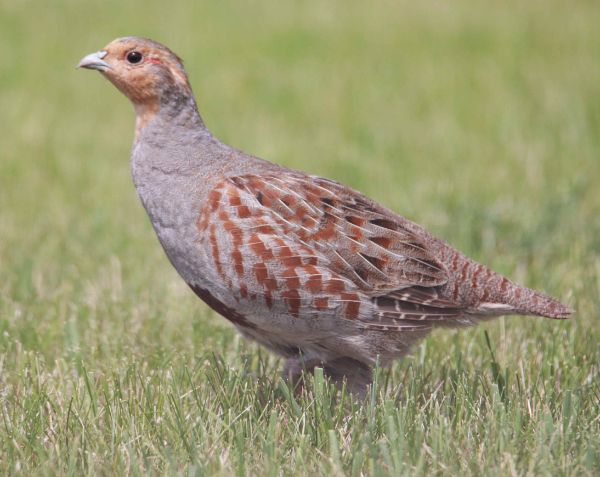
Of course, I checked back twice to see if I could re-find that Lark Bunting, or another one, without success. Back to my drive to Fargo, I also observed a Red-headed Woodpecker a few miles beyond the bunting, along with a Swainson's Hawk about 100 miles east near Casselton, which is not far from the eastern limit of that species' nesting range, along with an American Kestrel hovering as it hunted on the edge of West Fargo, and a pair of Gray Partridges that appeared a block away from my niece and nephews' house in southwest Fargo.
Friday Birding: As I started a morning birding drive, a new brood of ducklings caught my attention in the quiet pond on the opposite side of the road from Bobby's Bay. I repositioned safely to the side of the road and saw the brood of 10 recently hatched ducklings was led by a female Northern Pintail and I did my best to try to photograph the very active ducklings foraging around the female from a distance. It was interesting to also see 2 male Northern Pintails that showed an interest in the female and ducklings – perhaps because they shared some DNA with some members of the brood. There were also 2 male Mallards, a male Northern Shoveler, and a male Gadwall in the little pond, suggesting females of these species were nesting nearby. Two pairs of Blue-winged Teal were also on hand, suggesting this late-nesting species apparently hadn't initiated laying eggs yet.

Two lone American Avocets rounded out the birds on hand, although 2 late White-rumped Sandpipers flew low above the pond – perhaps non-breeding individuals that weren't making the migration to the Arctic nesting range of these small shorebirds this year. Speaking of which, it would be a great time to be visiting the tundra realm where the sun is shining 23+ hours per day and the nesting species enliven the open expanses and marshes as the nesting period is reaching a fast and furious crescendo. What a great thrill it would be to make another visit to the far north!
Understanding that sunshine was questionable over the weekend, and having a surge of energy after an afternoon in the office, I wanted to take advantage of a sunny evening in spite of the strong west wind. I decided to drivee to Hecla Marsh, which was probably a bit overdue considering I hadn't checked Hecla in a while; but when I arrived, it quickly became clear I was right on time. Among the first birds I observed on the water were Western Grebes, including 2 females that each had 3 very young hatchlings riding on their back – and they were active close to the almost unused road that bisects the marsh (mostly unused while I photographed anyway).
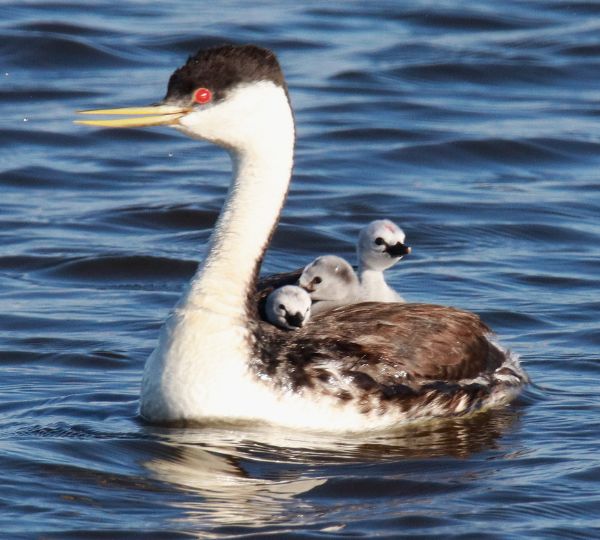
The Western Grebe families held my attention most of the time as I tried to get some interesting photos when the male brought small fish for the new hatchling, usually passed to the female who fed 1 of 3 hatchlings on her back. I did break away from the grebes to check for other photo subjects, and found a variety of ducks, including a Mallard with a brood of ducklings aged in their third week. There were also Great Blue Herons, Great Egrets, Tree Swallows, American Avocets, and a pair of Black-necked Stilts – then I spent a little more time with the grebes. (You can see more grebe photos in my Bird Photography article at the end of this issue.) Other birds sighted during that evening drive included 1 adult Bald Eagle, an American Kestrel, and 2 feathered nestling Bald Eagles in a nest on the edge of Hecla Marsh. Within 4 miles of home I observed a White-faced Ibis, 2 Black-crowned Night Herons, 4 White Pelicans, and 2 pairs of Western Grebes at Melody's Marsh.
Dakota Loon Update: After noticing and documenting a Common Loon in adult plumage last Monday evening (June 8) while birding with my friend Kristine, I was compelled to check back on Carlson Lake Tuesday morning. Although there was no loon to be seen then, after publishing the June 10th issue Tuesday late afternoon, I headed north again. With an incoming storm on the horizon, I found the loon lying on the shore near where I last observed it, but was I ever surprised to see a second loon swimming toward its position!
Immediately it was evident that this loon was not colored in a similar alternate adult plumage. The second loon's plumage was more similar to a basic loon plumage that you would see between October and February, so this was clearly a sub-adult plumage that I can't say I've seen before during the April to September period when adult loons are in alternate (breeding) plumage. Now the question was, were both of these loons sub-adults – one closer to an adult age than the other.
To learn more about the plumage molts of Common Loons, I referred to the Birds of the World website – the ultimate first reference source for birders and biologists. One sentence that stood out stated: "younger individuals often remain in similar habitats used by adults as wintering areas for up to 3 years before commencing migrations to potential nesting areas, and 'summer' plumages during the period before they begin to nest are variable." For me, that explains why I haven't seen subadult loons before during spring or summer in Minnesota – or anywhere.
The authors of the Common Loon species account concluded that "Although hard evidence is limited, Definitive Alternate [breeding] plumage is attained during the spring of its third year." This suggests the adult-looking loon is probably at least 3 years old, showing its full adult alternate plumage. The second loon showed basic (winter) plumage, but close inspection of the poor-quality documentary photographs I took showed light-colored edges lining the feathers on the loon's back (often referred to as "scalloped edges"), which indicated it is a yearling. Therefore, my impression is that the older loon at Carlson Lake likely hatched 3 years ago, while the subadult with the scalloped edges on its back feathers hatched 1 year ago.
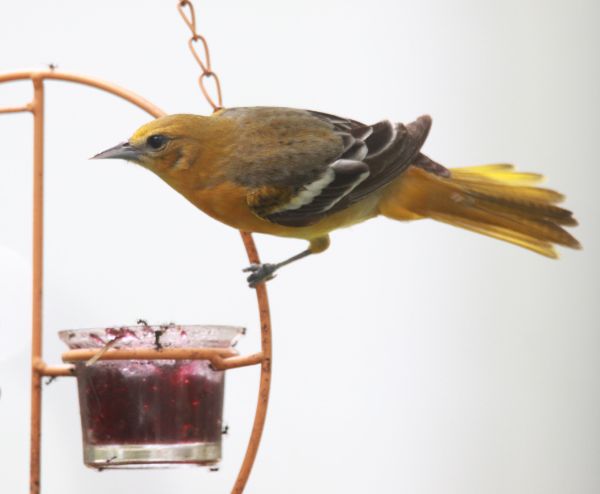
YardBirds: The first fledglings to visit my feeding station were a trio of House Finches that perched in a row atop the tallest shepherds crook and begged the adult male for food (grape jelly) Friday afternoon. The first robin fledgling appeared Saturday morn, looking like it was way too undeveloped to have left the nest already, but when the adult male flew to my sumac grove the fledgling showed it was a strong flier already as it followed, calling. Later, 2 cute robin fledglings were poking around my front steps when an adult arrived with grape jelly from my feeder.
The male Ruby-throated Hummingbird continued to be a regular nectar feeder visitor through Sunday, and although I became very comfortable that it was going to stay longer term, it has not returned since Sunday evening. The female Baltimore Oriole is regular at the jelly feeder, but the male has only been making fleeting visits that I didn't notice every day – until Sunday when it became a very regular jelly consumer, as has the female, suggesting they may be adding jelly to the diet of growing nestlings. Other jelly eaters are at least 2 male Orchard Orioles. A new yard bird was a Northern House Wren that came to my birdbath, but I haven't heard a wren singing in the neighborhood yet. And the first robin fledgling stopped for a drink at my birdbath too as I was putting the finishing touches on this issue.
I hope you are enjoying the birds you see as you make your way through the week, seeing an occasional "new" bird in your yard, neighborhood, and birding destinations. The green season adds a lot to the areas we visit with binoculars in hand, and again, 2 rarer sighting jazzed my birding up appreciably. I'm thinking of heading west this week, but I'll base my plans on how the weather turns out – you know how it goes. Will you be searching for a different group of birds a little farther afield soon?
Article and Photos by Paul Konrad
Share your bird sightings and photographs at editorstbw2@gmail.com