
Last Wednesday I set sail for my hometown, Bismarck, a favorite birding drive that can take many twists and turns as I search for birds and other wildlife, plus photo opportunities. As often happens, the 2-hour drive turned into a 5½-hour cruise that was rich in birds and even warranted an additional 1-hour extension. Although the birds I observed were interesting, as always, I was hoping to find a premium photo opportunity as I meandered across the Missouri Coteau's hilly grasslands mixed with abundant wetlands and ag fields. I checked for everything from Burrowing Owls and Bobolinks to sandpipers and duck broods on the way to such outstanding hotspots as Long Lake National Wildlife Refuge and McKenzie Slough. But it was my last hotspot check that turned my birding afternoon around from a typical outing into an exciting bird photography adventure.
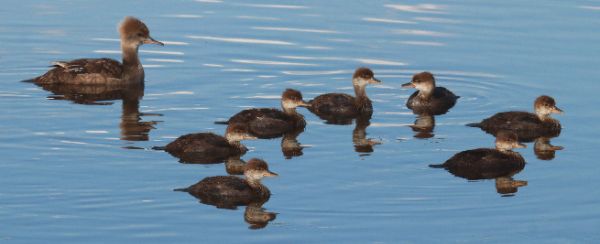
Located just 10 miles east of Bismarck, Dogtown Waterfowl Production Area has been unusually quiet this spring, but just as its name implies, last week the marsh turned into a very impressive duckling rearing location where I was able to find 12 duck broods ranging from just hatched to about 2½ weeks in age. The species and number of ducklings in each brood included 5 Mallard broods numbering 6, 7, 3, 6, and 9 ducklings, each with an adult female leading the way; and there were 3 Hooded Merganser broods numbering 3, 9, and 4; 2 Wood Duck broods numbering 11 and 6, and 2 Northern Shoveler broods, also numbering 11, and 6. This concentration of duck broods was especially impressive considering I only saw 1 Mallard brood during the rest of my 120-mile birding drive. I provide more of the story and several photos of broods in the Bird Photography feature at the end of this issue.
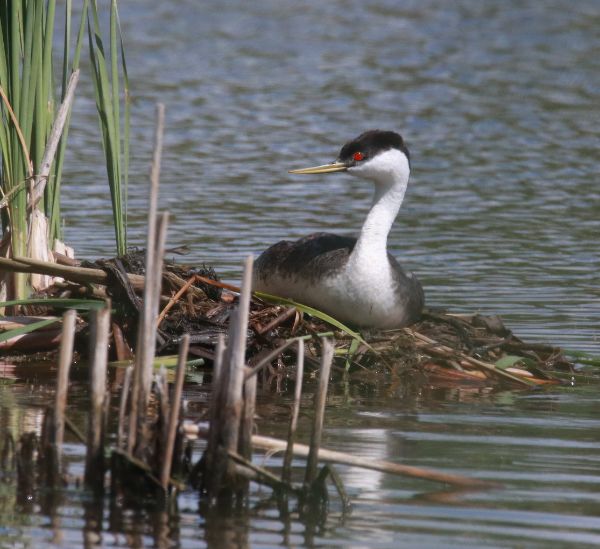
As I made my way onward to the capitol city, 4 cock Ring-necked Pheasants were obviously interacting in close quarters in a short-cropped prairie. As I coasted closer 2 of the pheasants faced off, bowing low to the ground with their long tail feathers raised, and just as my camera focused on the birds, they erupted into a Dakota cock fight that continued about 40 seconds before one ran off, followed by the apparent victor in chase. Other interesting notes of the day were more about what I didn't see – there were no Burrowing Owls to be seen although I checked the 3 locations where I've documented them this spring. There were also lots of Western Grebes, but didn't see any hatchlings yet. Along that line, I did find a very open nest site with an incubating Western Grebe on board on the outside edge of a stand of cattails at McKenzie Slough.
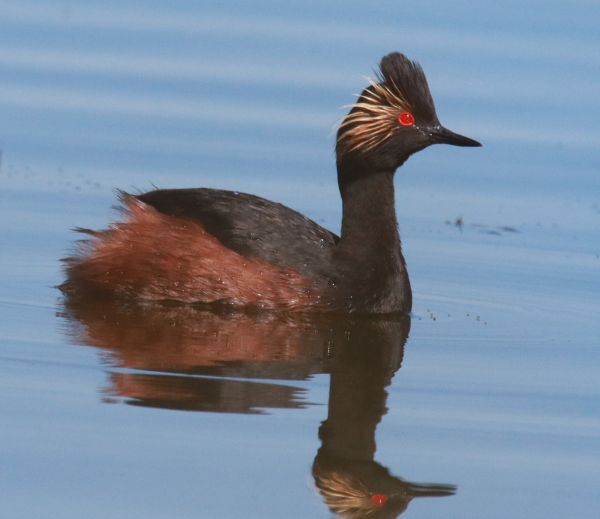
Other birds present at McKenzie were many White-faced Ibis, which are a relatively new species in the region, along with Black-crowned Night Herons, Great Egrets, Snowy Egrets, and others that have expanded their summer range north or northwest in the past 20 years or so. Plus, there were many Eared Grebes, some large mixed-species flocks of male ducks loafing along a few open shorelines where ducks traditionally gather to molt, along with a very vocal concentration of Franklin's Gulls that were active in one cattail area, possibly foraging, maybe nesting(?), considering that this was the only location where I observed this species Wednesday.
At Long Lake Refuge the highlight was when I checked for White Pelicans and Western Grebes along a stream that flows between 2 lakes. There I stopped on a bridge along a dead-end road to photograph a few pelicans and grebes, but suddenly the sight and sounds of about 40 White Pelicans erupted from below the bridge, paddling loudly on the water to gain flight wing to wing in a broad mass just a few feet away from my bridge-side position. It was quite a surprising calamity!
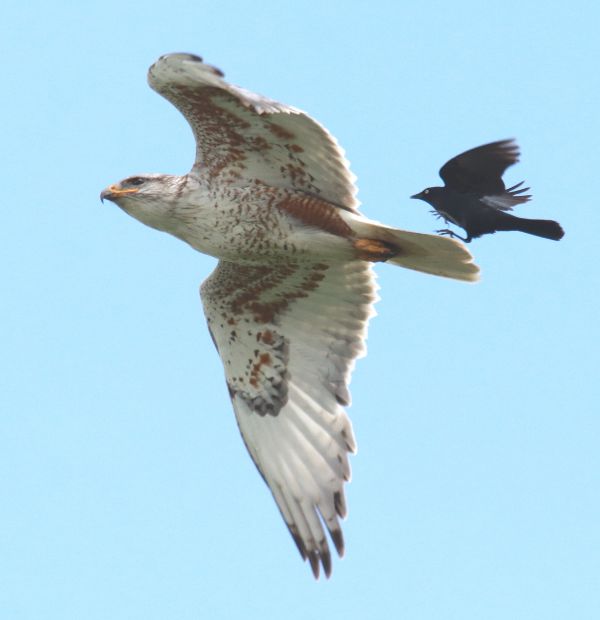
I also checked back on the annually successful Ferruginous Hawk nest that is 25 miles northwest of my office. The female was feeding now-feathered nestlings while the male was perched in an adjacent tree. It looked like there were 3 maturing nestlings, and as I was leaving the male took flight in my direction and made a half-circle past me as he winged north. Of course, I photographed his progress in spite of the momentarily cloudy conditions. Just as a grackle began diving at the big hawk, sunlight reappeared and I managed a couple interesting photos with ample light.
Local Birding: Much closer to home I checked on the brood of 9 Northern Pintail ducklings at the small, shallow pond across the road from Bobby's Lake, and found a female Mallard with her newly hatched brood of 10 ducklings feeding. During a follow-up brood check the next day, I sighted another Mallard brood of 4 with a female across the road in Bobby's Lake. When I checked back on the broods Sunday, the Mallard duckling count was down to 8 in the pond, and a drake Mallard was attending the other female with her 4 ducklings in the lake. The adjacent Bobby's Bay also held a pair of American Avocets, a pair of Marbled Godwits, and a few single Wilson's Phalaropes. My next stop was nearby Dean's Lake, where I was surprised to see a group of 25 Marbled Godwits lining the western shore.
Farther south I encountered 2 molting male Wood Ducks, the first of their kind to arrive in this area to molt, an annual activity in this area. I also enjoyed seeing one of the pairs of Red-necked Grebes I photographed a month earlier, and in the same location – Herb's Lake – I also observed 5 Great Blue Herons, 2 Black-crowned Night Herons, and a pair of American Goldfinches while I lingered to listen to Marsh Wrens singing during the quiet evening on the first day of summer.
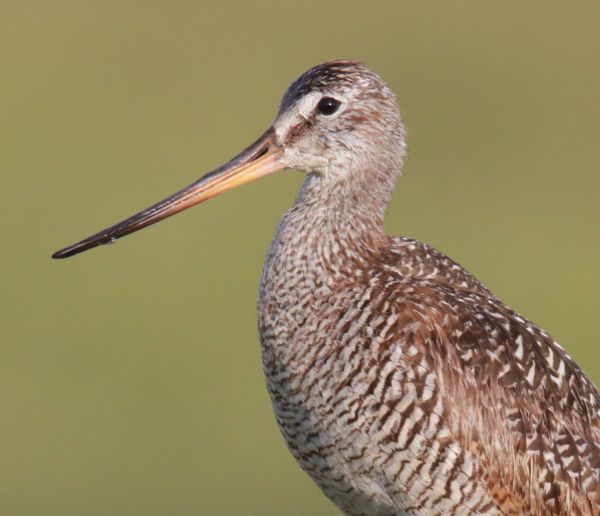
Along the edge of White Lake I saw a Gray Catbird, a pair of Brown Thrashers, and a Least Flycatcher; and I would have sworn I saw a male Eastern Bluebird, but I'm only 90 percent sure due to the poor lighting conditions and quick flight observation. I checked on my original Bald Eagle nest in the region, about 25 miles southeast of home, where there hasn't been any indication of nesting, but there was an adult perched in the open near the nest tree, so I will continue to keep an eye on that location. That tree grove is also a Red-headed Woodpecker hangout, so it was nice to see an adult there.
On my way back I swung by Charo Marsh a second time, and was very surprised when a female Green-winged Teal slipped out of a small stand of bulrushes into the open water with a brood of 7 newly hatched ducklings right in front of me, providing a couple nice photographs and a sweet view of the young ducklings (refer to the Bird Photography article). It was unusual to see 4 male Blue-winged Teal close in on the female and her brood from different directions; perhaps they were inquisitive, but the female became very defensive and lunged out with an open bill in response. Green-winged Teal are not common nesting ducks in this area, and Charo is one of the only locations where I have seen a Green-wing hen with a brood before – and now history was repeating in the very same spot in this marsh a few years later.
Of course, I checked back the following evening with hope of a repeat performance, and although there were no Green-wings, there was a brood of 11 week-old Northern Shovelers with a female, and a molting male too. At the opposite side of the marsh, a Mallard hen was foraging with her brood of 8 week-old ducklings too. Closer to home I sighted a growing flock of Redheads that numbered about 35 Monday, and an American Bittern was standing in the open.
Birds in My Yard: The most exciting feeder observations were the first and second appearances of a beautiful female Ruby-throated Hummingbird with pristine white plumage on her throat and underside, but Friday appears to have been her only day in Konradland. Even so, I was very happy to see the male Ruby-throated Hummingbird return last Tuesday evening and every day since. The Baltimore Orioles have an added interest in collecting the few ants that visit the jelly feeders, which they mix with grape jelly, likely intended for nestlings. They even visit small ant colonies on the ground to collect protein to add to the sugar-based jelly. At least one male Orchard Oriole continues to stop in for jelly too – there must be a female involved somewhere.
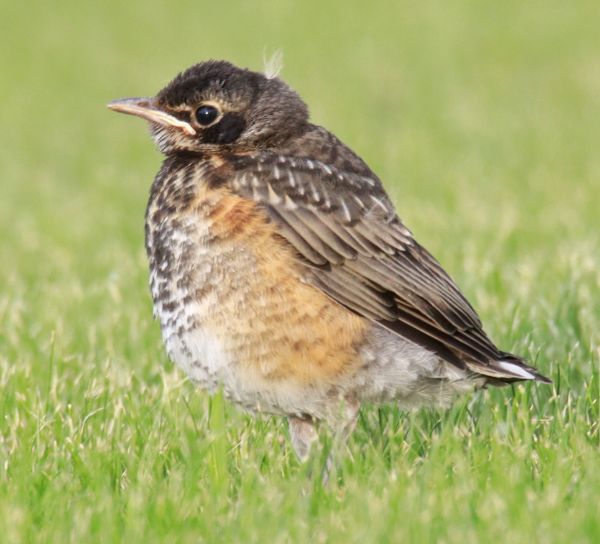
A Chipping Sparrow appeared in the ash tree adjacent to my feeding station, and Friday a small robin fledgling camped out on an ash branch above my feeding station for a bit, thereby shortening the distance the adult male needed to commute between the jelly feeder and the new fledgling. There appear to be 3 male American Robins feeding fledglings, which suggests that the females may be incubating a second clutch of eggs now. Fledgling House Finches perch on the shepherds crooks and beg for adults to feed them occasionally. How long till fledgling orioles arrive? By Sunday and Monday, a robin fledgling fed from a dish of jelly and drank at my birdbath, while another young robin – perhaps a nestmate – foraged on the ground next to the feeding station. Monday I sighted a pair of American Goldfinches in my yard, and a White-breasted Nuthatch made at least 2 visits to the ash tree next to my feeding station where it foraged up and down the trunk.
In accordance with the calendar, this is the first true week of summer, and I hope you are enjoying the summer birds that now surround you as they add nature sounds to the fresh air. With the 250th celebration of American freedom just a couple weeks ahead, it might be a good time to plan a birding activity to help you remember the historic event and to enjoy searching out some new birds, including new fledglings or broods. Make this a summer to remember!
Article and Photos by Paul Konrad
Share your bird sightings and photographs at editorstbw2@gmail.com