
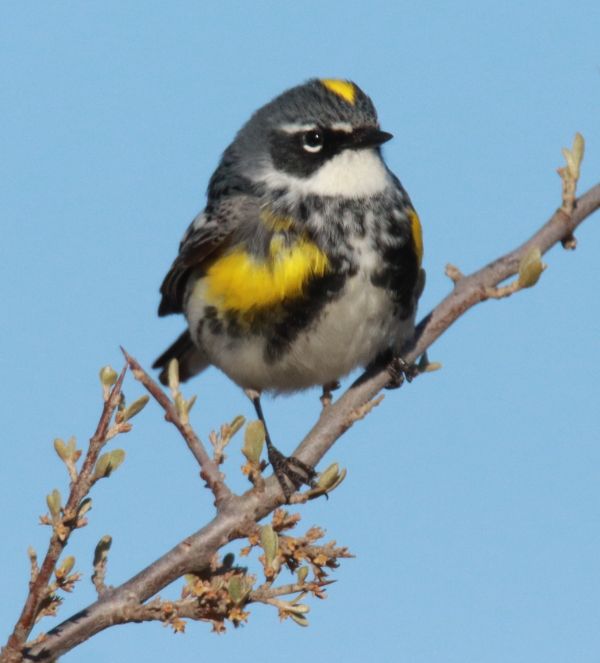
It was definitely one of my best local experiences among warblers! The best single-species warbler observation period I've witnessed, just for sheer numbers, but also for the fast-passed surround-vision that the warblers. Easily more than 200 Yellow-rumped Warblers were lining the west and north sides of the Old Schoolhouse Grove, plus the interior trees and surrounding cattail stands and small willows lining the 3 adjacent wetlands. The numbers were one thing, but once I stood in position, I was immediately surrounded by warblers, perched, flying out to catch newly hatched insects, mostly low to the ground; with warblers flying at my feet, my knees, within a foot of me.
Landing within 5 feet of me, I fully expected a Yellow-rump would eventually land on me. There were 16 in the tree before me, 13 in the next tree, 3 landing on the ground at a time to snatch a newly hatched flying bug, 12 in a low willow behind me, and 60 others in sight among the bare trees beyond the closest ones. It was a memorable time I will never forget; I only wish I had a birding friend or friends to share this warbler event with – woowee.
That morning when I opened the front window shade, there was an active Yellow-rumped Warbler, then another – both foraging within 5 feet of the ground as a result of the strong north wind. Moments later a Ruby-crowned Kinglet flew to the elm tree adjacent to my feeding station, followed by another Yellow-rump, with an adult White-throated Sparrow on the ground. Next was the first Tennessee Warbler of the season and 2 Hermit Thrushes – it was clearly time to check on the birds at Melody's Grove. As it turned out, the overnight migration (May 7 to 8) was 6 times greater than the biggest spring migration recorded on BirdCast in the northern plains May 3.
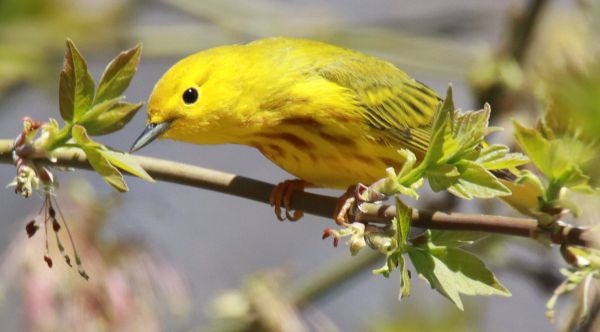
The first bird to "pop out" at The Grove was a brightly colored male Yellow Warbler, then another, plus many Tennessee Warblers, Orange-crowned, Yellow-rumped, and at least 1 Black-and-White Warbler. There were also a few Ruby-crowned Kinglets, White-throated Sparrows, a Lincoln's Sparrow, Hermit Thrushes, American Robins, Least Flycatchers, and I'm sure I had a quick glimpse of the first Western Kingbird. Most birds were warblers, and there were oodles of them before me at times, taking advantage of the windbreak the trees and overgrown shrubs provided, as were the small flying insects the birds were catching. Most birds were positioned less than 5 feet above ground, and very few foraged more than 10 feet high. At one point there were 5 Tennessee Warblers foraging on the ground, with a couple Yellow Warblers and a couple more Yellow-rumped Warblers just above them in an open cluster.
After the Yellow-rumped Warbler excitement at the Old Schoolhouse Grove, which was hard to break away from, I checked on the Red-necked Grebes I heard calling in the adjacent marsh to the north, where I actually found 2 pairs of Red-necks and had a chance to photograph 1 pair in fading sunlight. But there was 1 more stop to make – Charo Marsh – to check for shorebirds. There was a good variety, which included the first 2 Least Sandpipers and the first Spotted Sandpiper too. But what really caught my attention were the 5 godwits, 3 Hudsonian Godwits and 2 larger Marbled Godwits – actually, it was the Hudsonians that held my attention. But another interesting observation was the 40-plus Yellow-rumped Warblers perched along the fence lines on each side of the very rural road, foraging at ground level or just above the expanse of prairie pasture.
Actually, Friday night there was an excellent migration that looked like it stopped short at my house on BirdCast's live migration map, which made sense because there was a cold front with wind and light rain pushing down from the north – so with a sunny day ahead Saturday, the warbler action could be even better!
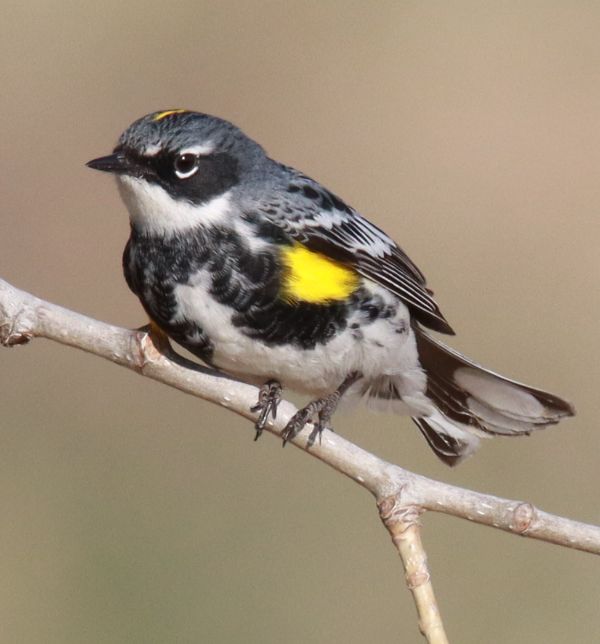
Saturday was almost a rewind of the exceptional warbler action experienced Friday at Melody's Grove. But at the Old Schoolhouse Grove, the remarkable numbers of Yellow-rumped Warblers were obviously even more abundant, plus the Yellow-rumps were more spread out across an area that measured a mile north to south by a mile east to west – essentially a square mile centered at the grove, but to see that many warblers in action at once was very dramatic.
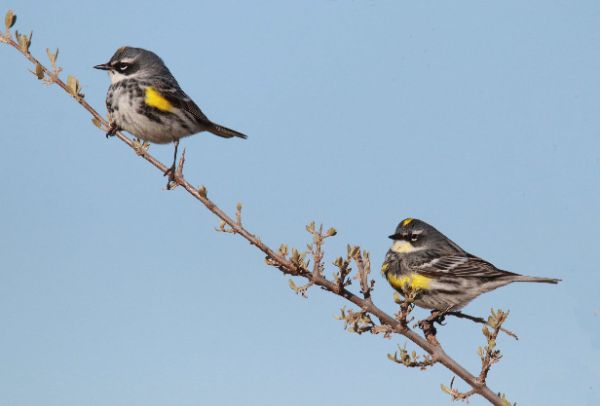
At just the right time of the evening, about 6:30pm in my area, I managed to take the best photos of some of the many warblers at a little buffalo berry bush, where there was a constant flow of Yellow-rumps perching and chasing tiny newly hatched flying insects. At any given moment I could count between 6 and 21 warblers perched in the bush, with many more in sight on the wing or perched on fences or plants. The wind kept the bugs and birds low, which was great for viewing and for photography.
Sunday morning showed another big overnight migration on BirdCast, but this time the migration was apparently outbound from Melody's Grove, leaving it absolutely empty, emphasizing that migration works 2 ways – birds arrive and birds leave. In open areas with short grass adjacent to gravel, large flocks of native sparrows were the most common birds. The flocks numbered between 20 and 60, mostly composed of Chipping Sparrows with a few White-crowned and White-throated Sparrows mixed in and a couple flocks contained the first Harris's Sparrows of spring. There were also a couple bright yellow surprises outside my bay windows – 1, then 2 male American Goldfinches in full alternate plumage and singing at my feeding station!
Sunday turned out to be quiet for warblers at Melody's Grove, but there was a first of season Brown Thrasher. In the Old Schoolhouse area, there were still many Yellow-rumped Warblers, but only half as many as before. I also observed a Western Kingbird and had a wild encounter watching territorial pairs of Red-necked Grebes sort out their potential nesting territories with spirited unison displays punctuated by loud calling that kept me enthralled and enjoying several photo opportunities. Oh, and I saw the first 2 newly hatched broods of Giant Canada Geese, numbering 4 and 6 goslings – always an event to remember.
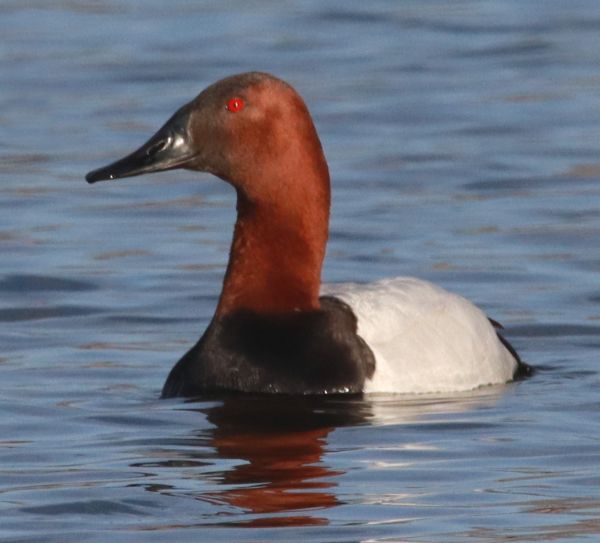
A waterfowl update reveals that some duck species have moved on, with Buffleheads, Common Goldeneyes, and Common Mergansers absent about 10 days. Although some scaup and ring-necks will likely continue north, most of the remaining ducks will probably nest here: Mallards, Northern Pintails, Gadwalls, Blue-winged Teal, Ruddy Ducks, Hooded Mergansers, Canvasbacks, Lesser Scaup, and Ring-necked Ducks, although there may also be a few Green-winged Teal and American Wigeons that will nest here too.
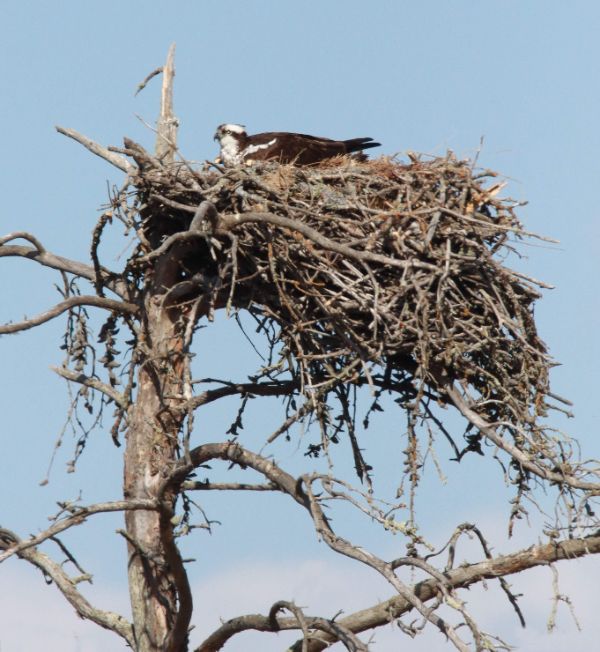
Minnesota Bound: Before the warbler fallouts of the weekend, Thursday morning I drove north then east to Tamarac National Wildlife Refuge northwest of Park Rapids, Minnesota. But first I stopped at Melody's Grove to see what birds may have migrated in overnight. Anxious to get on the road, I only spent 10 minutes there, but among the 4 birds I observed, 3 were new spring arrivals – a Palm Warbler, a Ruby-crowned Kinglet, and a Lincoln's Sparrow. Tamarac is a much larger refuge than I remember, and it was filled with Yellow-rumped Warblers along with a variety of other birds, including 2 first of spring birds – a Swainson's Thrush and an Eastern Phoebe. My theme for the Tamarac visit was to find and photograph a Pileated Woodpecker in the Minnesota Northwoods – a tall wish for the day's adventure.
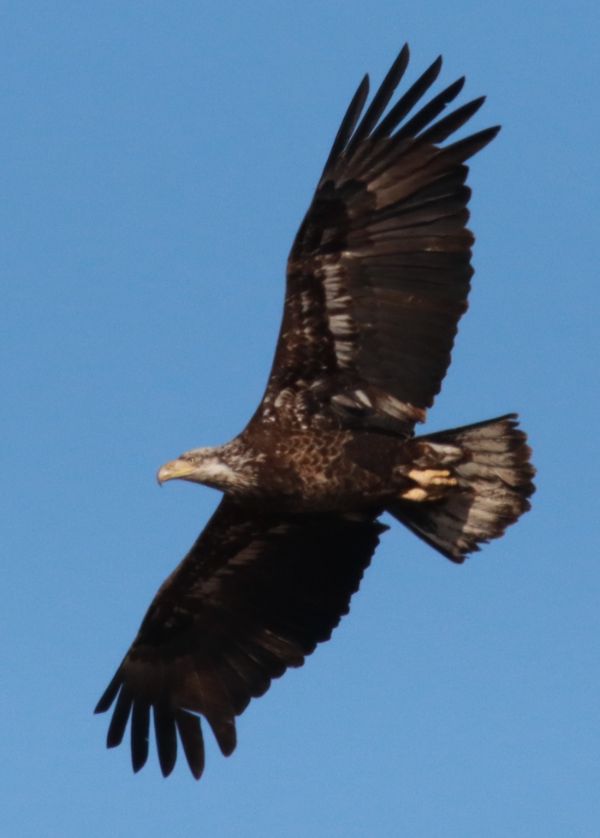
It was great fun to spend time where deciduous and coniferous forests meet with tall grass prairies, broken by lakes, streams, and marshes – and to see the birds in the zone. Other highlights included a dozen Wood Ducks spread around area marshes, nesting Trumpeter Swans and Ospreys, 3 Bald Eagles, a few single Turkey Vultures, Great Blue Herons, Hermit Thrushes, Lincoln's Sparrows, White-crowned and White-throated Sparrows, and many large flocks of Tree Swallows.
In addition to Wood Ducks and Trumpeter Swans, other waterfowl observed were Ring-necked Ducks, Mallards, Blue-winged Teal, and Giant Canada Geese. After leaving Tamarac Refuge, I also appreciated observing and photographing a rarely encountered Broad-winged Hawk and a colorful Red-bellied Woodpecker. Although I didn't find a Pileated Woodpecker, I managed some of my best photographs of a male Red-belly with an electric-red crown, and he even showed me his roosting cavity.
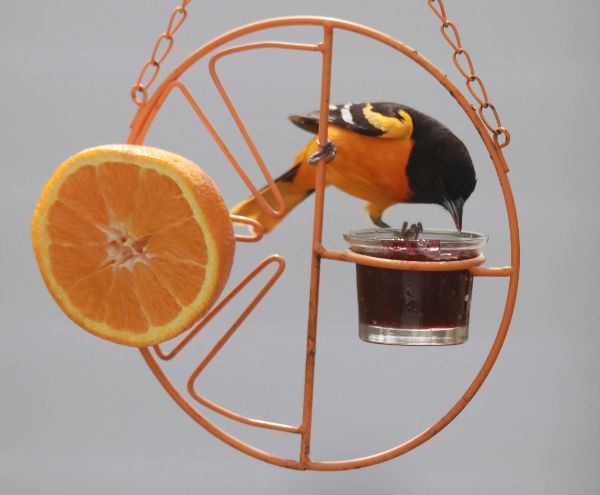
Hip Hip Hoooray! Monday began with the sweet sound of an oriole's song and call notes, and the stunning male Baltimore Oriole was the first bird I viewed that day – right outside my bay windows after it began feeding on grape jelly at one of my oriole feeders. This first of many orioles that will follow arrived on the same date as last year – May 11th. It's probably worth noting that at my feeding station, grape jelly is being digested by the first oriole, plus House Finches, but the cut orange on the same feeder has been ignored; but if nothing else, the orange acts as a bright beacon that initially attracts orioles to the feeder. Orchard Orioles will arrive too, and the first hummingbirds will be welcomed with fresh sugar-water nectar. In the meantime, suet attracts the most feeder visitors – primarily Hairy Woodpeckers and Downy Woodpeckers, and a Red-breasted Nuthatch. I also had the first Harris's Sparrow stop by to join a White-throated Sparrow near my feeding station.
It was an especially exciting week for me! And I haven't even mentioned one local highlight: Last Tuesday I had a chance to see a pair of Western Grebes performing their "dancing on the water display." Well, this week was definitely the start of the peak songbird migration combined with the start of mating and nesting activities. I hope you are excited about seeing new arrivals, and look forward to new birds and new observations as mid-May leads to some of the best birding opportunities of the season – Enjoy it all!
Article and Photos by Paul Konrad
Share your bird sightings and photographs at editorstbw2@gmail.com