
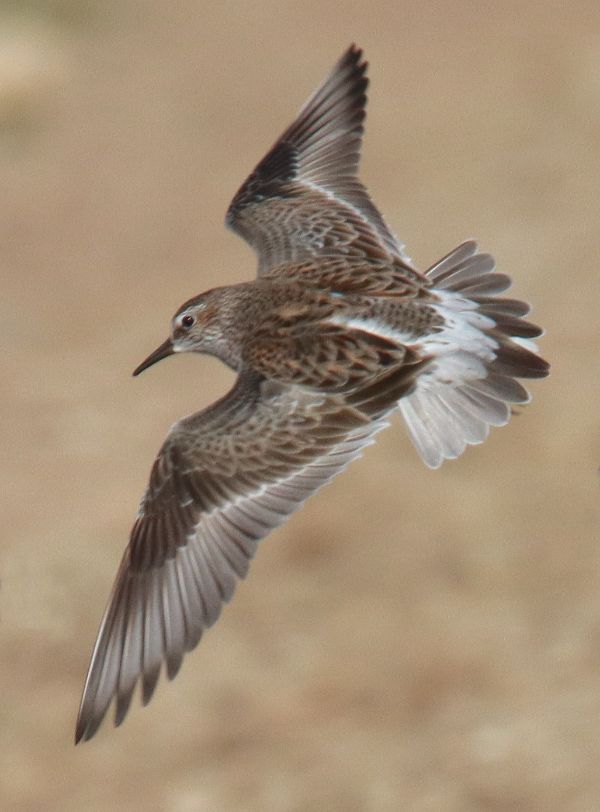
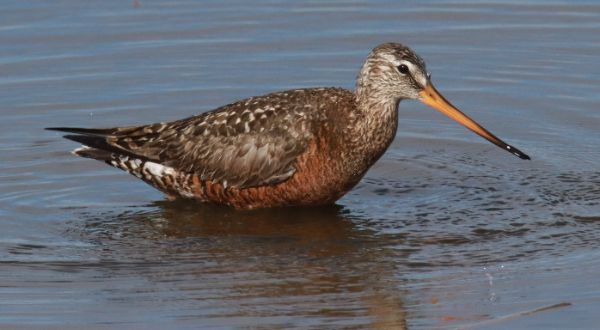
A Peregrine Falcon suddenly a zipped into view, flying low and determined as it flushed a flock of White-rumped Sandpipers, then another. A quarter-mile ahead of me the fastest bird in the world began rising into the sky, circling once before pressing north. It was the first Peregrine I've seen in a few years, but with the remarkable numbers of sandpipers in the area it is right on time, even when considering the dates of past spring sightings. But the real story on Wednesday was the expansive numbers of White-rumped Sandpipers and Ruddy Turnstones, along with a variety of other shorebirds – even a fully colored Hudsonian Godwit.
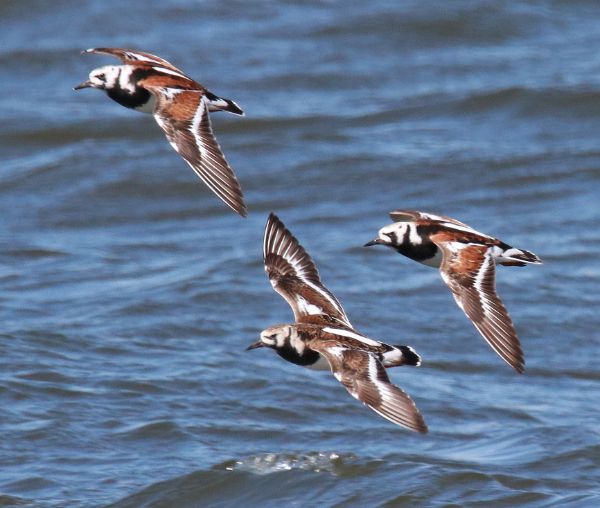
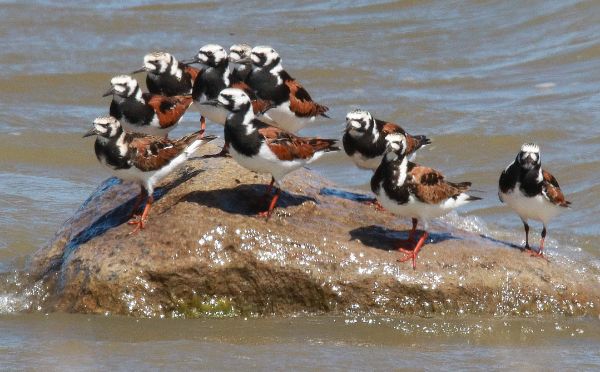
At an unlikely lake 3 miles north of home, a large flock of feeding Franklin's Gulls and Ring-necked Gulls encouraged me to check out the hundreds of birds assembled, with flocks of sandpipers on the wing just above the turbulent wind-blown water too. But it was a small flock of Ruddy Turnstones that made me take an even closer look at the scene. With the wind blowing from the south and a big hatch of flying insects being blown into the water, the gulls and shorebirds were massed along the north side of the 3-mile long unnamed lake – the apparent reason for the apparent feeding frenzy. A couple hundred turnstones were foraging the rock-lined shore in flocks up to 25, with the lone Hudsonian Godwit among them, but the biggest numbers of birds were the White-rumped Sandpipers that likely numbered more than a thousand! A flock of 4 Stilt Sandpipers joined a turnstone feeding session on a tiny beach area, as did a few Baird's Sandpipers for good measure.
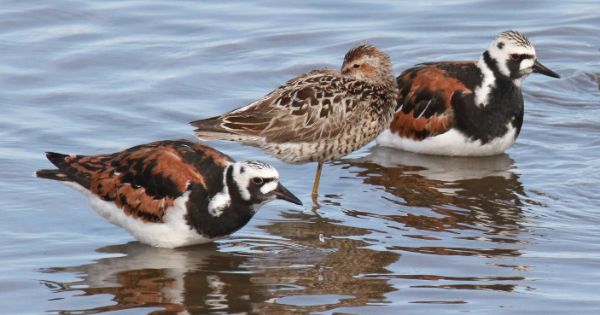
It was a bit overwhelming to scan the north end of the lake to see flocks of White-rumps, Black Terns, Ring-billed and Laughing Gulls flying low to the water, seeming to swarm above the water flock by flock with an occasional smaller flock of Ruddy Turnstones adding to the mix. I spent a lot of time photographing and enjoying the surprise food-based frenzy. Three miles southeast of there I found another swarming thousand White-rumped Sandpipers that stretched along the west side of Dean's Lake to a small airport landing strip where large flocks were feeding on bugs among the short-cropped grass. Usually, White-rumps are casual migrants sighted in small flocks of less than 30, and never before have I witnessed these kinds of numbers anywhere. As for Ruddy Turnstones, I consider them a rarely encountered species, I think this is only the fourth spring I've ever seen them in Dakota – so Thursday was certainly a wild change from the norm.
The small White-rumped Sandpipers migrate from wintering areas near or at the southern tip of South America along one of the longest bird migration routes in the Western Hemisphere. From here, they will continue north to nest in the open tundra in the Canadian Arctic. Much of their extra-long migration is made during a few long, non-stop flights that can last as long as 60 hours and transport the small sandpipers up to 2,400 miles during each leg of migration. As for the Ruddy Turnstones, some nest as far north as there is land – essentially to the North Pole (Ellesmere Island, Canada).
A more regular assemblage of 30 Sanderlings and 2 Ruddy Turnstones were on the beach at Carlson Lake. At Bobby's Bay a single turnstone was in the company of 3 pairs of American Avocets, a pair of Marbled Godwits, a pair of Wilson's Phalaropes, a flock of about 40 White-rumped Sandpipers, with 4 Long-billed Dowitchers and 5 Stilt Sandpipers. At the same time, between all these points and beyond, there were flocks of White-rumps scattered through the area with many feeding in crop fields, presumably for small insects.
Thursday morning a pair of Wood Ducks was a nice surprise, and another male Krider's Red-tailed Hawk was gliding above a tree grove about 12 miles north of the office. There was a regularly colored female present there too, but I'm unsure if they were a pair and I didn't see a nest in the trees. The small airport area held half as many White-rumps Thursday, but it was still very impressive if you didn't see the throngs assembled the previous day.
When the Rains Came: After a drenching rain throughout the day Friday, the sun broke through mid-morning Saturday, and I was greeted by a Red-headed Woodpecker as I entered Melody's Grove. There were a couple Orchard Orioles (a female and male), female Baltimore Orioles and a few Yellow Warblers – the only warblers on hand, which wasn't unexpected. A pair of Wood Ducks appeared to be checking out some of the biggest 80 feet tall, century-old cottonwood trees for cavities, although a female Hooded Merganser may already be nesting in one. Earlier last week I saw a starling chase the female Hoodie twice from the tall cottonwood area, which surprised me that a starling could keep up with such a fast-flying duck. That evening the Grove yielded a male Rose-breasted Grosbeak and 2 females, a male Blackpoll Warbler, 2 Red-eyed Vireos, and 2 Eastern Warbling Vireos. Elsewhere, after the Wednesday-Thursday abundance of shorebirds, there were few remaining – very few.
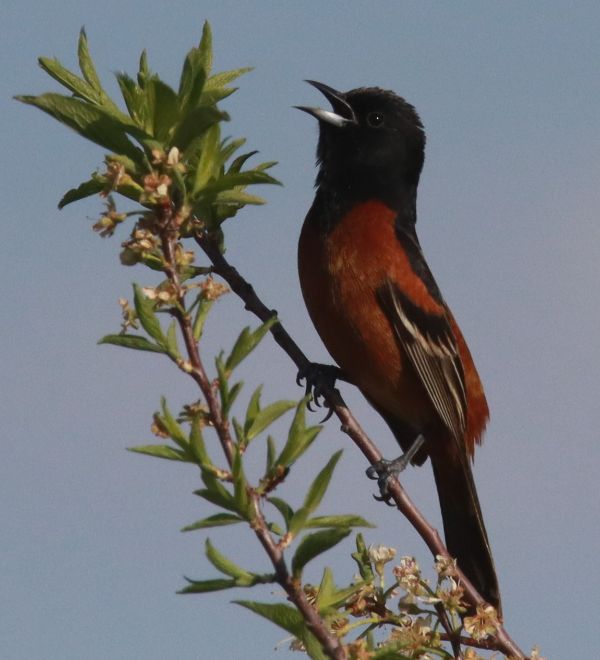
I imagined a big songbird fallout for Sunday morning, even though the fallout numbers didn't happen, at Melody's Grove there was a male Common Yellowthroat, a Tennessee Warbler, several Yellow Warblers, a couple Gray Catbirds, and a few Least Flycatchers. I also checked the Old Country Schoolhouse Grove where only a regular Say's Phoebe and an immature male Cooper's Hawk on hand, and at White Lake a male Orchard Oriole and a pair of Brown Thrashers were present along with a pair of Upland Sandpipers and an adult Bald Eagle nearby. Maybe the fallout would happen Memorial Day morning, but there should be one more with the most exciting warblers appearing pronto – I hope.
By Sunday, another influx of White-rumped Sandpipers was obvious in the shallows at several area wetlands, and I was surprised to find yet another flock of 21 Ruddy Turnstones at Bobby's Bay mixed with a few Stilts Sandpipers among about 35 White-rumps. Most of the White-rumped Sandpipers were at Dean's Lake, where there were a couple Dunlins and a few Long-billed Dowitchers feeding the shoreline shallows among perhaps 400 White-rumps.
Memorial Monday, the holiday morning provided some shorebird surprises – first, a flock of 89 American Golden Plovers that I saw flying before they landed in an agricultural field to feed north of Bobby's Bay – very exciting. But an even more surprising observation was finding a dozen Ruddy Turnstones at the Bay; and as turnstones landed and left, the group flew up and I watched them fly to a similar adjacent ag field, where more than 100 turnstones were scattered across a low hill – quite a holiday surprise!
At Melody's Grove, the fallout didn't materialize again, but there were a couple new species: A Mourning Warbler was the prize of the morning, and an excellent chance to photograph a male Common Yellowthroat was a high point; as was seeing a male Rose-breasted Grosbeak at close quarters, along with a few female and male Orchard Orioles and a couple male Baltimore Orioles – with Yellow Warblers appearing mostly in a little wave of action.
Feeding Station Action: Last Thursday the 9th oriole of the day was the first male Orchard Oriole of the season, who fit right into the jelly line-up, and the next newbie was a female Rose-breasted Grosbeak, another jelly jammer. A male Ruby-throated Hummingbird merely zipped by my nectar feeder, as did a Chipping Sparrow, along with a couple American Goldfinches and House Finches. A male Hairy Woodpecker and the female have returned to the suet feeder rather sporadically after an absence of more than a week. A Swainson's Hawk provided a bay window sighting too, and Monday a Hooded Merganser flew through my bay window view.
Saturday boasted the jelly bellies as 3 male Baltimores, 4 female Baltimores, and 2 female Orchard Orioles, and at least 1 male American Robin. But Sunday, it seemed the orioles were down to the first male and female Baltimores and a male Orchard Oriole – and that trend has continued until I published Tuesday (yesterday). A male Ruby-throated Hummingbird fed a couple times at my nectar feeder a couple times Monday and continued to fuel up Tuesday. While I've been seeing occasional American Goldfinches in the field, none have appeared at my feeding station lately. [Ah, the ups and downs of spring migration.]
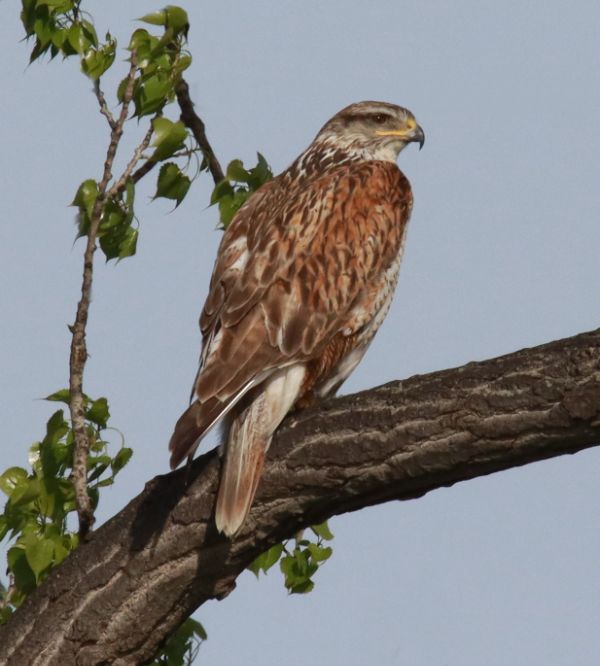
Nesting Hawk Watch: Sunday, a Swainson's Hawk is incubating in the Alaska Grove nest as another was immersed in a hunting flight a short distance southeast of the nest. The new Swainson's nest just west of the Ferruginous Hawk pair's nest had a hawk lying on the nest too, presumably egg-laying or incubating. The male Krider's Red-tailed Hawk was perched near the remnants of the nest he initiated, and the male Ferruginous Hawk was preening in what appears to be his favorite cottonwood tree, providing me with a couple distant photos of the raptor surrounded by new leaves.
The exciting thing about birding is that you never know what will happen next, whether it's outside your windows, down the road, around the corner, or in the sky above! New birds, new numbers of birds, rare birds – and each day there are new observations to make and others to build on as we watch and learn in tandem. What will tomorrow bring? At least one more big songbird fallout I'm hoping. Enjoy your time among birds!
Article and Photos by Paul Konrad
Share your bird sightings and photographs at editorstbw2@gmail.com