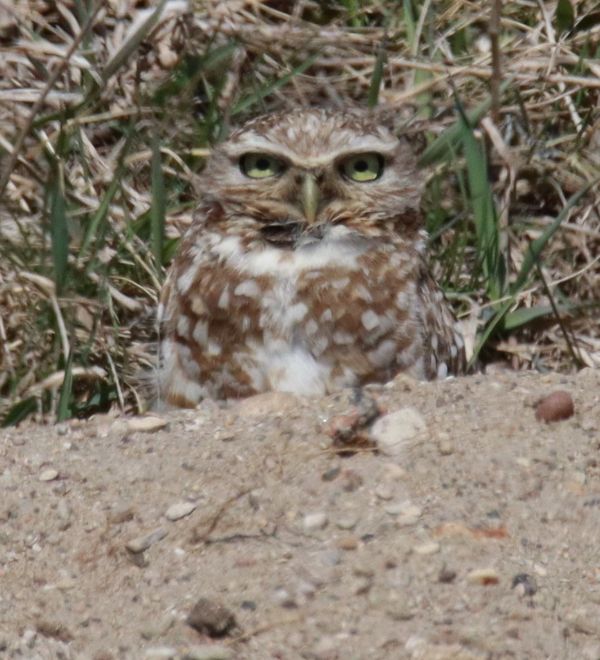
An exciting surprise sighting of the week was finding a diminutive Burrowing Owl, exceptionally rare east of the Missouri River these days, but I found 2 last year after not seeing any the previous decade, so their return is promising. I'm almost surprised I found the too-kool owl because it blended into the grass background so well, although it was standing low behind the rim of bare dirt at a sizeable badger burrow. It seemed like it was even claiming the burrow considering it permitted me to take a few photos without flinching at my approach or quick photo series.
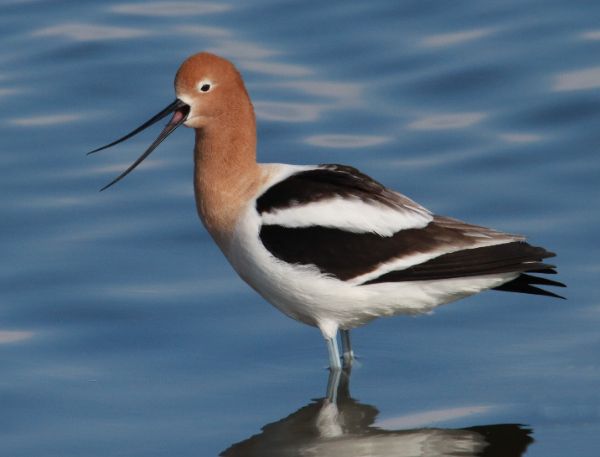
Also on Wednesday, I observed my first pair of Western Grebes of the year followed by a single Westie Saturday afternoon. Tuesday I observed the first of spring Marbled Godwits, a Common Tern, and a Wilson's Snipe that was foraging for earthworms 200 yards south of my office. I also spent some time photographing some of the 10 American Avocets at Bobby's Bay just 2 miles north. Thursday afternoon brought the first 2 lone Horned Grebes to area wetlands, and there was an obvious migration of Franklin's Gulls. The interesting thing about the Franklin's was that these birds had the light-pink belly and breast plumage of adults in full alternate plumage.
At the same location where I saw the early Swainson's Hawk on Sunday, Thursday afternoon a Swainson's was standing on an old nest in a tree grove – how exciting! I also observed 4 other recent Swainson's arrivals, including a pair on a territory used last year, and 2 other singles. This was April 16, so still a little earlier than my usual April 18 to 22 first arrival date for the species.
The obvious migrating birds tied in with the fact that BirdCast showed that Tuesday-Wednesday was a big migration period, and Wednesday-Thursday was the new biggest 24-hour migration period of spring to date. But just as some birds migrate into or through the area, others migrate farther north beyond the area. Some species left the area in noticeable numbers – diving ducks and especially Canvasbacks with only a small percentage of Cans remaining by Thursday; plus, there were no more Arctic-nesting geese to be seen.
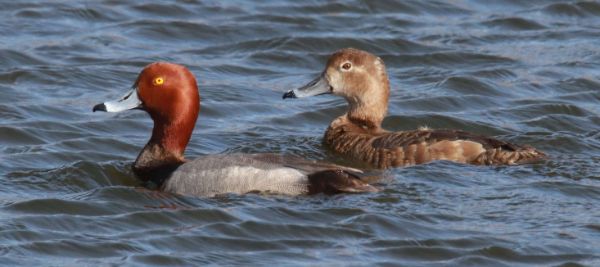
As an exceptionally strong wind buffeted the area Friday and Saturday, I finally broke away to check on birds in spite of the blast from the northwest. I had a chance to photograph a pair of Red-heads, but most birds appeared to be in cover until I reached the southern-most point of my drive. There a Sharp-tailed Grouse caught my eye and I photographed it as its behavior evolved from standing quietly to something of a display as it raised the feathers on its head and spread its tail feathers as it tipped its tail up. That's when I noticed there were 2 other Sharpies and watched them walk over the low hill. There was also a lone Baird's Sandpiper at Charo Marsh, a beauty of a male American Kestrel hunting along the way, and 4 miles south of my office a flock of about 50 Sandhill Cranes was flying low until they began soaring ever higher to resume their migration flight into the fierce wind.
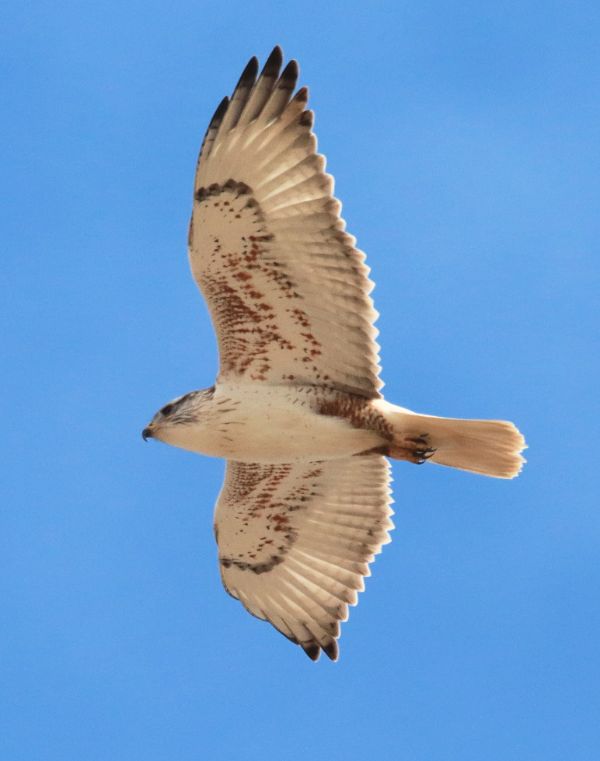
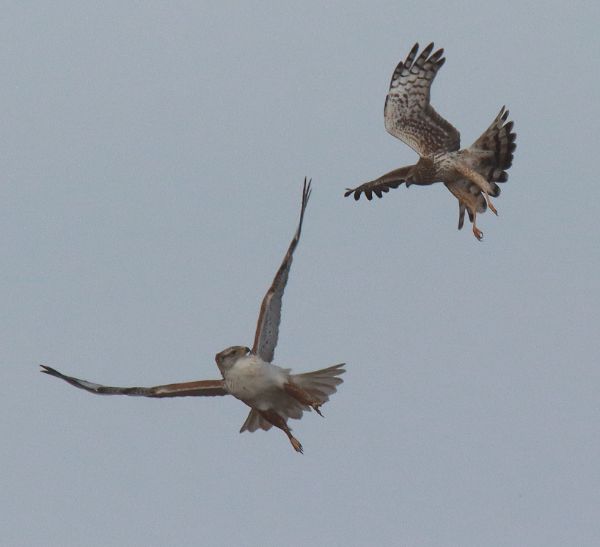
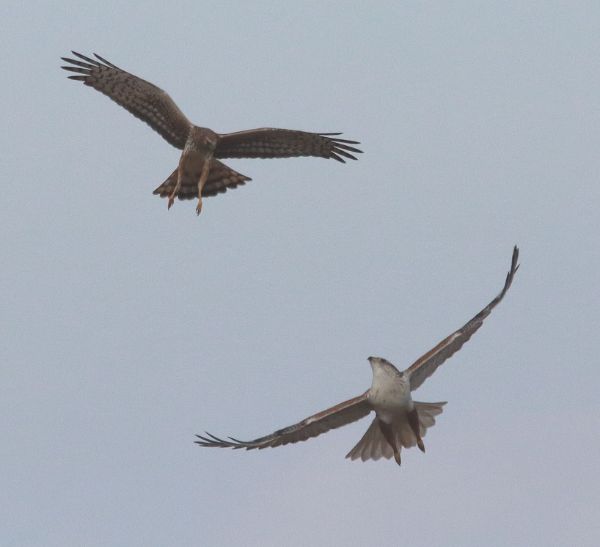
Hawk Watch: As I approached the Ferruginous Hawk pair's territory last Tuesday, I scanned the open prairie for a glimpse of one of the raptors. As I passed by the nest, a flurry of action erupted in the open sky! At first I had the impression it was the pair of adult Ferruginous Hawks immersed in a mating flight, sweeping upward as they met with one hawk flipping over and both reaching out with their talon-tipped feet. They were 200-plus feet west, circling and re-positioning in a flight that was hard to follow due to its speed and intensity. After 2 interactions, it seemed there may have be 3 birds involved in the action – was this actually a skirmish on a territorial level?
Because I was seeing muted flashes of white on the tails of all 3 hawks, it gave me the initial impression that there was a third Ferruginous Hawk, and I fumbled with that impression for a moment while wondering if maybe there was a Northern Harrier involved. All the while I was intent on trying to take some photographs of the intense interactions on the wing. It turned out that the Ferrug pair was double-teaming what turned out to be a female Northern Harrier, with one Ferrug engaging the harrier and the other either circling around or perching in the tree to the south of the nest, then engaging again.
Suddenly the female harrier broke away by flying north, which prompted the male Ferrug to perch high above the nest and the female to soar overhead a half-minute before perching in the south tree. Soon the female perched near the nest for a minute before transferring to the nest platform where she settled into the nest bowl. That's when I broke away, but I couldn't see either bird when I passed by 15 minutes later (timing is everything).
When I checked for the male Krider's Red-tailed Hawk and any other Red-tail (a potential mate) at the apparent territory a mile south, there was no sign of hawks in the area Tuesday or Thursday, and there was no sign of new activity where the new nest was initiated. But when I checked the location Saturday afternoon, the Krider's male was circling low near the nest site and I could see that new, longer twigs had been added to the small but advancing nest.
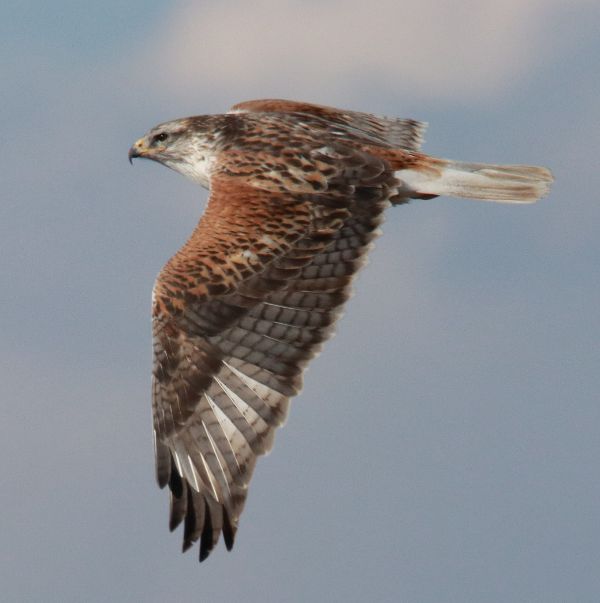
A mile north, I couldn't see either of the Ferruginous Hawks at their nest or in the surrounding area, but to be honest I imagined the strong wind would keep them in hiding. Even so, I decided to take a little used side road east, and on the lee side of the second low hill the head and shoulders of the male were suddenly obvious. As I was traveling very slowly, I instinctively stopped, but then wished I hadn't for fear of displacing the hawk; but once stopped I took 2 photos before it did take flight into the strong wind. That's when I managed a couple interesting flight photos as the hawk fought to progress westward. I followed its flight toward the nest, but instead of stopping there, the male continued on a course that united him with the slightly larger female that was invisible to me up to that point. I was glad to see them, and thrilled to get a couple unplanned photos (throughout my observations of the Ferrugs I've made it a point to try not to disturb the hawks during the pre-incubation period).
Along my route to Bismarck Sunday, I checked on last year's primary Ferruginous Hawk nest where I haven't seen any hawks to date; but Sunday afternoon the female was incubating as the male was perched along the tree row less than a quarter-mile west of the nest – bingo. I hope this is the same pair as have claimed that nest the past couple years because they are a very trusting pair to study and photograph. Less than a mile to the east, an adult Bald Eagle was incubating on another larger nest in a more substantial and taller tree. Last year the nesting pair of eagles raised at least 1 female fledging – an impressive bird. Farther along, I also observed 3 Red-tailed Hawks at nest sites – 1 standing on a nest, 1 flying to a nest, and 1 in incubating position on a nest.
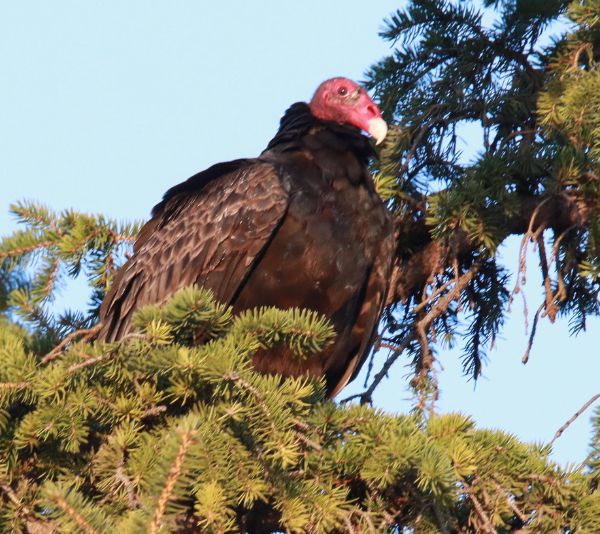
Yard Watch: Another Brown Creeper provided a momentary look as it landed on the ash tree adjacent to my feeding station last Tuesday afternoon. New yard birds that evening included 2 Turkey Vultures, 1 after the other, circling very low above my backyard and perching below the top of a tall spruce tree nearby. Last week I heard and saw migrating flocks of Sandhill Cranes above my yard – 1 flock Tuesday and 2 Wednesday while doing some spring cleaning in my yard. A Northern Flicker was present Sunday afternoon, and another flicker appeared on the ash tree outside my bay windows Monday. Also Monday, I could see Franklin's Gulls flying just above the tallest trees at times, which was a first for the season. Feeder visitors haven't changed: Hairy and Downy Woodpeckers, Red-breasted Nuthatches, White-breasted Nuthatches, House Finches, Mourning Doves, and American Robins; but there weren't any Dark-eyed Juncos in my yard – they probably left during the big migration nights last Tuesday or Wednesday.
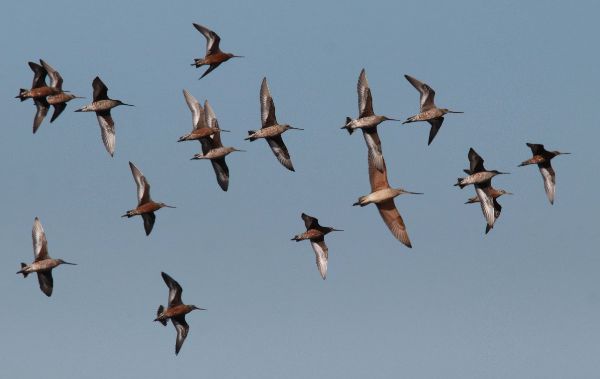
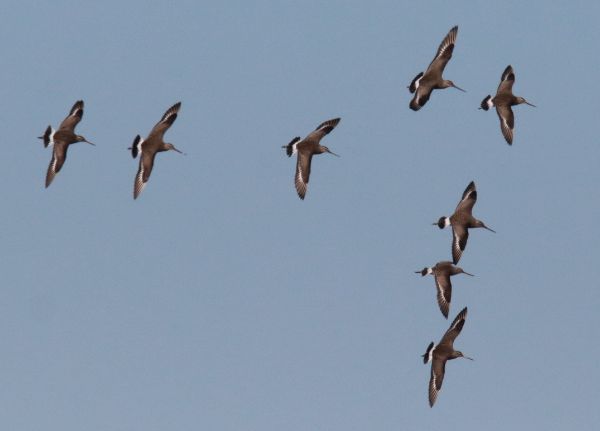
More Newbies: Sunday afternoon provided 6 more first of spring sightings that included a Willet, a Loggerhead Shrike near the long-time Ferrug nest, at least 2 Chestnut-sided Longspurs at my traditional nesting area, a flock of about 50 White-faced Ibis, a Marsh Wren, and the biggest surprise of the day – a flock of at least 60 Hudsonian Godwits! Hudsonians are a favorite Arctic-nesting shorebird species that migrates through the region each spring with some small groups stopping over for a few days or more, and these were in company with a few Marbled Godwits, a locally nesting species that just arrived within the week. I hope you are finding great new bird species – maybe even more than I'm able to find. It's definitely prime migration time for many birds, and you may even be seeing the first warblers and flycatcher species; Good Luck!
Article and Photos by Paul Konrad
Share your bird sightings and photographs at editorstbw2@gmail.com