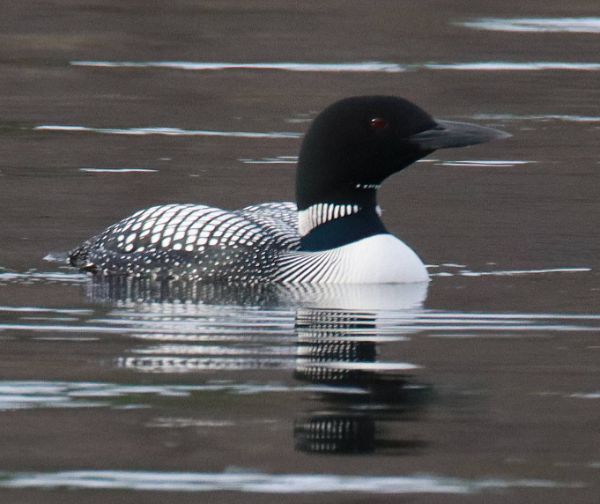
An inspiring trip to Minnesota lakes country last Wednesday, which was coincidentally Earth Day, yielded looks at 4 active Bald Eagle nests and 2 active Osprey nests, as well as a sighting of an Osprey flying with a fish in its talons. After a warm walk through the woods filled with the sounds of Song Sparrows, American Robins, Red-winged Blackbirds, a Blue Jay, a Red-bellied Woodpecker, a Downy Woodpecker, and pierced by a loud Pileated Woodpecker call, I made a second check for Common Loons. With the wind calmed to a murmur, the first pair of loons of the season materialized in a familiar location, which prompted me to approach a bit closer on foot. But the loons turned the table on me and actually approached me, which was both surprising and exciting.
Although the sun was blocked by clouds, I enjoyed photographing the pair together and individually as I noticed a beaver too. As if that wasn't Northwoodsy enough, a Pileated Woodpecker flew across the little bay to land in a nearby tree – were all the kool birds coming my way? The big woodpecker didn't stick around or offer a photo beyond the blurred images I tried to take as it flew nearby – a typical no-photos-please Pileated. The loons were so chill they weren't concerned with my momentary steps toward the woodpecker tree, and the sun even slipped out from behind the clouds for a couple photos. With Turkey Vultures teetering to the north and a couple Song Sparrows rambling along the edge of the cattails, a Hairy Woodpecker appeared, yet another addition to the the loon stop avifauna.
Driving south a couple miles, I was stunned by another big Pileated Woodpecker swooping head-first in front of my car – close – and landing on a tree as I passed by, providing a great view! But would it provide a great photo? I hadta stop and try a long photo of it clinging low on the tree trunk, but it flew a couple feet in the process, providing a couple more blurred flight fotos before it landed on an open moss-covered spot below the trees. That appeared to be a great photo chance, but it turned out to be just a momentary view that yielded no photo ops (Pileated Woodpeckers have long been the toughest birds for me to get a photo of, but at least they are appearing before me with tantalizingly fine momentary views – some day I should get a photo!).
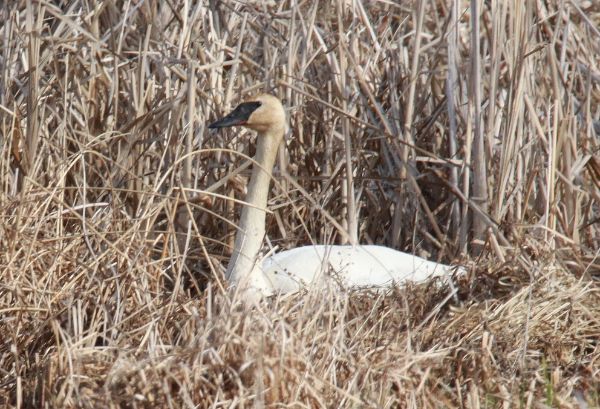
Among the 4 active Bald Eagle nests I sighted, a downy nestling could be seen standing above the rim at 1 nest. Perhaps the biggest surprise sighting of the day was a Broad-winged Hawk, and as I photographed it flew overhead a passing shadow alerted me to a trailing associate – they were the first 2 Broad-wings I have ever seen in the region. I also able to get my first photograph of an incubating Trumpeter Swan on its nest as her mate was feeding nearby in the wetland shallows. There were a few other Trumpeter pairs in the area I covered, and other waterfowl observed were Mallards, Blue-winged Teal, Ring-necked Ducks, Lesser Scaup, Giant Canada Geese, and a male Common Merganser – but no Wood Ducks, which was surprising.
I also appreciated 3 sightings of Eastern Bluebirds, including 2 pairs that were checking out nest boxes and the area surrounding the potential nest sites. Plus I observed the first White-throated Sparrow I've seen this spring, so that's an indicator that other native sparrows and finches should arrive in my yard soon. My Earth Day hike provided a grounding feeling that I need more of this spring, and the overview of birds in the area was insightful and a nice change from the plains, as was the woodland scenery.
Local Birding: Most of the birds that were first sightings the past couple weeks are now regular sightings in the area, but it was noticeable that there were more flocks of Northern Shovelers and Blue-winged Teal in the area last week, and I observed migrating Great Blue Herons in groups of 5 and 4, as well as what appeared to be a migrating adult Ferruginous Hawk a few miles north of the Ferrug nest. New spring sightings in my area of Dakota last Tuesday included a rare observation of an Eastern Bluebird, a male; plus a Savanah Sparrow, and 2 adult Black-crowned Night Herons.
Saturday it was clear that Ruddy Ducks were the latest migrants to arrive on the water, and on the shore it was a couple flocks of White-faced Ibis numbering 8 and about 35. A new spring species sighting was an America Bittern, and I had a chance to follow a migrating dark morph Harlan's Hawk for a few miles, but didn't have a chance of a close photo; just a couple long-range documentary photos.
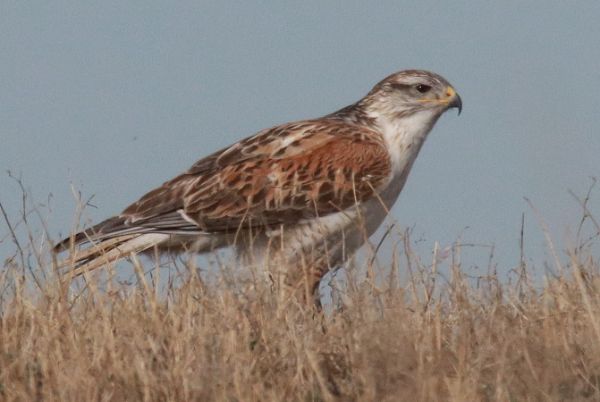
Hawk Watch: Last Tuesday, my raptor nesting list increased to 4 – the Ferruginous Hawk pair at their nest site and the Krider's Red-tailed Hawk nest building site, plus a pair of Red-tailed Hawks I've been waiting to arrive at a traditional nest site north of White Lake, and the Swainson's Hawk nest at the Alaska Grove. Although the White Lake nest is off my regular driving route, I can check the other 3 nest sites when I drive south.
Last Tuesday the Swainson's Hawk was soaring near the nest, but soon perched in a tree near the nest in the "Alaska Grove." It was perched in a similar position Friday and the nest appeared to have doubled in size with new twigs added. It almost seems like this first Swainson's arrival has been waiting for a mate to join him, or for a new arrival to find his nest site and the nest builder attractive – or am I just missing seeing the second nesting bird of a pair; and that may also be the case with the male Krider's Red-tail.
Back to last Tuesday, when there was no sign of hawks at the Krider's site, but as I approached the Ferrug nest the male was sailing above the road, but the nest was empty of an incubating female, which leads me to point out that it's getting late for the female not to be incubating eggs yet, especially considering the pair has been on territory for 7 weeks. Although I didn't see her initially, the female was actually standing next to the side road, hidden from my hawk eyes; but she revealed herself and repositioned in a short low flight to a branch near the nest.
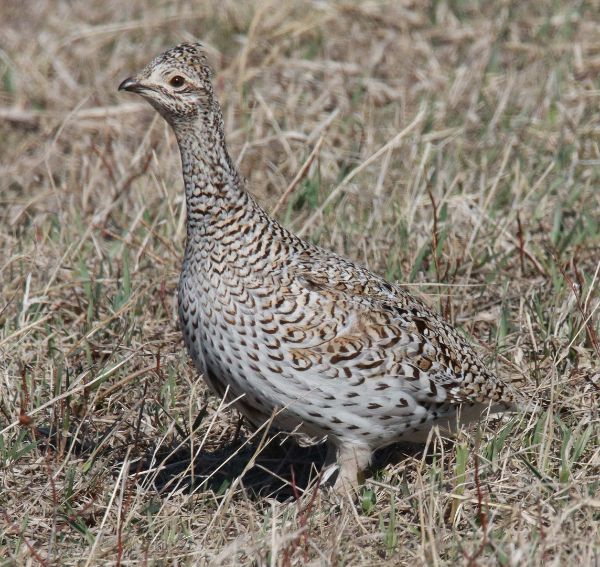
I didn't make it that far south again until Saturday afternoon, when one of the Ferrugs was standing on the nest. And a mile south the male Krider's Red-tail was present and circled over the broad prairie area to the east. As for action at the Swainson's nest, as I approached the location I saw an adult flying directly toward the nest, but it stopped short to perch within about 20 feet of the newly renovated nest. Monday it was perched in about the same place. Overall, it will sure be interesting to see how these 3 nests progress in the next week, and beyond.
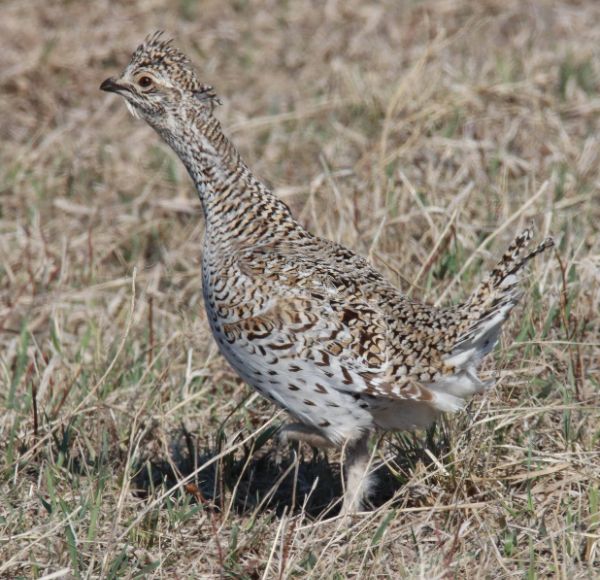
Yard Sightings: Friday's new feeding station arrival was a White-throated Sparrow, and a Northern Flicker checked out the adjacent ash tree's bark for morsels left behind by other woodpeckers or nuthatches. Overhead, as seen through my bay windows, I witnessed a passing Common Tern, 3 Double-crested Cormorants, and 3 Turkey Vultures. Actually, the vultures stayed overnight at nearby Melody's Grove, and they ventured into the Saturday morning wind at 9:15, passing above my yard in their teetering, gliding fight. That's when I also noticed a pair of Mourning Doves building a nest 60 feet away; and a bit later a few Franklin's Gulls graced my bay window view. Monday afternoon, 2 White-throated Sparrows were present in my backyard, as were 2 American Robins.
The female Hairy Woodpecker has been making some interesting adjustments to its feeding behavior, checking the ground for fallen seeds, and even climbing the birch branch attached to the feeder crook, but failing to understand how to perch on the tube feeder. She even landed on the hanging suet cage and poked at the suet a bit but was unsuccessful in getting a taste, but she's making progress even trying to land at the seed feeder and suet cage. Friday evening I even tested her extreme wariness by waiting for her to climb high in the ash tree, then cautiously walking to the ash tree to deposit some shelled peanut halves at the base, and it worked, in that as soon as I made it back to my entryway, she dropped halfway down the tree to a branch to investigate the peanuts a moment before reaching ground level to grab a peanut half that she chiseled into pieces to eat. She is an interesting and unique individual, that's for sure.
There has been a change among the nuthatch crew that visit the feeders in that all the previous nuthatches left, presumably to spring destinations. But a new Red-breasted Nuthatch arrived, almost simultaneously. It is small and has an almost white breast and belly, which permits me to distinguish her individually. Male and female Downy Woodpeckers and Hairy Woodpeckers and House Finches are the other feeding station birds, and other yard visitors are American Robins, Mourning Doves, White-throated Sparrows, and Northern Flickers. But I'm going to bet that more than 1 new species will be attracted to my property this week, as well as new species in the field – after all, it's almost May! As we look toward May birding action, I hope the weeks ahead are especially exciting for you – Good Luck!
Article and Photos by Paul Konrad
Share your bird sightings and photographs at editorstbw2@gmail.com