
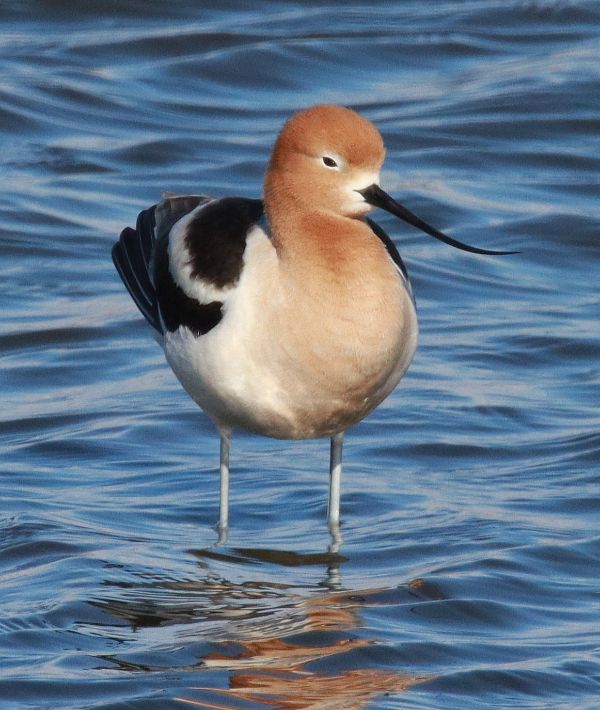
A week of new sightings began Thursday with a look at the first Great Blue Heron at Melody's Marsh, the first in North Dakota that is, preceded by Great Blue sightings in Minnesota 2 weeks before and in northern South Dakota 5 days earlier. At Charo Marsh 6 Baird's Sandpipers were firsts as they foraged with a Greater Yellowlegs. Friday was a much bigger migration day with first of year birds including 4 American Avocets, 6 Great Egrets, 7 Bonaparte's Gulls, and 28 Turkey Vultures, plus 14 more early White Pelicans and another Great Blue Heron. I also found my first nesting Giant Canada Goose of the year Friday, along with the first nest-building Red-tailed Hawk – the Krider's Red-tail no less.
The biggest surprise was a particularly early sighting of a Swainson's Hawk on Sunday the 12th – a week earlier than expected! I'm used to seeing the first Swainson's between the 18th and 22nd of April. The 12th is my earliest first sighting in these parts, and not many Swainson's are crossing the border north into Texas yet. Returning from wintering in central Argentina, this bird and other Swainson's Hawks that will follow migrated north over Brazil, Colombia, Panama, Mexico, and Texas to the Dakotas, and maybe on to the southern plains of Canada – making one of the longest migrations of any raptor species.
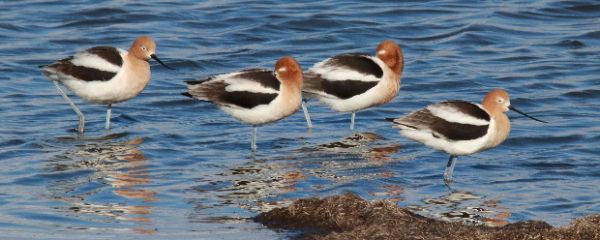
Another first sighting Sunday was a Franklin's Gull bathing among a small flock of Ring-billed Gulls – the first of many, many Franklin's! This species also winters south of the equator along the Pacific Coast from Ecuador to southern Chile. There were more Franklin's to be seen Sunday, with small flocks passing north, as were a couple more Bonapart's Gulls. Other new birds included 2 Tree Swallows on a 72-degree day when there were a few small flying insects on hand, especially near wetlands. And to top off the day, the first 4 Eared Grebes arrived at Grebe Marsh, so named for the many Eared Grebes that arrive there and eventually nest, along with other species of grebes.
A few male Yellow-headed Blackbirds were also perched on cattails at Grebe Marsh, the first since the especially unlikely early sighting of a single male the first week of March. And a half-mile farther south I checked for owls again: After seeing 2 Short-eared Owls actively hunting on the wing 4 miles south of my office the previous Monday evening, I was almost surprised to see one still in the area Thursday. The Short-ear was perched on a cement post (marker), and it was also perched there the following evening.
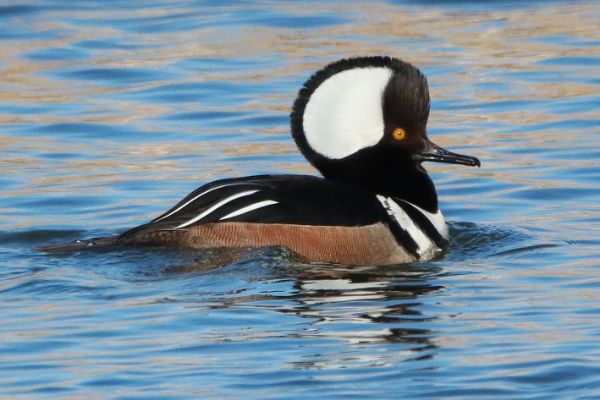
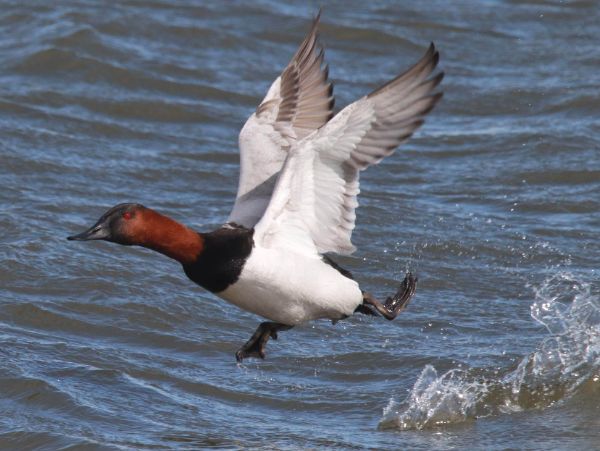
Ducks continue to be the overpowering birds in the area, which is quite a thrill considering their numbers and diversity, along with the photo opportunities they present any sunny day. With 15 species of ducks still on hand, Sunday morning I wondered if the 16th species – Wood Ducks – would make a spring appearance. By the end of the day though, I found a somewhat hidden pair of Wood Ducks standing on the edge of a meltwater pond near a lake they normally prefer – Hooray! Canvasbacks have been especially abundant and photogenic during the past 10 days with a couple concentrations nearing 100 Cans, with other flocks in the 30 to 40 range, and a scattering of pairs and small courting flocks too. I have enjoyed such good luck photographing the interesting behaviors of Canvasbacks recently as the males vie for a mate and perform innate behavioral displays to attract a female that I devoted my Bird Photography feature to Canvasback behavior in this issue.
In addition to many Canvasbacks and other ducks at Bobby's Lake, there have also been between 2 and 9 Tundra Swans some days during the past week – just 2 miles north of my office. There are still 4 species of geese in the area (Snows, Ross's, White-fronted, and Canadas), although they are in smaller flocks of 50 to 300 rather than the tens of thousands of Snow Geese observed until a week ago (the Canada Geese are mostly territorial pairs or small groups of younger nonbreeders). Flocks of White-fronted Geese have really been dominating the goose scene now, but I wonder how much longer the remaining Arctic-nesting geese will remain.
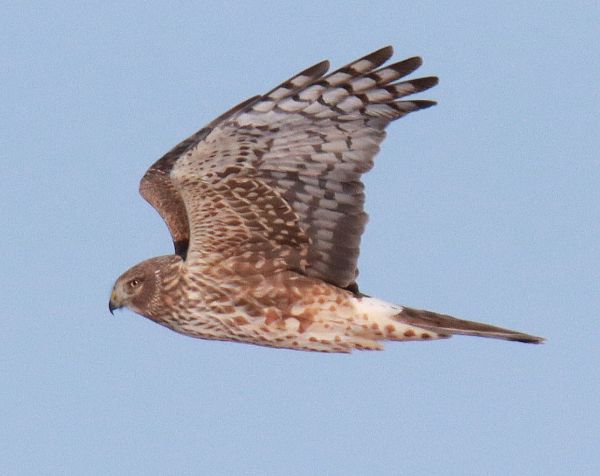
Hawk Talk: Last Tuesday both Ferruginous Hawks were present on territory, with the female seemingly meeting me as she flew to the nest. We met – her flying low and me driving, both in a southerly direction – and she swooped up to the nest as I continued past it. I watched from a distance to see if something else might happen, and when I checked the low hill where the pair likes to stand, the male was suddenly present. Friday, the female Ferrug was standing on the nest, facing the road the first time I drove by, but she was facing with her back to the road during my return drive 15 minutes later.
During the interim I checked for the male Krider's Red-tailed Hawk to the south and was very surprised to find him standing on the beginnings of a nest composed of 30 or more small branches that he was apparently beginning to build about a mile south of the Ferrug nest. I checked back Sunday afternoon during a strong wind period, but didn't see any hawks. The nest building action seemed to have stagnated too, but I'll check back on the hawks after publishing this issue Tuesday afternoon – I'll fill you in on what I find next week.
Yard Talk: New for this year in my yard was a Brown Creeper that appeared twice Thursday afternoon on the ash tree outside my bay windows, adjacent to my feeders. The first Northern Flicker appeared in my yard Friday, as did a Mourning Dove, and by Sunday the doves had quickly become regular yard birds. Robins have become more vocal the last couple days, especially during their primary singing periods during early morning and after sunset, with one singing loudly from a nearby perch as it becomes dark, providing very welcome evening serenades.
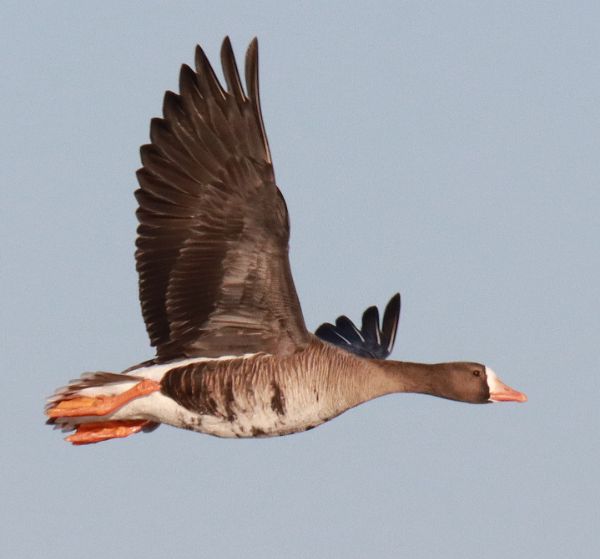
Species at the feeders have been predictable for some time: White-breasted Nuthatches, Red-breasted Nuthatches, House Finches, Hairy Woodpeckers, and Downy Woodpeckers. The female Hairy Woodpecker continues to hike down the ash tree to ground level to get shelled peanuts from the dish I put at the base of the tree trunk – the only place she will feed, for a reason known only to her. Haven't seen the female Downy Woodpecker in some days, but the male is regular at the suet feeder. Tuesday as I was putting the finishing touches on this issue, I heard a Blue Jay, but couldn't locate it optically. And 2 hours later I heard Sandhill Cranes, and observed them migrating northward as I stood in my front doorway – an especially welcome yard sighting.
As it turns out, last Friday night was the biggest migration of spring to date, with a huge spike in birds migrating across southern states, the Atlantic Coast, and north across the Great Plains, with my area of Dakota smack in the midst of it all – perhaps your area too. To review the migration radar for Friday April 10th overnight into Saturday April 11th (see Live Maps – BirdCast) and overnight Monday to Tuesday was almost as good. I hope new sightings of migrating birds are keeping you excited and searching for more! As we progress through April, birds are truly taking over our landscapes, with some of the most exciting songbirds and shorebirds yet to arrive – can't wait. Enjoy the birds you see this week!
Article and Photos by Paul Konrad
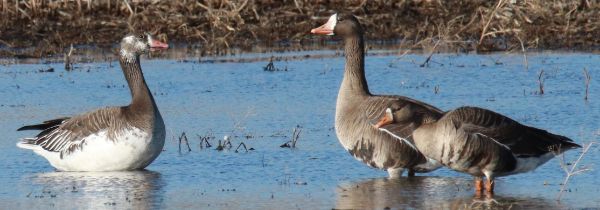
Addendum: Sunday evening I saw and photographed what appeared to be a hybrid between a White-fronted Goose and a Snow Goose. It was standing in a small melt-water pond with 2 pairs of White-fronted Geese, a couple hundred yards away from a flock of more than 100 White-fronts. After checking the photos I took, it showed it was indeed a White-front x Snow hybrid owing to the white Snow Goose feathers breaking up the gray White-fronted plumage, as well as white-lined black secondary wing feathers – a trait that is most obvious in the field in blue morph Snow Geese. The hybrid also has some obvious white feathers on its face and neck, and a pinker bill like a Snow Goose rather than the orange bill of a White-fronted Goose. I've only seen 1 Snow x White-front hybrid before, so this was yet another exciting Sunday find!