
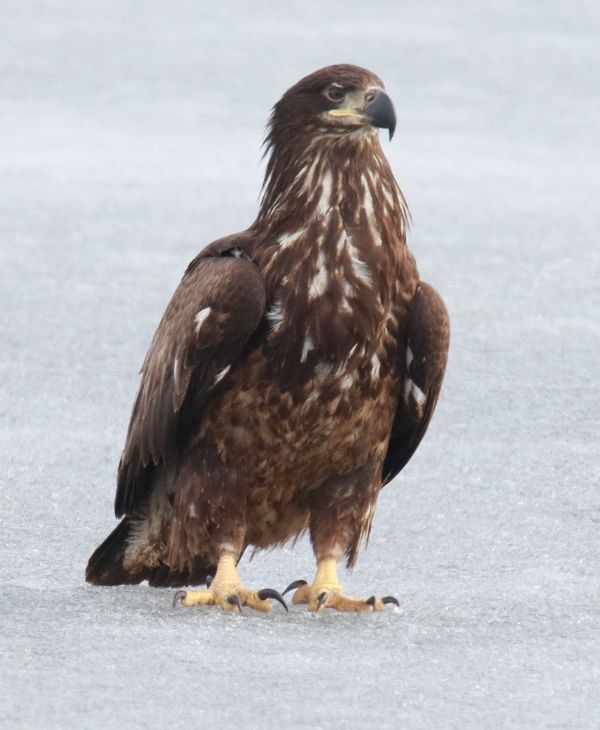
A Bald Eagle Extravaganza – again! Last Wednesday, on the way to Minneapolis-St. Paul, I counted 176 Bald Eagles at the Border Lake, just north of the border between the Dakotas! After checking for Bald Eagles in the Hecla area a week earlier and seeing none, it appeared that after poor weather conditions over the weekend, the first concentration of eagles arrived recently and should continue to build in numbers almost daily. Ice still covered the lake, as did scattered Bald Eagles in groups of up to 9, with lots of action as many eagles were patrolling the ice in low flights or perched in trees along the far side of the lake.
A few Eagles were soaring higher, with one group of 5 circling directly overhead, and 22 eagles were perched in one large cottonwood tree. It was a bit of an initial deja vu as I watched and listened to the sounds of the eagles and many Ring-billed Gulls, but there would surely be more eagles across the border at Hecla Marsh, east of the little town, and southeast a few miles too. But as I checked the area, not a single eagle was to be seen on the South Dakota side of the border, except 2 incubating Bald Eagles at local nests. There was a large flock of about 55 Ring-necked Ducks and Lesser Scaup in the first open water Hecla Marsh, and a smaller flock of 7 Lesser Scaup nearby – but no migrating eagles to my surprise. After all, about half of last year's spring concentration of Bald Eagles was active on the South Dakota side of the border.
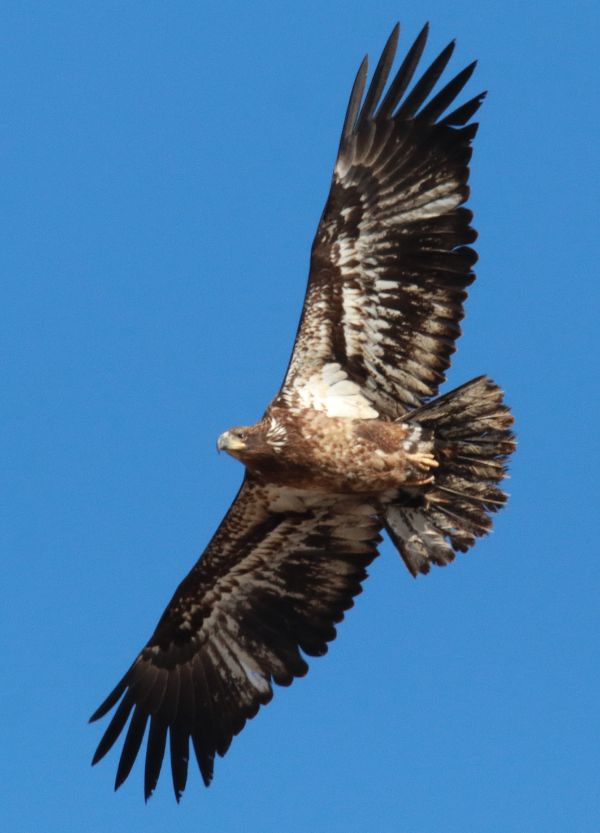
As exciting as seeing 176 Bald Eagles was, numbers should triple if they get close to last year's high count, which was 618! However, that count was probably at least 100 short of the real number on hand, because during the high count last year I couldn't explore 2 side roads for fear of getting stuck in mud during my first visit. Eventually I found at least 50 more eagles at each of those 2 locations – and that was after the peak count – so there were very likely more than 700 eagles on hand during the high count date. I obviously would return throughout the week to monitor this year's eagle buildup a little closer than the '25 season and how it progresses toward peak numbers with an eventual decline of eagle stopover migrants there.
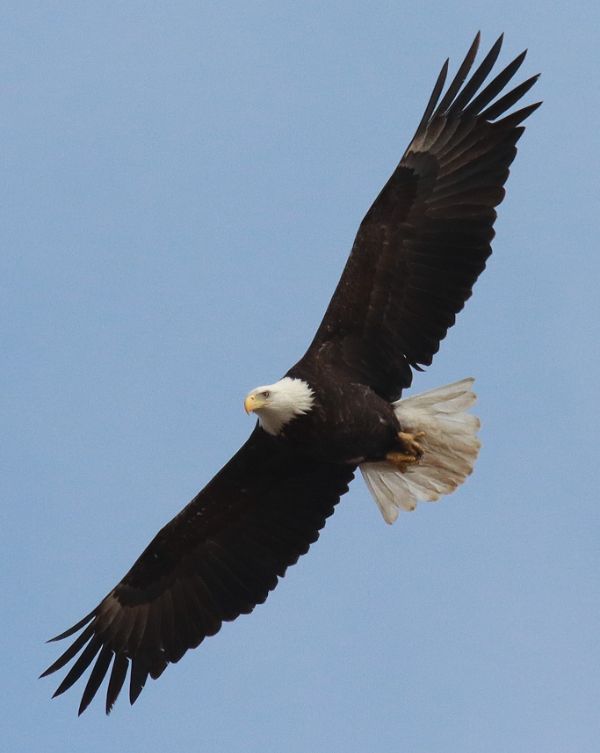
Local Waterfowl Breakthrough: As I began my 350-mile drive to the Twin Cities I passed frozen lakes without a sign of open water or birds, but at mile 4 I was surprised to see most of the lake open for business and covered with a large mixed flock of more than 200 ducks, primarily Ring-necked Ducks and Lesser Scaup, but also several Hooded Mergansers, Common Goldeneyes, a couple pairs of Common Mergansers and Mallards, a pair of American Wigeons, a male Redhead, and a male Bufflehead – plus about 15 American Coots. The waterfowl apparently arrived overnight or early that morning after the ice-covered lake opened into a new open-water habitat.
Two miles farther south, another big flock of migrants found another open-water marsh, but this mixed flock of ducks included mostly Canvasbacks (about 80) along with some Redheads and Lesser Scaup, a few Mallards, a pair of Gadwalls, and a pair of Ring-necked Ducks. And a mile farther south the first pair of Tundra Swans was standing on the ice of a favorite swan marsh. A few flocks of Snow Geese that undoubtedly included Ross's Geese were migrating northwest, and Canada Geese were scattered in pairs and small flocks of 6 or less along the way. Other migrants included the first 2 Killdeer and 3 Red-tailed Hawks, but I didn't see a Ferruginous Hawk in the nesting area.
During the rest of my drive to Minnesota, birds were surprisingly scant, including 3 more Red-tailed Hawks, 1 Bald Eagle, and 1 American Kestrel (but no harriers); a migrating flock of about 90 Sandhill Cranes north of Hecla, and a resting flock of about 300 White-fronted Geese joined by nearly 70 Snow Geese and a few Cackling Geese near the town of Fullerton. On the Minnesota side of my drive, there were flocks of 7 and 5 Trumpeter Swans, 2 American Kestrels, 1 Sharp-shinned Hawk, and 3 groups of Bald Eagles. The first group of 19 eagles was assembled on the ice of the Mustinka River, while 2 other groups of 28 and 25 Bald Eagles were on the ice or perched in trees on the edge of 2 frozen lakes east of the town of Elbow Lake.
The following day in the eastern suburbs of Minneapolis, I enjoyed a seeing a new combination of birds that included 6 Wood Ducks, scattered Mallards, and 10 Wild Turkeys in the Lake Minnetonka area, plus 2 single Great Blue Herons that were both flying low (possibly still migrating). Farther north I counted 5 Bald Eagles on Rice Lake, and saw 2 Wild Turkeys, then 1 more. In my niece and nephews' neighborhood there was a flock of about 30 migrating American Robins, a few Mallards, and the sound of singing Northern Cardinals. As for the robins, there was obviously a big push north by American Robins during those 2 days, along with Red-winged Blackbirds and Common Grackles.
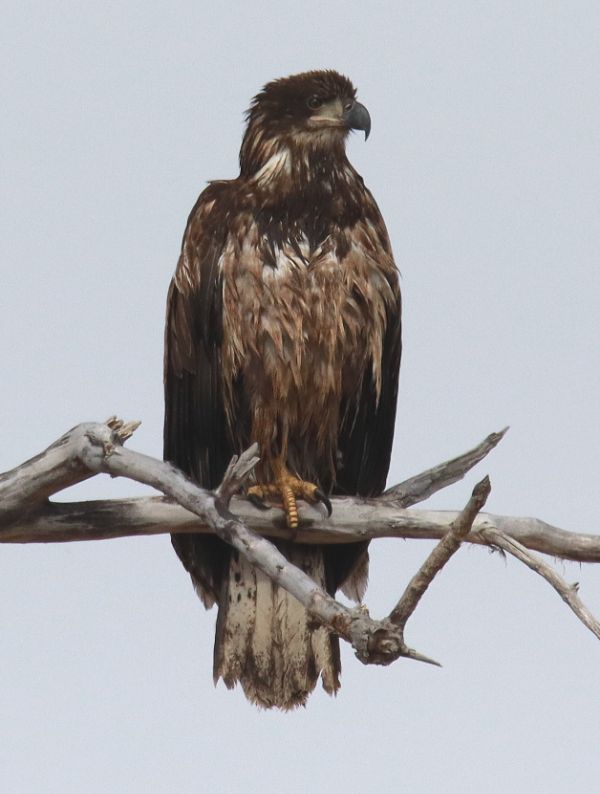
Eagle & Hawk Checks: Back home on Friday, after a morning in my office I headed an hour east to the Hecla area to check on the Bald Eagle concentration. The blue sky was inviting, but the temperature was only hovering around the freezing mark and it was very windy with a northwest wind that didn't seem conducive to migration; nonetheless, nature was calling me back to the eagle hotspot. After seeing a minimum of 176 Bald Eagles 2 days earlier, the area north of Hecla was comparatively empty, with only 36 Bald Eagles on hand – woo, that was quite a surprise. The cover of lake ice was replaced by open water, which didn't seem to affect eagle numbers the previous spring, but the exodus of eagles did suggest a minimum of winter-killed fish at the site. On the plus side, I enjoyed more photo ops with Bald Eagles, especially young eagles.
Other raptors observed along the way included 14 Red-tailed Hawks, 5 Northern Harriers including 2 females, 3 American Kestrels, 1 Sharp-shinned Hawk, and the male Ferruginous Hawk was perched in a tree adjacent to the nest site during my driveby. It was also interesting to see the return of a very light-colored male Red-tailed Hawk that has mostly white tail feathers that end with a light-orange terminal edge. It has a completely white underside, pale-brown dorsal plumage and a whiter than usual head – a Krider's morph. The Krider's Red-tailed Hawk was displaying to a regular-colored female after what may have been copulation, or a copulation attempt that I noticed when I first saw them.
Saturday the Krider's male was back on territory, just a mile south of the Ferruginous nest site, this time soaring over the wide-open prairie hills with a branch in his beak. He carried the branch for some time, even landing and taking off with it, likely displaying for the female that appeared to be soaring far above. With his white underside, light-colored head, and white and light-orange tail, this male resembles the Ferruginous Hawks, and it will be interesting to watch for any interactions, but so far the hawks seem to have something of a no-fly zone between their presumed territories. Another thing that's interesting about the Krider's Red-tail territory is that there is not nest site there – and little potential for one with only a small stand of trees across the prairie. But the Red-tails just arrived, and it will be fun to watch their progress along with the Ferruginous Hawks.
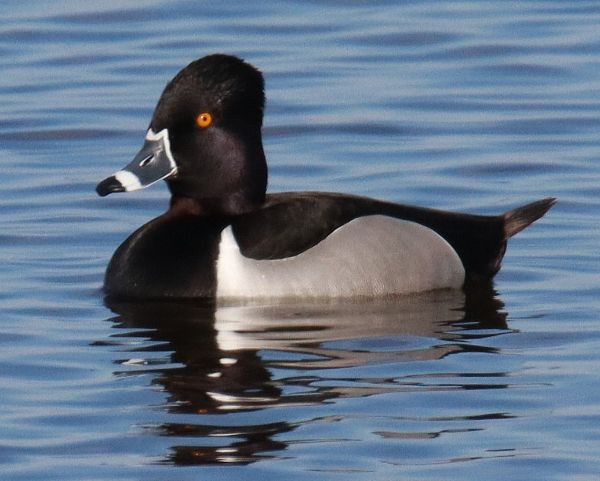
Waterfowl Action: As more marshes and lakes free themselves of ice with warmer temperatures and the action of the wind, they promptly become filled with ducks, to my delight. Mostly flocks of diving ducks – Ring-necked Ducks, Lesser Scaup, Canvasbacks, and Redheads with occasional Common Goldeneyes, Buffleheads, and Common Mergansers making migration stopovers. A percentage may stay in the area to eventually nest, along with the more likely Mallards, Northern Pintails, Gadwalls, Northern Shovelers, Blue-winged Teal, and to a lesser extent, Green-winged Teal and American Wigeons, along with Hooded Mergansers. Right now, Hooded Mergs are quite common and are among my favorite photo subjects along with Canvasbacks, Ring-necked Ducks, and Common Mergansers; plus I'm hoping for chances with Common Goldeneyes that I've watched displaying in the distance. This area is a true duck haven during migration, and throughout the nesting season and into fall migration!
When I drove cross-country to Minnesota Wednesday, and again to the James River Valley Friday, I was surprised by the lack of geese encountered along the "goose highway." I even drove through Sand Lake National Wildlife Refuge and there were no Arctic-nesting geese (only local Giant Canada Geese). Had the millions of Snow Geese already passed through? As I returned home with that question on my mind, I began to see mixed feeding flocks of geese that numbered between 40 and 140 – starting just 4 miles south of home – including Snow, Ross's, White-fronted, and Cackling Geese.
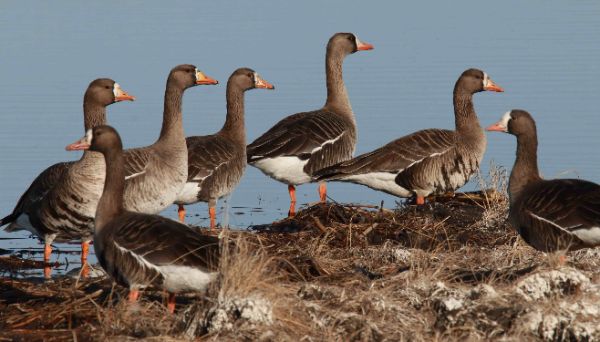
Continuing my drive a short distance north of home, I was surprised to find a huge flock of more than 1,000 Snows and Ross's Geese feeding in a harvested corn field 6 miles to the north, and there was another flock as large or larger 3 miles west that took flight into the sunset colors. I checked back Saturday with a gasp when I saw the expansive flock resting on the icy waters of Roy's Lake. Later I got an idea of the enormous numbers of geese concentrated there when I watched thousands pour into the sky, flying high to the north without so much as denting the overall flock that remained on the lake. There must have been many tens of thousands! Closer at hand was a feeding flock of maybe 700 Snows and 250 White-fronted Geese with a mixed flock of ducks – Mallards, Northern Pintails, and American Wigeons feeding too.
Saturday and Sunday were remarkably beautiful blue sky days with windless afternoons that made birding all too attractive and office work all too difficult to concentrate on, just what you need to create a definite case of spring fever; or is it birding fever? The ducks provided plenty of photo ops, and geese added some more. Sunday evening it was especially exciting to see the female Ferruginous Hawk standing on the nest, turning west and east during my slightly extended observation from a distance. The male soon appeared too, alighting on the low hill to the northeast, then moving to perch in the tree a short distance south of the nest. There was no sign of the Krider's Red-tail, but a dark morph Harlan's Red-tailed Hawk with a brown plumage and bright red tail feathers was perched 2½ miles south of the office.
The mega-flock of thousands of Snow Geese left overnight, but there were a couple hundred White-fronted Geese with 50ish Snow and Ross's Geese just 3 miles south Sunday, and that group inflated to about 300 White-fronts and half that number of Snows Monday. I also observed the first Greater Yellowlegs of the season, and the first Ruddy Duck (a male), which brings the duck species number up to 15 – only Wood Ducks remain to be seen up here.
The Yardbirds: The arrival of Common Grackles wasn't the biggest joy last week, but robins and juncos are regular now. As for feeder birds, the species remain static, as do the individuals among the Downy and Hairy Woodpeckers. I did create a new feeding option that has been quite fruitful: Because the female Hairy Woodpecker won't feed at the feeders after a few weeks of checking for morsels on the ash tree next to my feeding station, I placed a small bowl at the base of the tree trunk and filled it with some shelled peanut halves and shelled sunflower seeds – and now it's her regular stop to eat peanuts and sunseeds – Hooray! It's great to have Dark-eyed Juncos were feeding on the ground and the Red-breasted and White-breasted Nuthatches and House Finches as regulars, and to hear the robins sing, especially during mornings and evenings.
It's hard to imagine a week with more change in the avifauna scene than this one, and I'm sure you are excited about the birds you see in your yard, in your neighborhood, and in the field. Hope you have some day trips with birding in the forefront planned, and hope you can break away for a daily dose of birding. It's remarkable how birds can add tranquil periods followed by a thrilling surprise in a flash; birds can help clear your mind and refresh your soul. Aren't you glad you are a birder!
Article and Photos by Paul Konrad
Share your bird sightings and photographs at editorstbw2@gmail.com