
Before starting my drive east to Minnesota lakes country, I decided to choose a Pileated Woodpecker for the top of my wish list of birds to encounter. That's a bit of a far-fetched wish for any day, but it's been done before in the Pelican Lake-Cormorant Lake area. Photo? Don't even think 'bout it. But as rare as it would be to see a Pileated Woodpecker, after observing 3 species of woodpeckers a black crow-looking bird flew ahead of me – but it was no crow – it was a Pileated Woodpecker! I tried to get a second look at it by turning onto a muddy side road, but without luck. Even so, the luck was in crossing paths with the most noble woodpecker of the region.
The other 3 woodpecker species encountered included a Red-bellied Woodpecker, a Hairy Woodpecker, and Downy Woodpecker. The Red-bellied Woodpecker ranks almost as rare a sighting for me as the Pileated was, so I was especially glad to find it too. It flew to a well-excavated woodpecker snag next to an open location where a few American Robins and a Dark-eyed Junco were foraging below, and that's where the Red-bellied Woodpecker met a Hairy Woodpecker – the Red-belly being very vocal and loud before leaving. There were a few Black-capped Chickadees scattered along the woods along the north shore of Pelican Lake too.
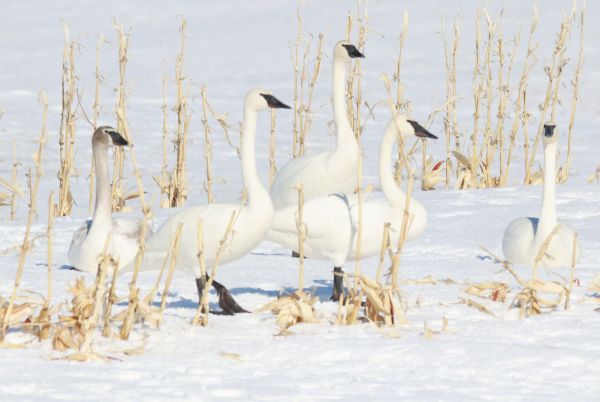
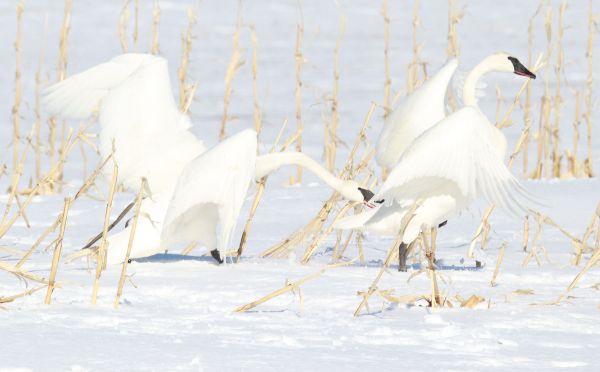
The birds I really expected to see were Trumpeter Swans, but there were none present when I checked back to the beautiful Pelican River pond surrounded by white ice where Trumpeters provided many nice winter photos while active in the clear blue water. When I checked on the snowy field where swans were present during my mid-January visit to the area, there were many Trumpeter Swans on hand, plus a scattered few Canada Geese. The swans were positioned along a few rows of corn that the farmer left for wildlife. The corn stalks were heavily tattered by winter winds, making it impossible to photograph the Trumpeters without the corn skeletons surrounding them, but in some ways, it made the photos unique.
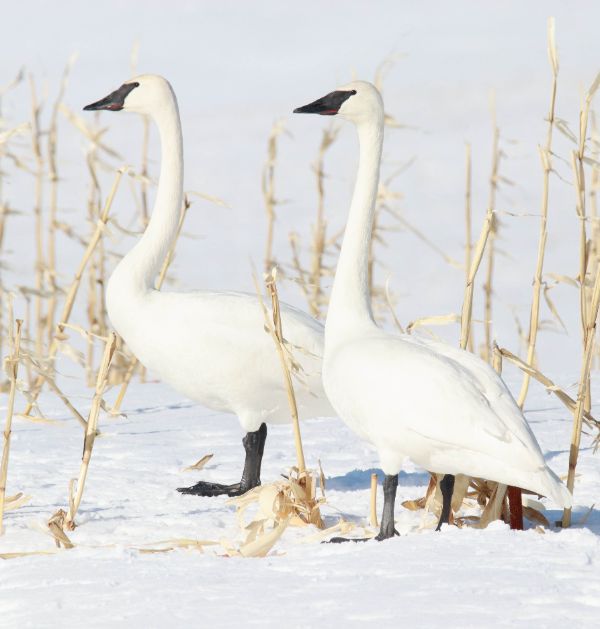
I was hoping some swans would take flight against the afternoon's blue sky, and even though a pair, a group of 4, and a young swan did a few laps above the snow-covered field, they didn't provide a good photo opportunity. But a couple big males did get into a little fight, which created a chase that I documented. It was exhilarating to hear the loud brassy vocalizations and view the white swans on white snow, so large and yet so graceful. This was a group of about 60 Trumpeters, different from the Pelican River concentration, and I did cross paths with another group of Trumpeters as they flew to a field to feed during late afternoon. They looked especially elegant as they winged by in groups of 4 to 7, so refreshing to witness against the cleared blue sky.
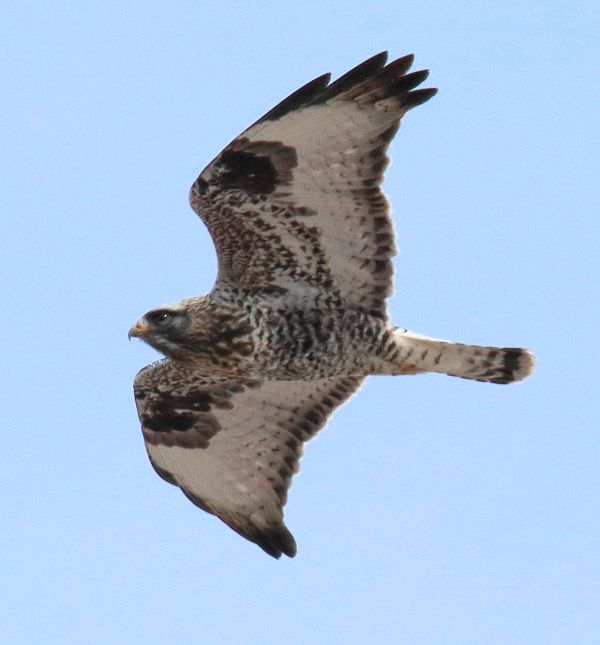
Even with such enjoyable observations of the woodpeckers, songbirds, swans, and geese, raptors dominated much of this birding drive from mid-morning to sunset. A trio of Rough-legged Hawks added early excitement to start the drive, and another was hunting closer to the Minnesota-Dakota border, with 3 more Rough-legs on the Minnesota side of the Red River Valley (7 total, including 2 males and 1 black morph). I also observed a male Northern Harrier in each state, and in the wooded lakes country farther east, Bald Eagles 2 to 6 materialized.
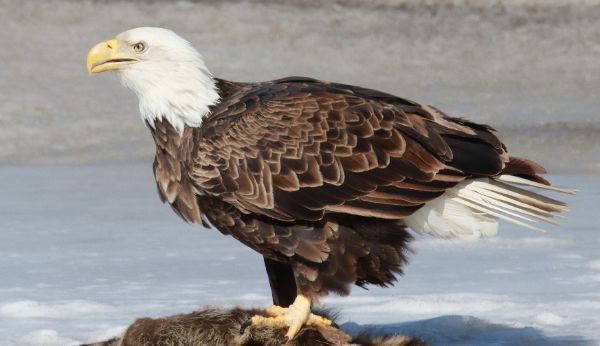
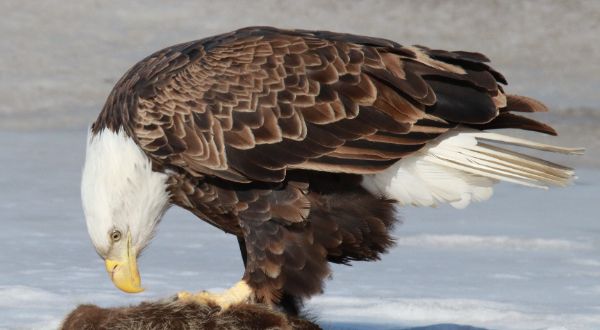
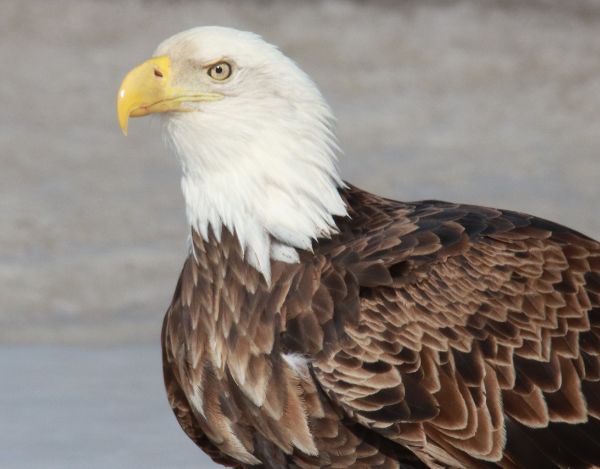
The first eagle, however, provided the best photo ops as it fed on a carcass near the highway in the Red River Valley of eastern North Dakota. To round out the raptor observations, a chance view of a Merlin flying overhead added a mini-falcon to the mix near Cormorant Lake, and as I was on the ecological border between woodlands and grasslands in western Minnesota, a pair of Red-tailed Hawks was perched – the first Red-tails of the year that far north – but it's getting to be that time of the year. Overall, I observed a total of 18 raptors, including 5 species – very impressive.
Westward Ho: As productive and enjoyable as my birding drive east to Minnesota lakes country was Thursday, it was preceded by a surprisingly empty drive the previous day west to the Missouri River, then north to Bismarck. For the most part, only a few scattered Horned Larks broke up the drive, until Ring-necked Pheasants materialized south and east of the capitol city - and one large flock of pheasants may have numbered 50. There was a flock of Canada Geese flying intently about an hour south of Bismarck, which may have been migrating, or they may have been wintering Missouri River geese.
Most of all, I was surprised by the lack of raptors – not 1 Bald Eagle along the river, not even 1 Rough-legged Hawk across the plains. I had high hopes of finding a Golden Eagle, American Kestrel, Merlin, or even a Prairie Falcon at this point of the season, but without a Bald Eagle to be seen along the grand river south of Bismarck or anywhere else, the indicators just weren't there in spite of past history.
The highlight of the drive was finding a third active Great Horned Owl nest with an adult incubating in February (the 25th). There is no telling when the owl laid its first egg in the former Red-tailed Hawk nest but it is now 1 of 3 Great Horned Owls I found incubating in North Dakota in February – unprecedented for me! And considering I found no nesting Great Horned Owls last year, it's a good sign for nesting raptors and it probably is another indicator of a high population of meadow voles in the region, small rodents that have attracted Short-eared Owls and Rough-legged Hawks to area grasslands throughout the winter – plus Northern Harriers in recent weeks.
Friday was horribly windy and Saturday there was a pretty, light snowfall all day, but that afternoon I drove south, with a flock of about 30 Horned Larks flushing a quarter-mile from my office. There were a few more scattered Horned Larks along the road, but at mile 11 a flock of about 40 Snow Buntings was present. No large birds were evident, but a mile north of my office a huge flock of Horned Larks that extended for a quarter-mile was assembled along the road, probably numbering more than 200 larks with a few Snow Buntings mixed in. another half-mile north a flock of about 20 Snow Buntings took flight, and although I drove another 5 miles north, the songbird flocks did not continue.
Back East: Sunday I drove to Fargo to attend my little niece Ruby's 2nd birthday party, and I wish you could have seen her playing with the beautiful antique wooden table and chairs and a new tea set that her great-grandmother gave her. My 4 young nephews provided lots of energy, but there was almost no avian action along the drive to the big city, aside from a Common Raven a number of miles to the west. But in my family's neighborhood, a male American Kestrel was present with a recently caught vole, but that's the only bird I saw on the edge of the city.
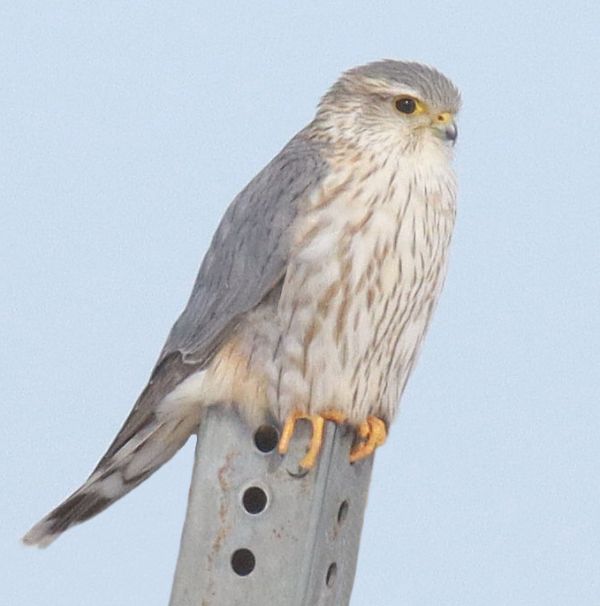
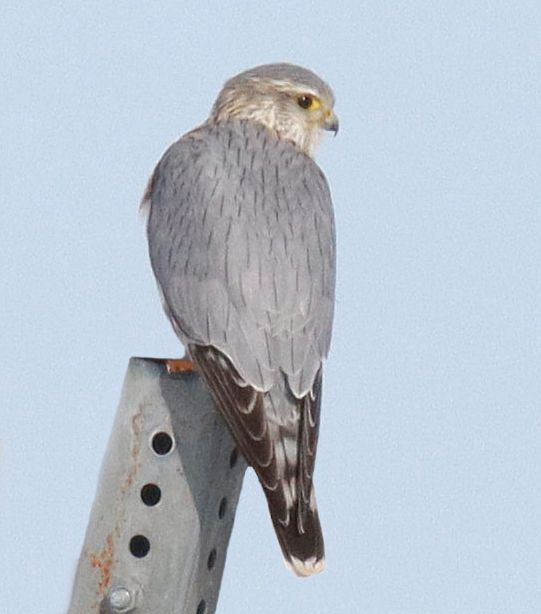
Although I was a bit road weary, with bright sunshine and blue sky Monday morning I was enticed from my office for a quick drive south, where only widely scattered Horned Larks showed to the point where I began heading back after 17 miles. But within a half-mile a tiny falcon creased the air just above the new snow cover along the side of the road. I watched as it followed the contour of the land, likely hoping to encounter a roadside lark. Without notice it swooped upward to land on the back of a metal post in just the right light. I edged forward and took some initial photos of the little male as it showed its silver-gray back, nape, and tail colors with black wingtips; until it turned to face into the morning sunlight and afford me photos of its frontside too. The pale coloring certainly indicated this was an adult male Prairie Merlin, a separate race declared unique from the darker colored Taiga Merlins from the northern forests – it was a beauty! I usually only see female or first-year Prairie Merlins, so to see a pale male and to get some documentary photos added a special twist to my busy work day.
I was able to edge forward for another series of photos until the li'l falcon took flight to the east, and although I lost sight of its low flight, I saw that it flushed a flock of about 25 Horned Larks a couple hundred yards away. I waited some moments to see if it might return to the roadside, then headed forward and indeed it was perched on a fence post. But as soon as I noticed the tiny falcon it began another low hunting flight to the west, which was my last view of it. Closer to home, a perched adult Bald Eagle materialized, and a few hundred feet from my doorstep I sighted a Blue Jay. Sure would be nice if jays took over my feeding station again.
Yard Birds: Nine days after I last saw her, the female Hairy Woodpecker returned to the elm tree adjacent to my feeding station, but as always, she only foraged on the elm tree, twice, ignoring the suet, seeds, and shelled peanut halves in the feeders – and she returned a second time a couple hours later. I'm guessing she is looking for pieces of peanuts and seeds that nuthatches and other woodpeckers lodge into cracks in the bark, or pieces that fell into cracks when a bird braces a seed or nut in a crack to break it into pieces. Glad to see her, but her behavior is quite unique.
After sharing that I didn't see a Red-breasted Nuthatch last week, one came to the seed feeder Wednesday, and again Friday and Saturday, and House Finches are regular visitors again too. Monday morning there was a flurry of activity at my feeding station with 2 larger, more colorful Red-breasted Nuthatches visiting the feeders, along with 2 White-breasted Nuthatches and a male Downy Woodpecker that came to the suet feeder – the first in a couple weeks. Later that Monday I also caught a glimpse of a male Hairy Woodpecker on the elm tree near the feeders, the first male in a while, and it returned Tuesday afternoon with the rest of the gang, including the male Downy. Curious that I didn't see the male Hairy Woodpecker visit the feeders either day – like the recent female, it only ambled upward on the elm tree trunk.
During a pretty snowfall Saturday morning I heard the first woodpecker drumming, probably a Downy considering the slight sound, and 2 White-breasted Nuthatches were following one another on a tree trunk – signs of spring perhaps. There has been such a roller coaster of weather this winter that one day it's frigidly cold and 2 days later it's like spring, which aptly describes the most recent days – ha! The ever-nicer weather should afford me some extended birding time Wednesday, and maybe I will head south to try to intercept a spring migrant or flocks of migrating birds – it is March now after all. Enjoy any time you can clear to enjoy some birding time of your own – near or far – you never know what birds you will encounter.
Article and Photos by Paul Konrad
Share your bird sightings and photographs at editorstbw2@gmail.com