
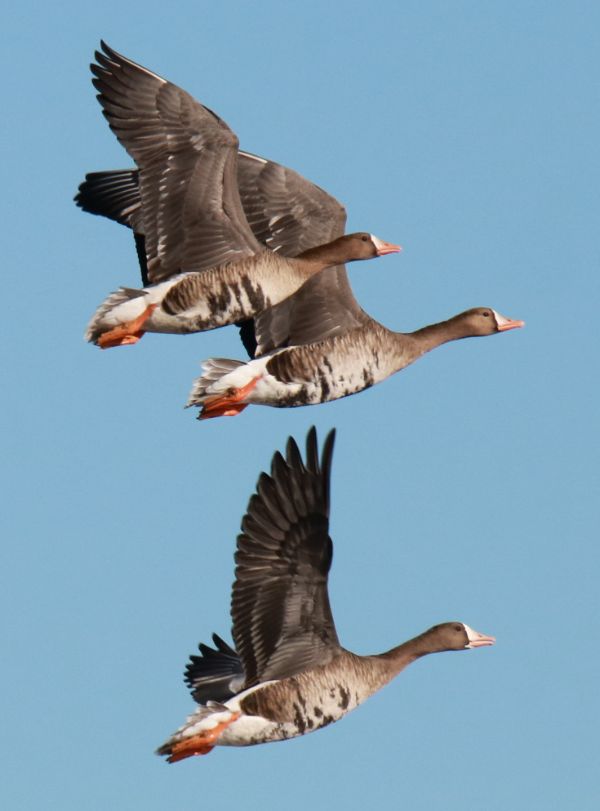
A second spring breakthrough of Snow Geese and other waterfowl broke through Thursday with almost constant flocks flying northwest. Primarily Snow Geese, but the first flock I viewed was a serious mix of Arctic nesting geese – White-fronted Geese, Cackling Geese, Ross's Geese, plus blue morph and white morph Snow Geese – what a great way to usher in a "repeat migration" event in south-central North Dakota. There were plenty of raptors headed north too, including 8 Bald Eagles, 3 Rough-legged Hawks, 1 Red-tailed Hawk, 1 Merlin, and 3 Northern Harriers that included 2 males and the first female of spring.
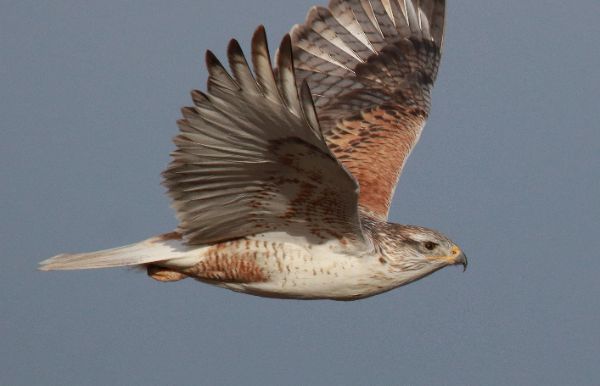
I also encountered a couple hundred Northern Pintails in 2 meltwater mashes accompanied by a few Mallards, with an associated flock of about 60 Cackling Geese, a couple White-fronted Geese, and some Canada Geese with a few more Northern Pintails and Mallards. I also witnessed my first Ring-billed Gulls in the state in 3 groups of 2, plus 4 Western Meadowlarks, and 1 American Robin. The sighting of the male Ferruginous Hawk on the low hill near the nest was a welcome sight because I didn't see any sign of the hawks the day before during a drive by. In fact, after passing by the male and turning around a mile to the south, the female was just landing next her mate on the little hill – hooray!
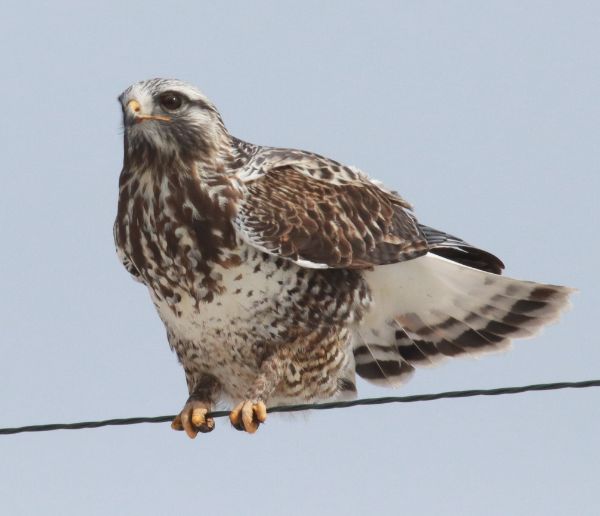
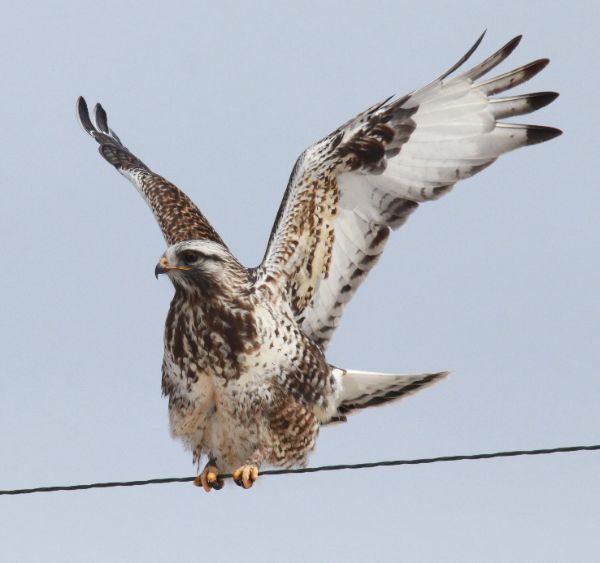
The previous day I cruised to Fargo, but only a couple small flocks of Canada Geese were evident, along with a few scattered pairs of Canadas checking out territory possibilities. I took a different route during the first half of the drive to the big city to check on the possibility of Bald Eagles gathering in the area north of Hecla, but I didn't see any eagles there. Along the way, I did see widely scattered raptors that included 6 Bald Eagles, 2 male Northern Harriers, 2 American Kestrels, and a beautifully marked male Rough-legged Hawk that provided some nice photos as it balanced rather precariously on a communications wire. While I have a personal aversion to wire perches in my photos, this hawk was just too beautifully regal to pass up – plus it was very trusting. As I photographed, it was clear the hawk had a mission, and to my delight it slowly spread its wings high and took a short downward flight to catch a vole in the short grass below, providing a nice photo series and the photo of the week.
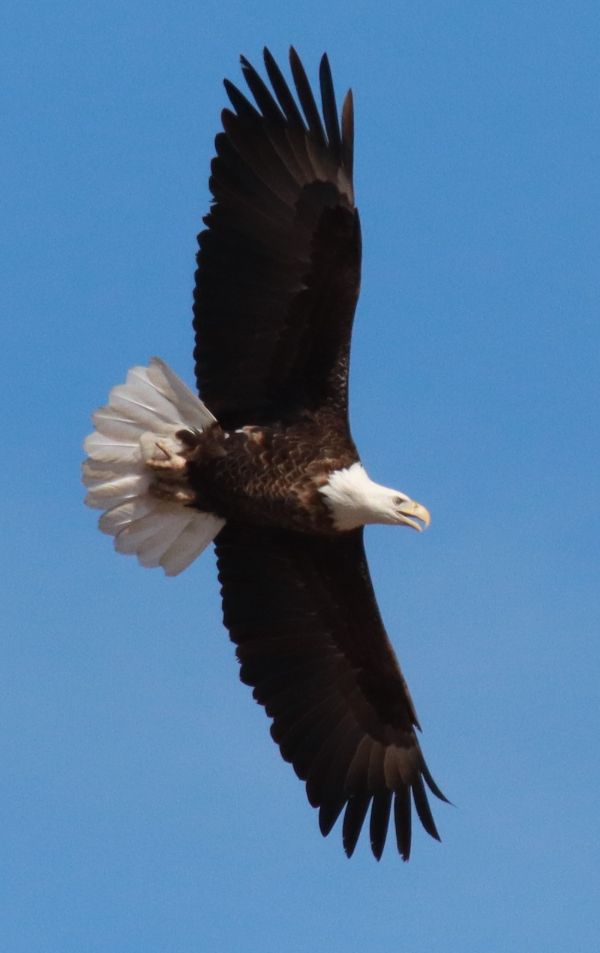
Scattered Snow Goose flocks were migrating in a northwest direction as I drove south of home Friday, and I counted 6 migrating Bald Eagles, of which 4 eventually assembled into the same airspace, circling in a thermal as they passed overhead – a great birding event. There was also a male Northern Harrier on the move, and an American Robin, but no meadowlarks – and no Ferruginous Hawks on territory that I could see.
Saturday, after 4 days with high temperatures in the 50s and 60s, ducks began to use shallow meltwater ponds and the melting edges of larger wetlands. Starting with the first sighting of a male Lesser Scaup, an especially interesting find was a mixed flock of 6 Ring-necked Ducks, 2 Lesser Scaup, a beautiful Common Goldeneye, and a Northern Pintail – all males. At nearby Melody's Marsh, the meltwater edges attracted the first pair of Mallards and 3 scattered pairs of Canada Geese; plus 11 Ring-billed Gulls and 2 American Crows. However, there were very few flocks of migrating Snow Geese Saturday, and only 1 Bald Eagle, but a breakthrough number of 3 Red-tailed Hawks, 1 female Northern Harrier, 7 Western Meadowlarks (singles or pairs), and scattered Canada Geese, mostly in pairs at meltwater ponds.
Sunday there was a minimum of avian action to the south of my office: 1 male Northern Harrier, 1 adult Bald Eagle, 1 Red-tailed Hawk, and a few scattered pairs of Canada Geese. But 2 miles north of the office a nice flock of White-fronted Geese was circling Bobby's mostly frozen marsh as a second flock pressed northward, as did several flocks of Snow and Ross's Geese. There were also 2 more Red-tailed Hawks to the north, and at Melody's Marsh the pair of Mallards was still present, along with pairs of Canada Geese; and a dozen Ring-billed Gulls were on the hunt along the ever-growing open water on the perimeter.
After not seeing either of the Ferruginous Hawks for 3 days, I unofficially wrote the pair off as abandoning the nest site – 3 strikes and you're out I figured. So I wasn't even going to check back on the nest site Monday, but as I was about to head home at mile 8, I decided I had plenty of time and the sky was clearing – what the heck. And as I approached the nesting territory, almost immediately I sighted the male Ferrug standing in bright sunshine near the road! Yahooo! Was I ever glad to be wrong!
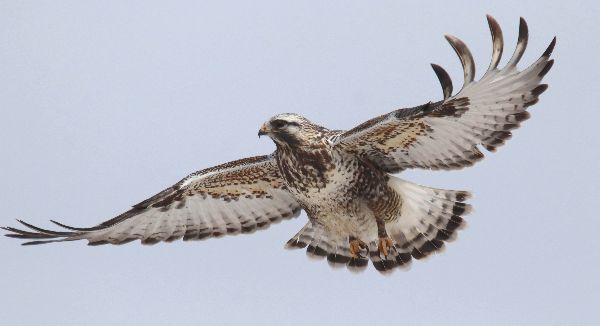
About a mile after I passed by the prairie hawk, I reversed direction to head for home, but from a distance I saw the Ferrug take flight into the south wind and wing low toward my northbound direction. All I could do was look in my rear view mirror to make sure there were no vehicles coming as I simultaneously lowered my passenger side window and stopped the car. I raised my camera and waited 2 seconds for the graceful hawk to fly by! Click, click, click, and it was past my open window – but I managed a couple quick flight photos in focus – double yahooo! Up to Monday, I didn't try to photograph the territorial hawks for fear of alarming them in any small way, and I will continue with that plan with the hope the regal Ferruginous Hawks will persist at the site.
All that was activity happened after spending time photographing incoming geese where a large flock of about 200 White-fronted Geese were feeding with a few Cackling and Canada Geese mixed in. Ring-billed Gulls were present at 3 marshes along the way in numbers around 40, 70, and 10, and flocks of male Red-winged Blackbirds were active in a couple locations, with some acting as if they were selecting territorial perches in small cattail marshes. There were a couple Red-tailed Hawks and 2 male Northern Harriers too, with the welcome sounds of robins singing when I returned to my office.
Yard Birds: Throughout the week, the male and female Downy Woodpeckers provided regular sightings as the female fed at the seed feeder, and the male preferred the suet feeder, as always (they were always present at different times). Occasionally, the female Hairy Woodpecker checked the ash tree near the feeders for morsels, but ignored the feeder foods available, as usual. Friday there was a rare visit by a male Hairy Woodpecker at the tube seed feeder. Rarer yet was a male Hairy that fed at the suet feeder Tuesday morning – an apparent newbie.
A special new yard bird last Thursday was the first American Robin of the season, a male of course, perched in the ash tree adjacent to my feeding station. Another male robin was searching the front yard Friday morning, and 3 or 4 were interacting vocally after sunset – broken by an occasional Canada Goose call nearby. New birds Saturday were Dark-eyed Juncos, which are wintering birds some years, but they were noticeably absent here over the winter. Robins were in sight almost all the time Saturday morning, searching the soggy lawn for morsels left after the snowmelt. Through my bay windows I also observed a Ring-billed Gull and a small flock of Snow Geese.
Sunday a couple juncos led to a dozen juncos in my front yard, along with a single Redpoll, all while 20 juncos were spread out across my backyard. There were no robins in the area, but at least 1 Blue Jay was sounding off 100 feet to the south. Although there were shelled peanut halves in the platform feeder, no visits were made by jays (again). I saw no robins Sunday, but I heard a couple after sunset, which may have been birds that just arrived. Monday up to 10 Dark-eyed Juncos were feeding on the ground around the feeding station. Throughout the week, 2 Red-breasted Nuthatches and 2 White-breasted Nuthatches were daily visitors to the tube seed feeder, and it seemed like the House Finches, which numbered 8 or so at times, were becoming ever-more territorial at the tube feeder.
Overall, the early flocks of geese have been refreshing, but there hasn't been a true goose migration yet, nor have any flocks of Snow Geese stopped to feed and spend some time feasting. As more ice melts, many more ducks will arrive in this nesting haven for a dozen species, that seconds as a migration stopover for 16 species of ducks. Similarly, Red-tailed Hawks are just breaking through, and Bald Eagles and Northern Harriers should build in numbers too, with more nesting pairs of raptors arriving too. In fact, as I was putting the finishing touches on this issue of The Birding Wire, some familiar calls alerted me to poke my head outside to see the first flock of Sandhill Cranes of the season soaring overhead. There will be exciting birds to enjoy on a daily and weekly basis as spring progresses, and I hope you are having some special early spring migration sightings too.
Article and Photos by Paul Konrad
Share your bird sightings and photographs at editorstbw2@gmail.com