
In Search of Spring, last Wednesday morning I pointed my car south looking for the most obvious signs of spring migration – flocks of Snow Geese flying north. A mile south of home a potential migrant flew above the road in front of me – a male Northern Harrier. The frozen marsh at mile 7 showed 5 new arrivals – Canada Geese – and a dozen miles farther south an adult Bald Eagle was also a pretty obvious potential migrant. It appeared the day had high potential to find a true vanguard of migrants, and at mile 19 I was shocked to see a bright yellow color beaming from the edge of a tree grove. I needed to double-check what I thought I had seen passing by at 60 mph – a super-early male Yellow-headed Blackbird (!) – usually the last blackbird species to arrive rather than the first blackbird of any kind this far north.
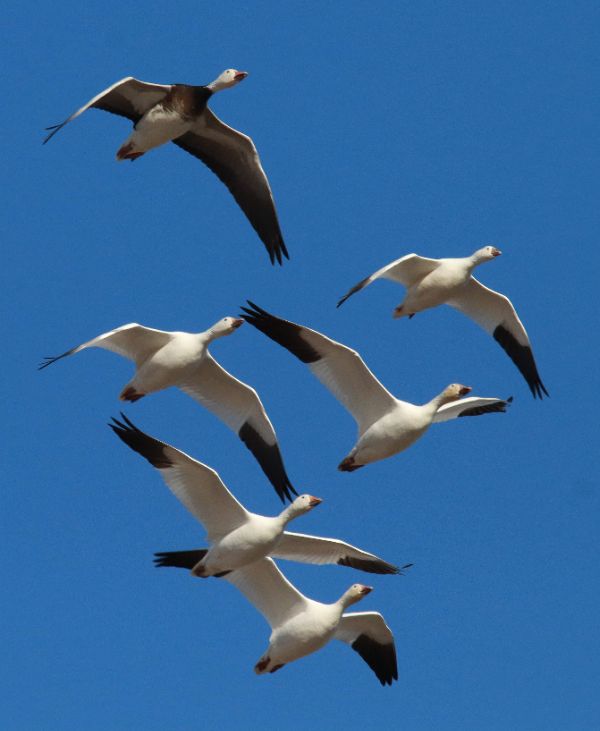
Moments later I observed the first small flock of about 25 Canada Geese flying due north in a V-shaped wedge that just crossed the border from South Dakota into North Dakota – the first of a dozen flocks of Canada Geese headed north that I would see during the next 45 minutes, along with a large flock of Northern Pintails and 2 smaller flocks of Mallards. But the breakthrough sighting would take place several hours later as I topped a hill above Red Lake (east of Chamberlain, South Dakota), when I gasped and involuntarily said out loud: "Oh my!" My first guess was a million Snow Geese, but that was when I was still in a bit of shock at the scene before me. When I regained my senses it was clear there were tens of thousands of Snows!
It was perfect timing as I approached the lake on a dirt road that was dry enough to venture closer to the water because that just happened to be when the Snow Geese began flying out to feed, thousands at a time, with almost hidden Ross's Geese mixed among the Snows. What an experience it was, with the sky seemingly filled with geese at times and the all-encompassing sound creating a roar as the geese flew from the lake, overhead, then east. As soon as one mega-flock passed, another would rise up from the huge flotillas of Snow Geese that covering expanses of the blue water. This was indeed the kind of "spring breakthrough" I was looking for to make my "search for spring" a success! But this wasn't the only mega-group of geese.
After seeing scattered small flocks of White-fronted Geese and Canadas on the way to the crossroads at Plankinton. As I filled gas there I saw a cloud of geese a couple miles to the south, so quickly headed that way only to meet the expansive flock of Snows with a sprinkling of Ross's Geese among the thousands and thousands of geese flying north. And that's when I joined the migration northward as the sun was nearing the western horizon. First I followed the Snow mass, eventually catching up and driving in the midst of the overhead flocks stretching out on both sides of highway. The mega-flock was about a mile wide and several miles long (5 miles long?), and while I wasn't trying to stay in contact with the group, it worked out that way for almost a half-hour, until the dimming skylight failed to distinguish the migrating geese south of the town of Huron.

The fields surrounding Huron and Redfield are annual stopover locations for migrating geese that feast on the leftovers of some of the richest corn fields in America. The geese probably made a stop in the Lake Andes area near the Nebraska border, and before that, the Platte River Valley much farther south in Nebraska. These geese may continue north to Sand Lake National Wildlife Refuge, a major stopover site along the James River in northern South Dakota, before spilling into North Dakota and the vibrant lakes country surrounding my home and office to the northwest. Actually, these geese may pass straight north into the Devils Lake region, while the geese at Red Lake are directly south of my home territory lakes and may end up in my neighborhood for an extended stopover with many more geese.
Of course, the next question was: When will Snow Geese break through to my neighborhood? Or did they break through while I was searching farther south Wednesday? Thursday was shrouded by dense fog all night and day until late afternoon, and as the sun chased the clouds away I did a short drive 7 miles south and a like distance north. A couple hundred yards south of home 3 Giant Canada Geese flew low toward ice-covered Melody's Marsh, and just 2 miles south a flock of more than 100 Snow and Ross's Geese was flying low to the east, as was a flock of about 70 Snow Geese 4 miles south of home. A lone drake Mallard also flew solo 2 miles from home – the first I've seen in the state this spring.
To the north, at the 5 mile mark 2 Bald Eagles were perched (an adult and a 4th year sub-adult), and a mile farther north 4 Giant Canada Geese were flying low in an easterly direction. So there were Snow Geese in the area, the first! And near sundown, as I was working in my office, the first solo calls of a Canada revealed its nearby flight. My next location check will be Sand Lake Refuge, but not until Friday's snowstorm passes.
Southwest Geese & Raptors: Actually, the above description of my Wednesday birding drive into SoDak only included the beginning and end of the day. In between, I drove south to Pierre and south of Interstate 70 before turning east to Chamberlain and Plankinton along I-70. During my drive south to Pierre, I was interested to check on raptor migration along with goose migration. Just south of the border I encountered the first flocks of Snow and Ross's Geese, plus flocks of White-fronted Geese between the towns of Harreid and Selby. That's also where I re-found the mostly white-tailed Harlan's Hawk that I photographed 3 weeks earlier.

But it turned out to be a long drive without raptors or geese to view until I was a dozen miles east of Pierre. There I sighted a fine female Rough-legged Hawk, followed by a familiar dark morph Harlan's Red-tail that wasn't present 3 weeks earlier, but was on winter territory during my pre-Christmas raptor survey. Just a couple miles outside of Pierre, 2 raptors were perched along a side road – the first was a rufous morph Harlan's Red-tail, and the second was a dark morph Harlan's Red-tail. The rufous hawk was identifiable by its uniquely colored plumage and tail feathers, and it was especially interesting that it moved about 20 miles west-southwest from where I observed it 3 weeks earlier! (I really enjoy having a chance to study the behavior and movements of individuals that are naturally color-marked.)
Although I didn't do a true "SoDak winter raptor count," I did find 29 raptors during the day, including 7 Bald Eagles, 1 Golden Eagle, 2 Rough-legged Hawks including a dark morph Rough-leg, 14 Red-tailed Hawks including the 4 Harlan's Red-tails I mentioned above, and 5 Northern Harriers. I also found a Great Horned Owl incubating in a former Red-tailed Hawk nest, and a Bald Eagle pair was nesting in a regularly used eagle nest. It was interesting to see both adults lying atop the nest with their white heads poking above the nest branches on opposite sides of the nest. Thereafter I drove east with hope of finding migrating Snow Geese east of the Missouri River, and that's when I found the mega-flocks at Red Lake and others beyond. It was quite a day afield!
Saturday Borderlands: Saturday morning sunshine pressed me to drive to Sand Lake National Wildlife Refuge and the Hecla marshes to get another update on the progress of early, early migration. I probably should have returned to my office long before seeing the first bird 50 miles southeast – a first-year Bald Eagle migrating north, but after a couple days in the office due to poor weather, I had a head of steam that kept me going. The first half of the refuge didn't improve the promise of birding success, with only a pair of Canada Geese and a trio of Bald Eagles on the ice. But a couple miles south, an opening in the James River ice was surrounded by hundreds of White-fronted Geese with a section apparently reserved for Canada Geese.

A bit farther south, a mixed gathering of Cackling Geese and Canadas was loafing and bathing on each side of the open river channel – a wonderful sight close to the road. Next was another Bald Eagle, this one in flight, and a Northern Harrier following the river course north. But more White-fronted Geese were assembled a couple miles south of there, with hundreds of Northern Pintails and some Mallards among them a short distance beyond the geese. That's when I began to enjoy some photo action as small groups of drakes pursued a single female in mating flights, which expanded to much larger flocks of seemingly paired pintails taking flight to unknown destinations.
Thereafter I reversed course through the refuge and headed for the Hecla area, checking a few Bald Eagle nests along the way. Three eagle nests were topped by an incubating adult, and 2 had adults perched nearby, all on the South Dakota side of the border. Overall, I observed 19 Bald Eagles during my drive, including 4 in my local area as I returned home. In fact, as I was approaching home, an adult Bald Eagle was perched 4 miles south, and about a half-mile south of home I watched the flight of an adult Bald Eagle that flew right over my yard, which I could verify because it flew directly over the tall spruce tree in my backyard – how exciting!
Other raptors of the day included 4 Northern Harriers, 2 Rough-legged Hawks, and an early male American Kestrel (26 total raptors). It's also interesting to note that I didn't see any Red-tailed Hawks, unlike my birding drive 3 days earlier, where 100 miles farther south Red-tails were the dominant raptors: 14 Red-tailed Hawks of 29 total raptors. And there were no Snow Geese to be found, which also pointed to an abrupt line of migration advancement not very far to the south of the borderlands.
Sunday Excitement: After a number of hours of working in my office, I broke away when photo ops would be best in the blue sky and low sun of late afternoon to see what birds were present in the area. A mile south I could see a small cloud of geese rise up a few miles farther south, and while a few flocks were flying south, they and I met up with a huge flock that took flight in mass from a feeding field, numbering at least 2,000 Snow Geese with Ross's Geese mixed in. Who would have guessed this concentration of geese was present, and while I paralleled the expanding flock I expected some groups to stop at some of the goose lakes (frozen yet), but they continued south all the way to the Dakota border and beyond.
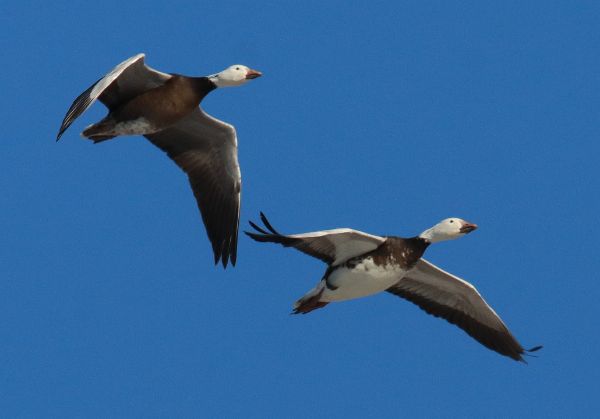
This was an expansive group of geese that extended more than 5 miles as they flew south, and they provided an absolutely exhilarating experience as I followed the geese to absorb the sights and sounds that provided a high degree of enthusiasm for me to stop and photograph when timing was best. It's exceptional to view the blue morph Snows mixed among the white Snows and smaller Ross's Geese – all moving and mixing and creating unending designs in the sky that continuously melded into the next design ever so fluidly. During these migration episodes the geese exude such a dramatic life force in their numbers, actions, and a combined multitude of calls that create a true force of nature that enlivens everything around them.
Along my 20-mile return drive, a small flock of 8 Canada Geese was resting next to a shallow meltwater pond, and an unexpected pair of Common Mergansers flew overhead near a trio of Mallard drakes. Although I did see the first American Crow headed north, I didn't see one raptor until I was 3 miles south of my office, where 5 Bald Eagles materialized (4 adults and a beauty of a second-year immature). I spent a little extra time to see what the eagles were up to, and during that period a Merlin zipped by.
A mile farther north it was interesting to witness something of a changing of the guard when I noticed a lone Snow Bunting within sight of the first American Robin of spring in the area. During that same period near the eagles, I watched a parade of continuous flocks of Snow Geese flying southward a few miles to the west. The parade extended for more than 10 miles and continued after I returned to my office to resume work – what a fun ending to 2 dramatic Snow Goose demonstrations.
Bay Window Birds: Friday morning a male Downy Woodpecker foraged along the trunk of one of the tall ash trees in my yard. And a female Downy came to the seed feeder late Saturday afternoon and Sunday morning, immediately followed by the female Hairy Woodpecker that only searched the bark of the ash tree adjacent to the feeders, as usual. Sunday a male Downy arrived at my ash tree, searched the bark for morsels, and fed at the suet feeder thereafter. Also Sunday morning, the calls of Snow Geese alerted me to flocks flying outside in long skeins that numbered more than 100.
Another flyover was the Bald Eagle I observed Saturday that I had the chance to see flying above the tall spruce tree in my backyard – a big surprise even though there was an obvious Bald Eagle migration in the area late that afternoon. Another bay windows observation Monday was a flock of about 30 White-fronted Geese, the first White-fronts I've seen on the North Dakota side of the border; as was the first Red-tailed Hawk flying north, sighted from my office chair Tuesday afternoon. Moments later, a Blue Jay called and flew into view.
Throughout the past week at least 2 Red-breasted Nuthatches and 2 White-breasted Nuthatches were regular visitors along with House Finches. Monday proved to be a busy day at my feeders and the adjacent ash tree where woodpeckers were the most active they have been in recent memory. Although the female and male Downy Woodpeckers visited the seed feeder and suet feeder respectively at first, thereafter the 3 woodpeckers seemed to band together into a trio of peckers – the 2 Downys and the female Hairy. This was repeated 3 times until the male fed on suet on its own late in the afternoon.
While the female Hairy didn't visit the feeders, it was especially interesting that after seemingly studying the male Downy get suet from the feeder, she actually "tried" to fly to a feeder, but she just couldn't follow through to land, even after making 3 attempts – ha! Late that afternoon the female Hairy returned, and after checking the ash tree's bark for tidbits left by the other woodpeckers and nuthatches, she tried another 5-foot flight to the feeding station, and this time flew past feeders and landed in a sumac before returning to the ash trunk – really surprising that she is so wary and so hesitant about the feeders, even though she now appears to crave the food there.
I certainly enjoyed the advanced level of migration during the past week, especially among the geese and eagles, but it's just the beginning my friends. I sure hope you are having some migration fun – it's so fresh after the limited birds of winter up here, but spring migration is just beginning for me and I'll be easily impressed when geese begin to fill my scenic landscape, along with 15 species of ducks, and eventually shorebirds and songbirds too – species after species will appear – until the first week of June – but I'm getting ahead of myself – ha-ha! Enjoy your week and enjoy the days as spring migration advances.
Article and Photos by Paul Konrad
Share your bird sightings and photographs at editorstbw2@gmail.com