
Seeing the first Northern Harrier in the area last Tuesday was a breaking point and I consider the silver-colored male to be the first spring migrant to cross north of the Dakota borderline that I've seen. And the following day, the first flock of geese showed – a mixed flock of 3 Canada Geese and 3 Cackling Geese. There was also a sprinkling of Horned Larks, numbering 1, 2, and 3, and a rare Golden Eagle sighting could be interpreted as a bird on its way north or northwest. My next step to check for the earliest migrants probably should have been to drive west to check for birds using the Missouri River as their migration corridor, but after heading west 20 miles short of the river, I turned south and made a beeline for Pierre, South Dakota.
Thursday, the weather was perfect for another SoDak winter raptor survey, and although I didn't see evidence of migrating birds in North Dakota, I didn't get far into northern South Dakota before I spied a large flock of Canada Geese flying low on what looked like a spirited northern migration push. A little farther south, I noticed more goose action, and stopped to check on a mixed flock of waterfowl resting on the open ice of a wetland. Now this was definitely a representative flock of migrants that included Northern Pintails, Mallards, White-fronted Geese, Cackling Geese, and Canada Geese! It was a small but diverse flock numbering in the 70 bird range – but what an exciting early migration find on February 12th! About 20 miles farther south was a resting flock of about 80 Cackling Geese, with a separate flock of maybe 60 Canada Geese about a quarter-mile to the north.
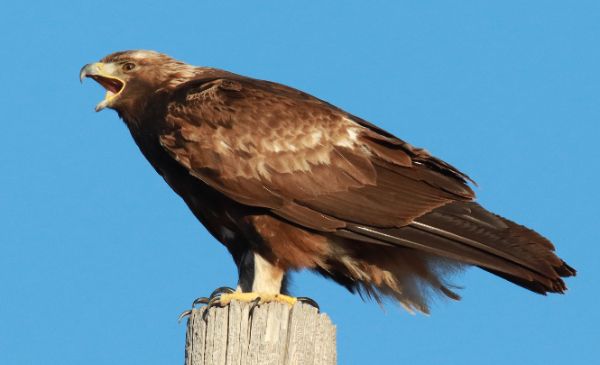
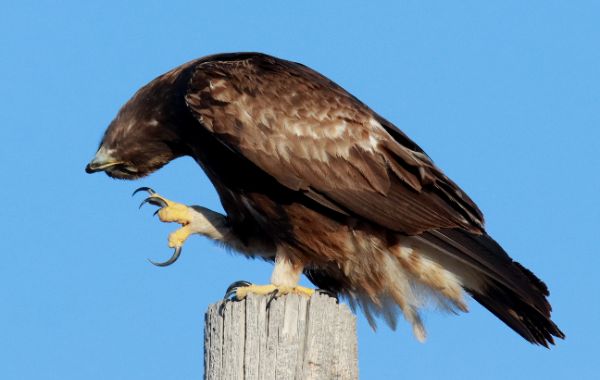
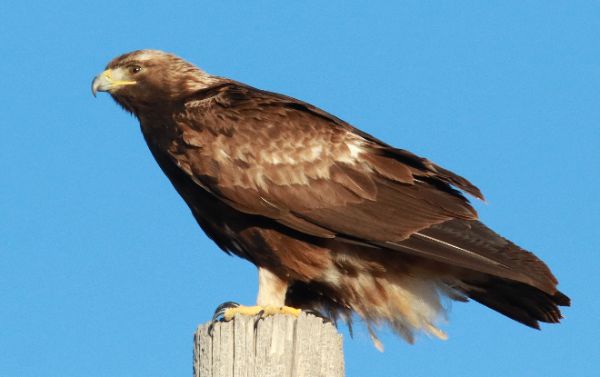
During my raptor survey 2 weeks earlier, I didn't see any raptors north of Pierre, which was a first considering I can see 1/3 of the birds of prey in that region north of the capitol city. But Thursday, I observed 2 adult Bald Eagles, 2 Rough-legged Hawks, and 4 Red-tailed Hawks – 3 of which were Harlan's Red-tails. Things were definitely looking up for a strong showing of raptors along my survey transect. But south of Pierre, numbers of raptors were significantly reduced with none showing in the Fort Pierre National Grasslands, likely due to an outflow of raptors reacting to the warmer weather and impressions of an early spring. But as it turned out, it was a matter of quality rather than quantity among the birds of prey, with a first-year Ferruginous Hawk and especially a first-year Golden Eagle providing some exciting shared time.
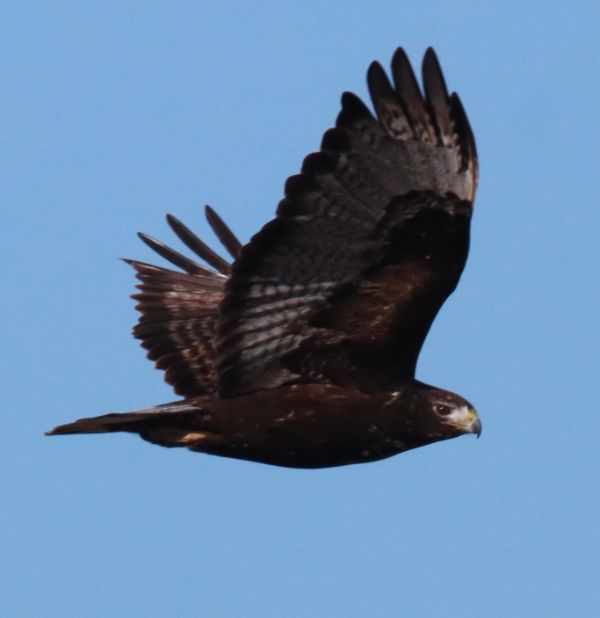
Overall, I observed 24 raptors last Thursday, February 12th, including 2 Golden Eagles, 2 Bald Eagles, 4 Rough-legged Hawks, 13 Red-tailed Hawks (of which 3 were Harlan's Red-tailed Hawks), 1 Ferruginous Hawk, 1 Northern Harrier, and 1 male American Kestrel that caught a mouse while I observed it. A total of 24 raptors and a diversity of 7 species, suggested a seasonal move out of the area, and a quick change from seeing 3 Prairie Falcons a couple weeks earlier and seeing none Thursday. During that January 30 survey, I saw no Ferruginous Hawks, Harlan's Red-tailed Hawks, or American Kestrels either, indicators of a seasonal change. But the big change was the numbers of Rough-legged Hawks, which dropped from 15 to only 4, an outflow that was probably due to the lack of snow cover and milder temperatures that might affect their migration physiology in addition to the longer daylight period now. At the same time Red-tailed Hawks rebounded with numbers almost doubling from 7 to 13 in 2 weeks, suggesting a migratory movement.
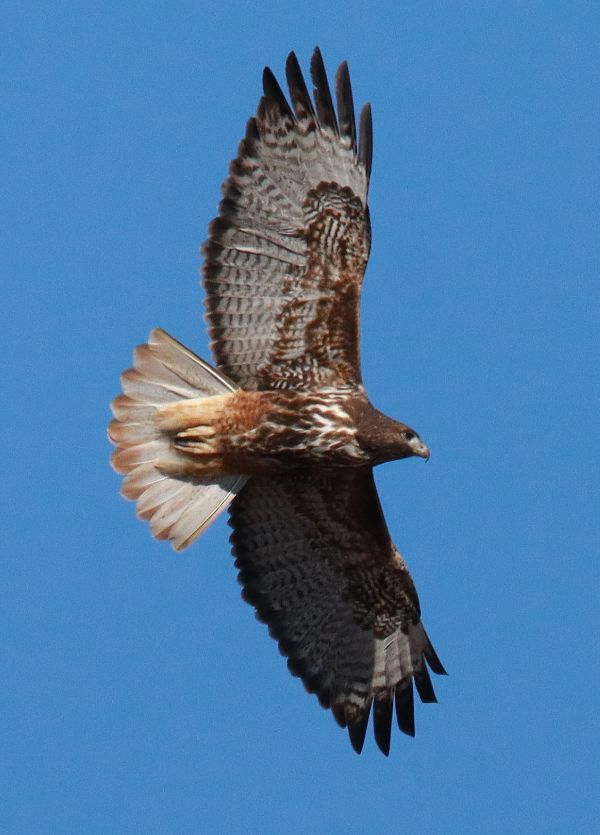
Speaking of Red-tailed Hawks, although there were no Harlan's Red-tailed Hawks sighted January 30, I found 3 Harlan's Red-tails Thursday – all north of Pierre – including 2 dark morph birds and 1 rufous morph Harlan's. I'm always fascinated by the tail color of Harlan's, and I was able to document the tail feathers of each of the trio I observed north of Pierre. One dark morph bird had mostly white tail feathers with a gray-black trailing edge. The other dark morph Harlan's had mostly white tail feathers with an orange trailing edge that was a bit more pronounced on the left side of the tail. And the 'rufous' morph Harlan's had a mostly orange tail color on the terminal half of the feathers with an interesting band of gray across the upper half of the tail feathers. All very interesting, and I also want to point out that this was the first year in many that the light-morph Harlan's Hawk was not on its winter territory after being a winter staple for several years.
A couple of the survey birds provided an opportunity to photograph them, most notably the first-year Golden Eagle that still showed extensive white on its wings and tail that didn't show when perched. This beauty turned out to be one of the most trusting Golden Eagles I have spent time with, and I was rewarded with a few simple variations on its regular stance looking north. Overall, it turned out to be a very good day observing and photographing birds of prey, with a total of 24 on February 12th, compared to 36 raptors January 30th, and 45 on December 20th. The differences in the totals among this winter's 3 raptor surveys echoed typical seasonal changes and provided some exceptional birding action.
An Ultimate Friday the 13th Surprise
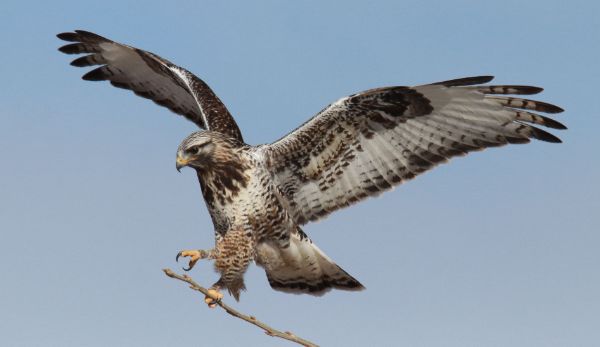
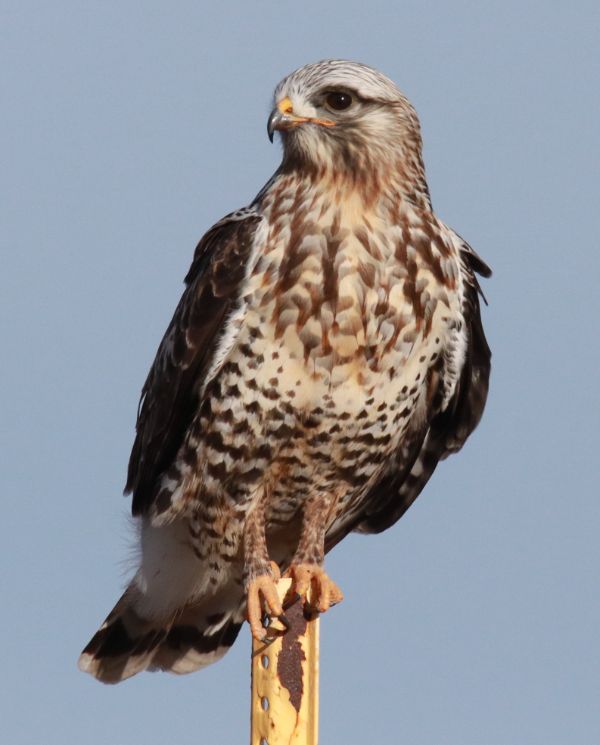
Having had a very rewarding birding trip to southcentral South Dakota, I was a bit deflated Friday and didn't expect to see much in the way of birds in my home area, yet was compelled to enjoy some time birding during the warm, sunny, windless afternoon. To make a long story short, and to refer you to the Bird Photography article in this issue, I enjoyed spending time with 2 super-trusting adult male Rough-legged Hawks actively hunting between 1 and 2 miles south of my office. Beautiful birds, very representative of the species, continually hunting or eating, and permitting me to take some especially pleasing photographs – what luck – and what a collective thrill! Who was it that dared to suggest that Friday the 13th is a bad luck day? I share a photo that reflects just how lucky I was that lucky Friday afternoon.
Similar weather and sunlight was so inviting Saturday that I took a "search for spring" drive an hour east to check on the Bald Eagle concentration area I described last March to get a baseline about when eagles would begin arriving in the area centered at Hecla, South Dakota – just south of the borderline between the Dakotas. Last year I counted a minimum of 618 Bald Eagles, but found 2 adjacent spots where a total of about another 100 eagles were present a couple days later – so there may well have been more than 700 eagles on hand during the peak concentration.
Back to Saturday: North of the border area, a pair of adult Bald Eagles gave me reason to believe there may be a few eagles on hand already, but the 55-degree temperature gave me the feeling we were in more of a mid-March migration period than mid-February. Alas, I only observed 3 more eagles south of Hecla, an immature that was flying low and an adult perched near 2 nest sites – I'll check back next month. Nonetheless, I counted 2 more single adults perched adjacent to nests, a single immature flying, and 2 immatures a first-year and fourth-year bird for 9 Bald Eagles total. Also 2 Rough-legged Hawks, 2 Northern Harriers, a flock of 15 Sharp-tailed Grouse, and scattered Horned Larks, singly or in pairs or 3s or 4s. Saturday, and throughout the week, the incubating Great Horned Owl was the only owl sighting; and Sunday and Monday were a bust for finding any birds aside from widely scattered Horned Larks, but that's birding some days – not every day is Friday the 13th, or Thursday the 12th.
Yard Birds: Male woodpeckers have dominated my winter woodpecker sightings, but late Friday afternoon I was excited by the appearance of a female Hairy Woodpecker on the ash tree adjacent to my feeding station, the first female I've seen in my yard this year! She was back on the elm tree Saturday morning, and an hour later a female Downy Woodpecker fed at the tube feeder that has shelled sunflower seeds and peanut halves a couple times. The 2 females continued to visit my feeding station the following days, but the female Hairy only forages on the elm tree, ignoring the feeders – hmm. Saturday a male Downy Woodpecker fed at the suet feeder, and stopped there the following days too.
Earlier Friday, and again Sunday afternoon I heard Blue Jays calling and added shelled peanut halves to my platform feeder – especially to try to attract jays, but I'm not aware that any swung by my yard. Red-breasted and White-breasted Nuthatches were very busy grabbing peanuts at the seed feeder daily, but I can't recall seeing any House Finches this week. With unseasonably warm weather the past week, we will return to the norm, starting with a day of rain followed by a day of wet snow, so we'll see how the birds react. Hope you enjoyed a great holiday weekend and fruitful days filled with interesting birds ahead!
Article and Photos by Paul Konrad
Share your bird sightings and photographs at editorstbw2@gmail.com