
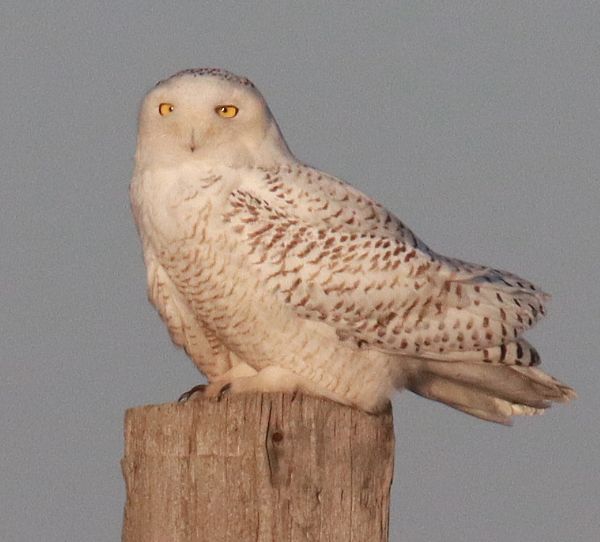
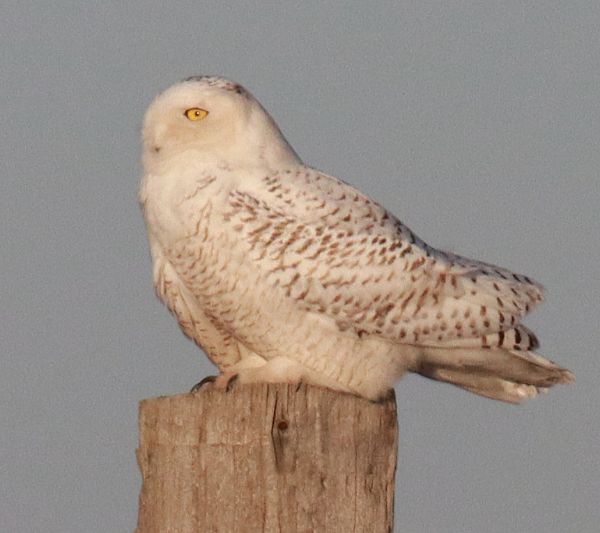
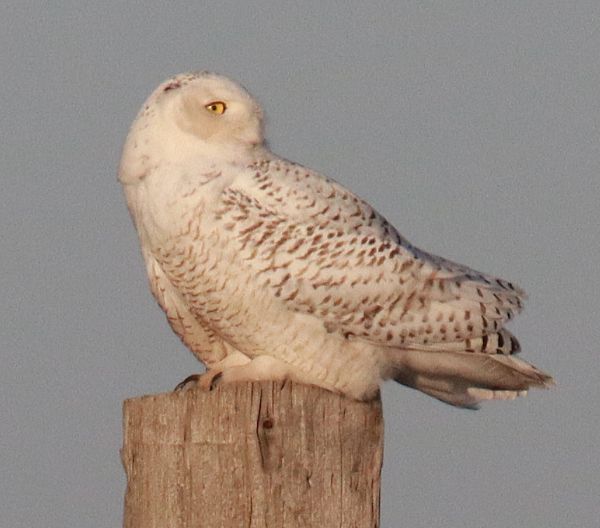
It seemed as if I had a case of owl fever today as I searched all the most likely areas where I might find a Short-eared Owl, or any owl in the area. But without a trace of any birds, I decided to double back to the east side of the 7-mile prairie south of home. On the way I encountered a yearling Rough-legged Hawk and an adult Bald Eagle – things were looking up. And when I least expected it, as I rounded the top of a low hill a Snowy Owl appeared! Perched on a sturdy fence post near the road, our eyes met and as I instinctively reached for my camera the Snowy instinctively took flight, beginning a low fluid movement on long white wings along the fenceline. It seemed the great white owl might land, and it did, providing some photographs from a much greater distance – very exciting nonetheless – for there is nothing like a Snowy Owl encounter!
Halfway along the east side of the 7-mile prairie, another owl was perched on a fence post – a Short-eared Owl that made it a 2-owl drive. A couple miles ahead I encountered a third owl – a Great Horned Owl – but this owl was positioned in an incubating position atop a nest used successfully by Red-tailed Hawks the past couple years. It was certainly a very early nesting observation considering my earliest sighting of an incubating Great Horned Owl has been the first week of March.
In response, I checked historic nesting records provided in Breeding Birds of North Dakota to get a range of early nesting records for this owl species. Although the information was a bit sparse, the earliest nesting records were cited as "late February," but that could have been in the southwest part of the state, which is significantly warmer with less snow. That leaves me to dare to believe that this might be a new earliest nesting record for Great Horned Owls in the state: February 5th. And by the way, Great Horned Owls are the first native birds to begin nesting in NoDak each year.
Three owls, 3 species, all within the last hour before sunset! And there was 1 more owl just 4 miles south of home at dusk – another Short-eared Owl. My level of excitement increased with each owl sighting, but Snowy Owls are special among any birds, especially when you can document the Arctic visitor with a photo or 2 or 3. After reporting on my friend Herb's Snowy Owl sighting less than a mile south of my office, the Snowy I encountered was perched just 2 miles east of his ranch hub, and the nesting Great Horned Owl was just a mile away. The following afternoon, Friday, the Great Horned Owl was definitely in incubating position, and although I checked all the potential hunting areas used by owls, no other birds showed, underlying how lucky I was in the area during the sunset hour the previous afternoon.
Timing is Everything
Saturday afternoon I was coming up with another zero until a flock of 17 Sharp-tailed Grouse took flight ahead of me, but after covering the recent owl hotspots I decided to recheck an extended area of prairie hills south of the incubating Great Horned Owl. This area is usually as good as any to find Short-eared Owls, as well as Rough-legged Hawks, which is not surprising because these birds share similar habitat and prey preferences. For the second afternoon in a row, I passed through the 12-mile prairie area and continued south past the 14 mile mark south of home – and that's where a small male Rough-legged Hawk materialized on a post. And within the moment a second hawk flew up from ground level to an elevated perch – hooray.
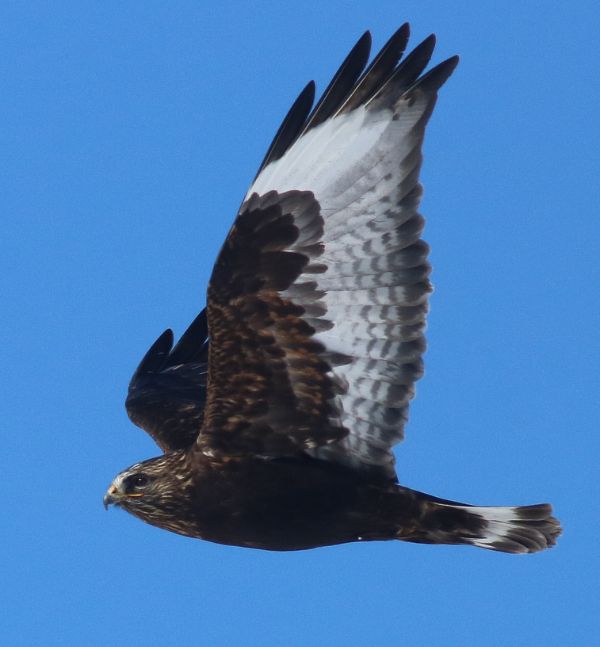
I passed by both hawks and saw the larger second bird was actually a dark morph Rough-legged Hawk, a big female. As I watched the hawks from a distance I saw the young male fly to the ground as though it was after a rodent, and the black female noticed too. She flew to a closer perch, then advanced toward the smaller hawk's position. The black hawk dipped low and the chase began, with the young hawk fleeing and pulling up in a tight vertical circle in an effort to elude the aggressor, followed by a swifter flight across the prairie hills until the dark morph Rough-legged Hawk let up.
That's when things became even more interesting as the black hawk returned to my position and landed at the closest post, which allowed me to photograph its approach and as it landed on fully spread wings and tail that acted as brakes. After a brief stop, the black lady flew out to the east where she hovered a number of times on the hunt. I continued south and after 1 more mile, another hawk was hovering, and a fourth Rough-legged Hawk took flight near the road – that totaled 4 Rough-legged Hawks within 1½ miles!
After checking the area to the south with binoculars, I turned back north, and passed the small male Rough-leg; but a mile north of it another Rough-leg was present, then another was flying ahead of me, and yet another passed behind me! There were 3 hawks in sight at this north point where none were present a half-hour earlier, and it meant there were at least 7 Rough-legged Hawks overall within 4 miles that included the black-morph female and 2 adult males – pretty exciting! Of course, I couldn't leave it the area after all that, so retraced that 4-mile drive just for fun. On the way south the only hawk was perched at the southern point (an adult male), and during the return, an adult female Rough-leg was perched on the top of a cottonwood tree at the 3 mile mark. The hawks were definitely not static, and this was a classic example of one of my favorite birding adages: Timing is Everything.
Super Birthday Sightings
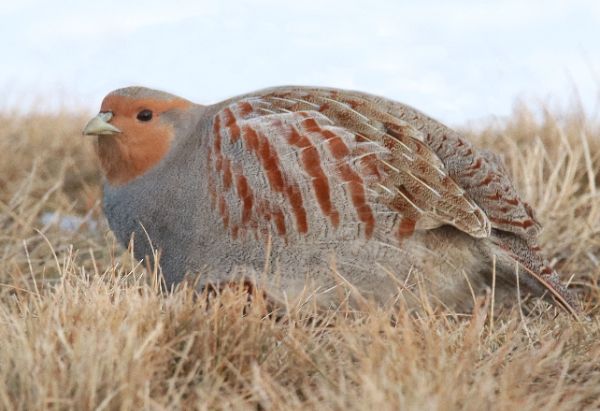
Of course, I was eager to return to the Rough-leg area Sunday, but the morning landscape was shrouded in thick fog, and I had a Super Bowl Sunday birthday party to attend in Fargo for my oldest nephew Blake, who turned 6! Of course I had to check out the surrounding bird-rich neighborhood and found 4 Gray Partridges that were feeding very low to the ground; but as I approached, a small silvery-colored male Merlin surprised me when it flew up from the ground and zoomed off to the northeast. There was another falcon nearby – a surprise American Kestrel perched high above the area where a pair nests annually. Has it returned, or was it around all winter? I think the former considering I check the area about every 2 weeks and haven't seen a kestrel anywhere in the state since the first snowfall – or in Minnesota or South Dakota either. But I saw another American Kestrel a bit more than a mile east-southeast of there, so perhaps the earliest kestrels are forging northward.
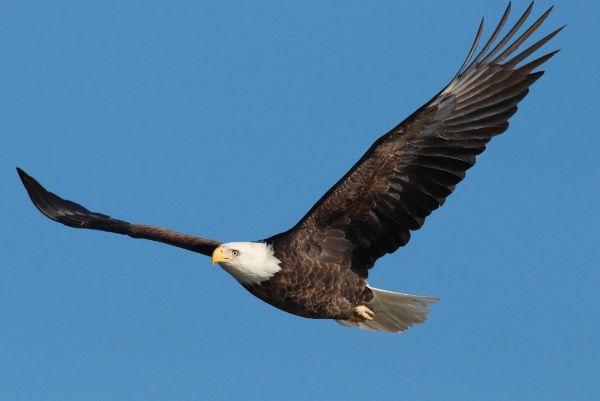
On the way to Fargo, I checked the Rough-legged Plain for birds and found a male Rough-legged Hawk perched in the distance – the first raptor I've seen in that area in several weeks. Another Rough-leg was perched about a dozen miles south of Jamestown, and a few hundred yards ahead a Common Raven was winging parallel to the highway – a rare sighting in the area. An immature Bald Eagle was soaring just after the sun broke through for the afternoon east of Valley City too – all signs that this winter was holding more birds in southeast North Dakota than normal, which has been the case this winter. With the break in the weather last week, I expect that trend will continue and improve in coming weeks – it is mid-February this weekend! That said, after cruising through all the owl and hawk locations south of the office Monday and Tuesday, the incubating Great Horned Owl was the only bird to show.
Great Backyard Birds: Excited by the appearance of a male Hairy Woodpecker at my seed feeder, I was doubly excited to hear Blue Jays calling and hustled outside to add shelled peanut halves to my platform feeder – especially for jays. But a moment later the next to arrive was a male Downy Woodpecker that fed on suet, which made me question if the 2 males loosely travel together? After another minute a Blue Jay appeared, very tentatively checking out the peanuts, grabbing, and going. A couple more visits by the tentative jay followed, and a second somewhat aggressive Blue Jay grabbed a mouthful of peanuts too before the jays disappeared. Red-breasted and White-breasted Nuthatches were very busy grabbing peanuts at the seed feeder and the platform, and House Finches were on hand too – a busy period of Friday feeder fun! The male Downy Woodpecker returned to the suet feeder a bit later, joined by 2 Red-breasted Nuthatches at the tube seed feeder – a nice combination of winter birds to watch!
Sunday morning a male Downy visited the suet feeder, perhaps the same male; and of course, I don't see every bird, especially when I'm gone for most of some daylight periods, so this Downy might stop by every day. Nonetheless, I report the birds I do happen to see when I'm at home within view of my feeding station. I certainly haven't been overwhelmed by birds this winter, but every season is different and things can change quickly as breaks in the weather lead toward early spring temperatures and new birds on the move.
Hope you enjoy some extra birding opportunities during the upcoming President's Day weekend, which includes Valentine's Day and Friday the 13th. Of course, it's also the extended weekend for the Great Backyard Birding Count that will bring the ever-growing numbers of birders worldwide together as we report our sightings on eBird periodically over the 4-day holiday period (Friday through Monday). Even on a local level, the numbers of birders have increased exponentially, especially among younger and middle-aged people across North Dakota – hooray! It's definitely a special weekend, and any time you can devote to one of your favorite activities and add information about "where the birds are" is prime time. I'm hoping to find another Snowy Owl, but will be excited to see every bird outside my windows and down the country roads: Enjoy your holiday weekend!
Article and Photos by Paul Konrad
Addendum: While taking a quick break just before publishing this issue yesterday (Tuesday afternoon), I drove 15 miles west to "Hawk Valley" to check for Short-eared Owls and Rough-legged Hawks, and was happy to see a suspected individual of one of those species in flight above the open grasslands. When I checked the bird with binoculars, I was immediately surprised to see a bird I didn't expect – my first Northern Harrier of the year in North Dakota, a silver male! There was passed a nice female Rough-legged Hawk hunting as I returned to the office, a nice bonus just 3 miles to the west.
Share your bird sightings and photographs ateditorstbw2@gmail.com