
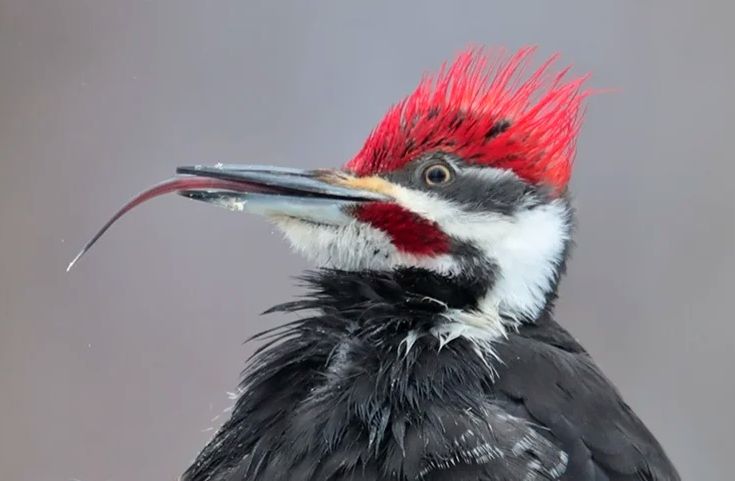
Few people are aware of just how important the tongue is to a woodpecker, but researchers have found that woodpeckers rely on their extraordinary tongue to thread into insect tunnels their beak can't reach. A typical woodpecker tongue is long and flexible enough to reach into crevices and tunnels to reach prey hidden deep inside. Clearly, drilling into wood with its beak is just the first step for a woodpecker to procuring food in bark, branches, trunks, and even beneath the ground. Two pairs of muscles guide the tongue, allowing it to move in and out, and in multiple directions when probing.
A woodpeckers' tongue is among the longest tongues relative to body size among all bird families, and woodpeckers use their tongue with remarkable precision. When not extended, the base of the tongue wraps around the back of the skull, and in some woodpecker species, the tongue stretches all the way around the skull to the position of the right nostril.
Specialized sticky saliva on the tongue attaches to insects, larvae, or other foods on contact to procure food that might otherwise escape. The tongue tip may also have bristles or backward-facing barbs that hook insects as the tongue pulls them out of a crevice. Woodpeckers' tongues have specialized keratin tips that naturally regenerate as they become worn.
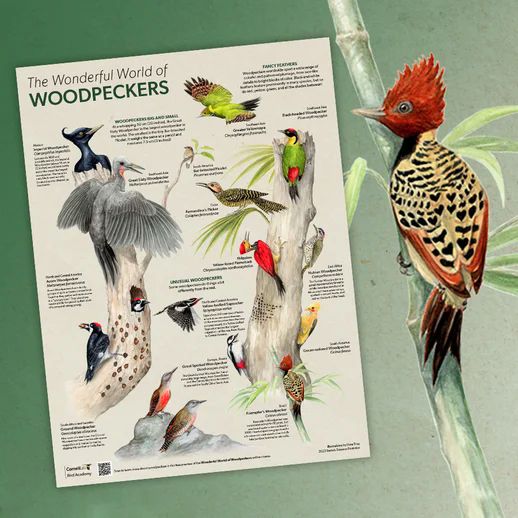
Woodpeckers are among the most diverse and interesting families of birds, numbering more than 200 different species found on 5 continents. There is so much more to learn about their fascinating adaptations, so if woodpeckers interest you, refer to the Bird Academy at the Wonderful World of Woodpeckers to look into their online woodpecker course, which is reduced in price now.
Free Woodpecker Poster
Celebrate the diversity and wonder of woodpeckers with a Free Woodpecker Poster that is beautifully illustrated and full of fun facts at Wonderful_Woodpecker_Poster_02012024.pdf. You can download and print a copy, or keep the .pdf for reference in your personal files.