
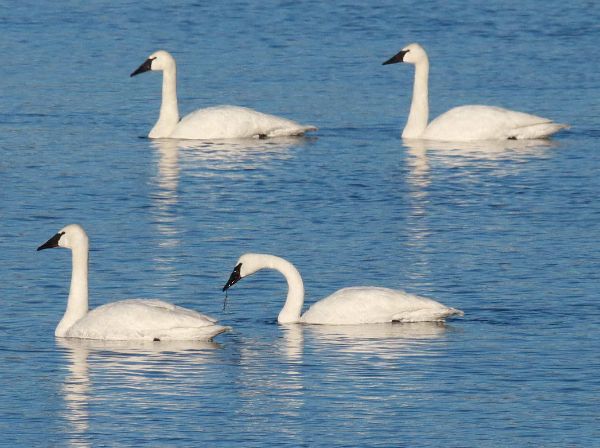
There is something about swans and snow – perhaps it's the pristine white on white effect – and when you add a beautiful shade of sky blue reflecting on the surface of tranquil water, it creates a very serene visual that takes you to a quiet place of meditation as you absorb the beauty of a captivating slice of nature. I let my body relax so my eyes could take the lead in absorbing the scene before me – aah. There were many pairs, single swans, 2 family groups, and larger loose groups that overall numbered about 70 beautiful Trumpeter Swans, swimming, feeding, bathing, preening, resting, and sleeping swans on the adjacent snow-covered ice, in what seemed to be something of a sense of community among the huge white waterfowl.
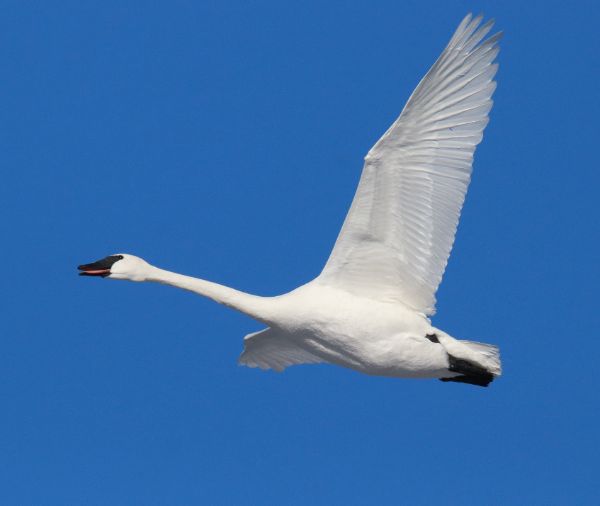
The ambiance was broken by a loud trombone-sounding call between a group of the largest of all the world's 7 species of swans. A bit of a scuffle ensued between 2 of the swans in the group of 6, with each of them rising up to spread their wings and reaching forward with their extra-long necks, and 1 of the swans even grabbed a bill-full of plumage and hung on tight for a moment as the bitten bird turned and fled a few feet with its wings flailing and the calls of many swans trumpeting to break the previous silent scene.
That was one of the overwhelming memories of my Wednesday birding trip to the area south-southwest of Detroit Lakes, Minnesota on a road I've never inspected before. The next hour proved to be so photographically rewarding that I refer you to the Bird Photography feature in this issue to expand on this introduction to the Trumpeter Swans of January on the western edge of lakes country. But this trip wasn't only about swans, there were other giants of the lakes and woodlands to photograph, starting with the 9 big birds surrounding ground-based food.
Ten miles before reaching the little pond along the Pelican River, my eyes were drawn to a low hilltop where what looked like the white head of a Bald Eagle poked above the snowy hill's horizon. With a turnoff to a farmyard between us, I braked, turned in and slowed to a crawl as I watched to see more. That's when 9 birds burst into flight before me – WoW – as 2 adult Bald Eagles and 7 Common Ravens flashed their wings before me, filling my view with panicked birds – dang. It turned out the winter birds were feeding on a carcass beyond the farm road, and while I was disappointed to have flushed the birds, especially as they were eating, I knew it could have happened when the farmer's wife drove home from work, or when a more dominant eagle flew in to claim the food.
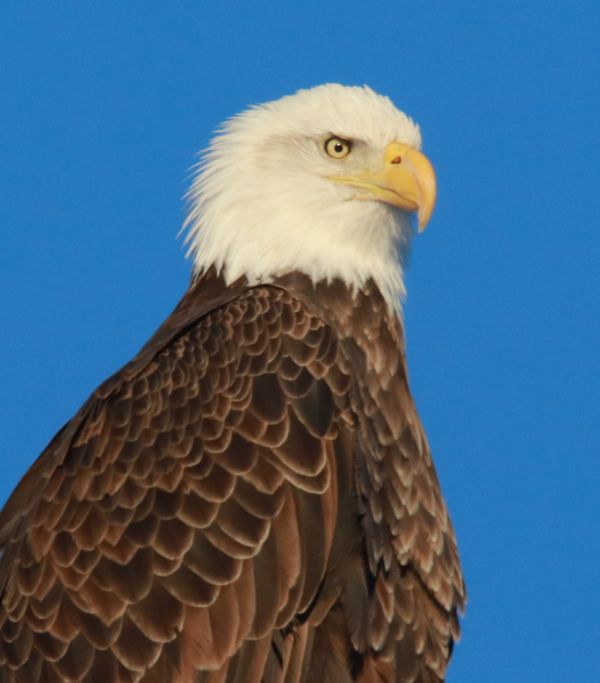
More important, I knew the big birds would return, and they did. The eagles simply perched in nearby trees, which led me to believe they would wait for me to leave and return to resume their feeding session, so I left. After my especially pleasing Trumpeter Swan photo session, I retraced my drive back to Fargo via the same road, and from a mile away I checked the hill with binoculars: Sure enough, there were 2 Bald Eagles at the feeding site, but not wanting to disturb the big raptors, I scanned the area.
Perched 4 power poles down the road, a third adult Bald Eagle may have been waiting its turn to eat, but maybe it would provide a photo op in the meantime. I drove past the eagle to get on the sunny side of its position with incident, then parked a moment to let on-coming cars go by. Seeing the eagle appeared unaffected by my car and passing trucks, I hoped it would hold its position as I approached and stopped. It worked, and it was quite amazing to be in perfect position with regard to sunlight to photograph the big Bald as it viewed the area, but only looked my way once. Not wanting to impact it if possible, I drove away after about 40 seconds and 15 photos to leave the eagle as I found it – the best way to interact with birds.
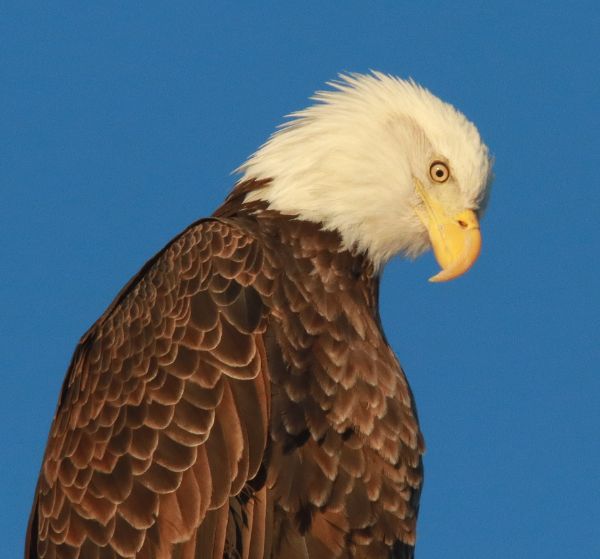
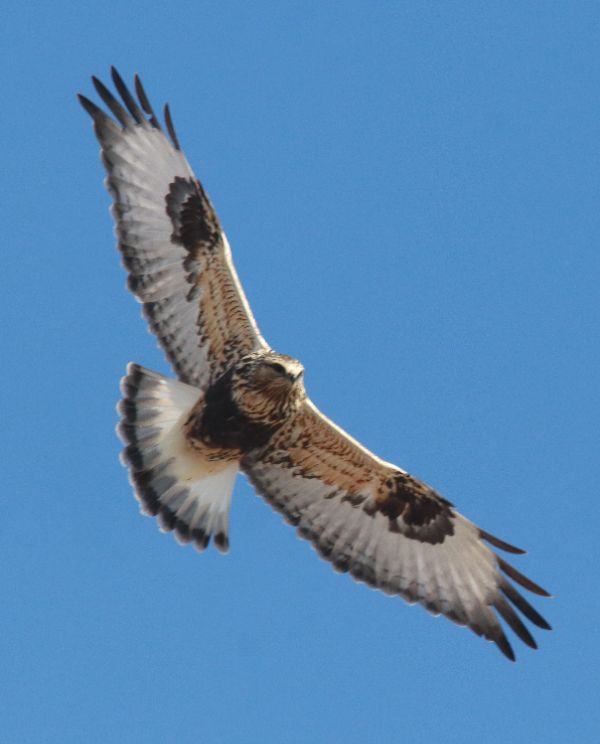
That afternoon I observed 5 Bald Eagles in Minnesota (southwest of Detroit Lakes) and 1 Bald Eagle in North Dakota, all adults. But the most interesting raptor sightings in Dakota that day were the birds that added to the continuing saga of winter Rough-legged Hawks in my area. After writing off the hawks sighted at Rainy Lake as gone, Wednesday morning a male Rough-leg greeted me where the original male was usually on site. I figured it was the same male and managed some documentary photos of it perched, but when I referred to my photos, it was obviously a different male – interesting.
There were 2 adult female Rough-legs at The Rough-leg Plain as I passed through – an encouraging sign that there were likely more in the area. While I hadn't seen any winter hawks north of The Plain, as I drove north it was interesting to see another female Rough-leg about 9 miles south of Jamestown, and an exceptionally light-colored male about 4 miles south of that city. The 3 new Rough-legs and the 2 new black Rough-legs sighted 2 days earlier indicated the winter hawks are mostly on the move, with a few in The Plain area staying for prolonged periods. The theme for each hawk has been their position in grassland habitat; and up to that point the snow cover has been at a minimum with large areas of open ground interspersed with remnant iced-snow.
Aside from the birds noted above, I only saw 1 Blue Jay and 2 female Ring-necked Pheasants, all within 20 miles of home during the 200-mile birding trip planned to observe and photograph wintering Trumpeter Swans. Speaking of home, as I write this Friday night, we are almost half-through a 4-day blizzard with temperatures dropping below zero (after 40 degree temps Monday, Tuesday, and Thursday). Normal frigid January temperatures appear to be the name of the game from Thursday night forward.
The blizzard was brightened by the appearance of a male Downy Woodpecker mid-afternoon Friday, first at my suet feeder, then an extended period searching the bark of my biggest, deadest sumac in my little grove next to the house. Saturday I had a repeat performance from a male Downy, perhaps the same one; and a male Hairy Woodpecker followed later in the day, but rather than visiting the suet feeder, it opted for seeds a couple times.
Another surprise was a tiny Pine Siskin that landed on my seed feeder last Thursday noon – the first finch of the new year. It returned a couple more times, and I hoped it might bring other siskins with it, but the northern finch didn't return thereafter. The usual feeder visitors continue to be at least 2 Red-breasted Nuthatches, 2 White-breasted Nuthatches, and a few House Finches that obviously increased in number Monday. I'm hoping for more northern finches to appear someday soon, and any newbies will be exciting – same goes for birds afield. Hope you had some interesting birds in your binocular views last week, and make a special effort to work a little birding into this week's schedule – Good Luck!
Article and Photos by Paul Konrad
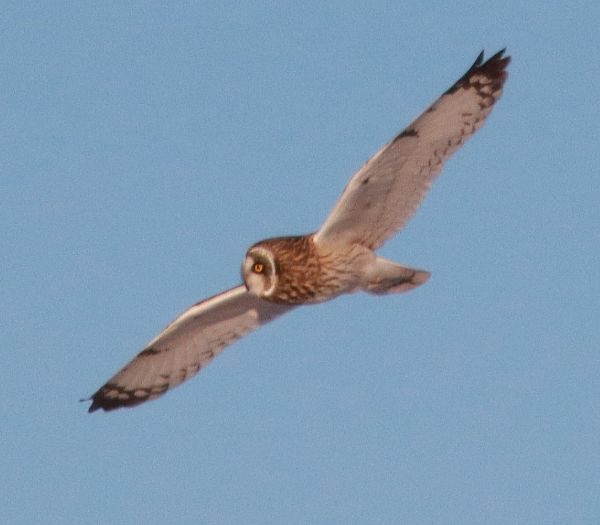
Owl Addendum: When the sun broke through Monday afternoon, I decided to see what birds I might find after the elongated blizzard period; but after an hour, only 3 single pheasants showed during my drive to The Rough-leg Plain. On a hunch, I extended my birding drive south, and from quite a distance I could see the telltale outline and flight of a Short-eared Owl – hooray! I spent extra time observing it and hoping for a photo op, and in the process 2 more Short-eared Owls appeared in hunting flights above the expansive grassland area 6 to 7 miles south. After sunset I headed back to work, but was short-stopped when I sighted a Great Horned Owl perched low near the road just 3 miles south of the office. Great Horned Owls have been pretty rare the past couple years, so I turned back to get another look. That's when an even bigger surprise greeted me – a second Great Horned had joined the first on an adjacent post! It's getting to be that time of year when the Great Owls prepare for nesting, with the first eggs laid about March 1st in this region of the northlands. How lucky it was to extend my drive a few miles south before sunset and find the first 5 owls of the year!
Share your bird sightings and photographs at editorstbw2@gmail.com