
Happy New Year and Welcome Back to weekly issues of The Birding Wire for 2026. While we hope you had a wonderful holiday period, I enjoyed some memorable avian observations, and photo opportunities, beginning back on Saturday, December 20th. After impatiently waiting for a month of days for a clear, sunny day to coincide with a day I had an open schedule to conduct my first SoDak winter raptor survey of the season. I've been doing this survey during winter months for 10 years now, during which I drive the same transect that is kinda centered at Pierre, South Dakota; counting raptors about 50 miles north and south of the capitol city.
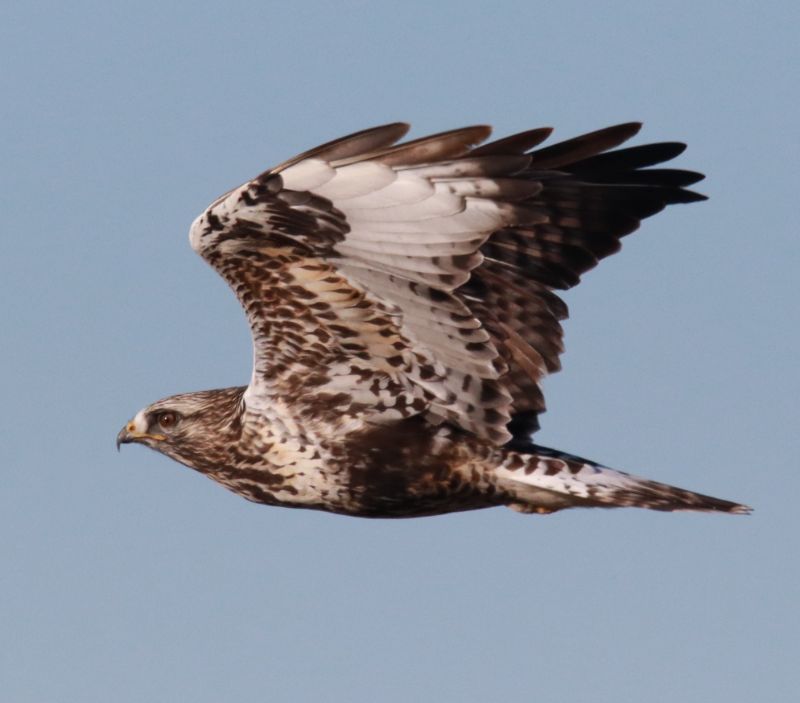
It's essentially the northern-most area where a concentration of raptors can be found in the Great Plains, and it's great fun to see what birds I find along the way, with good chances to photograph wildlife at the same time. Three impressive raptors provided really nice photographs that Saturday – a dark morph Harlan's Red-tailed Hawk, an adult Bald Eagle, and an adult male Rough-legged Hawk. As for the census, I was glad to get an uptick in total raptors over last year – 7 species numbering 45 total birds of prey (last year's December total was 29, with 55 in December 2023). Overall I observed 1 Golden Eagle, 14 Bald Eagles, 6 Rough-legged Hawks, 17 Red-tailed Hawks, 3 Ferruginous Hawks, 3 Northern Harriers, and 1 Merlin.
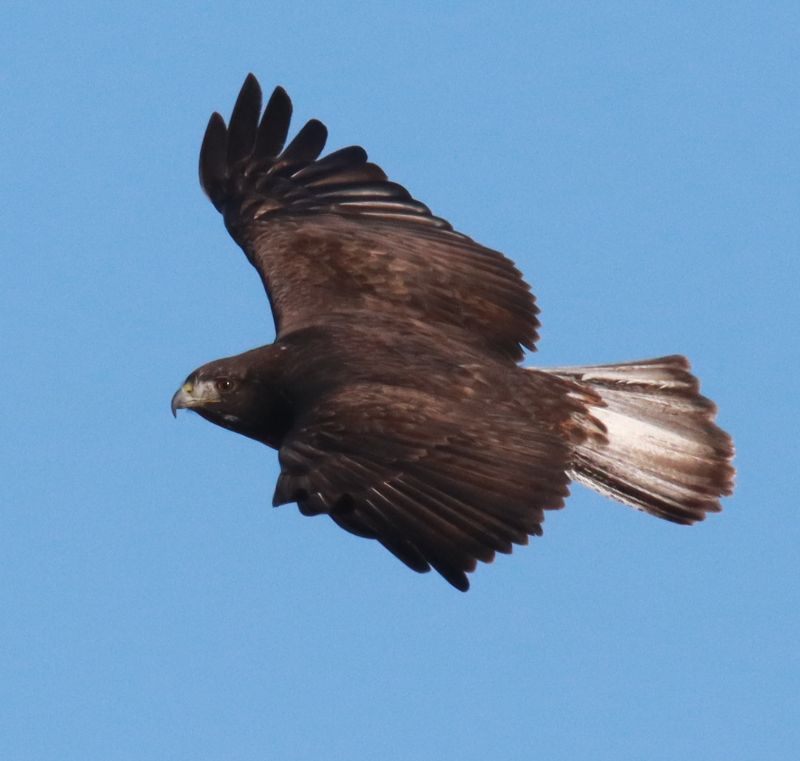
Golden Eagles were way down and can number a dozen or more, but it was kind of early for Goldens to concentrate; and no Prairie Falcons were observed, but they rarely number more than 3. Rough-legged Hawks should increase by the new year, while Red-tails and Bald Eagles traditionally decrease in the area. The dark morph Harlan's Red-tailed Hawk is an individual that is both rare and identifiable, which has made it interesting to document that it appears on the same winter territory annually. Even for a dark morph Harlan's, as you can see in the photo, it is pretty unique and identifiable due to its interesting tail color.
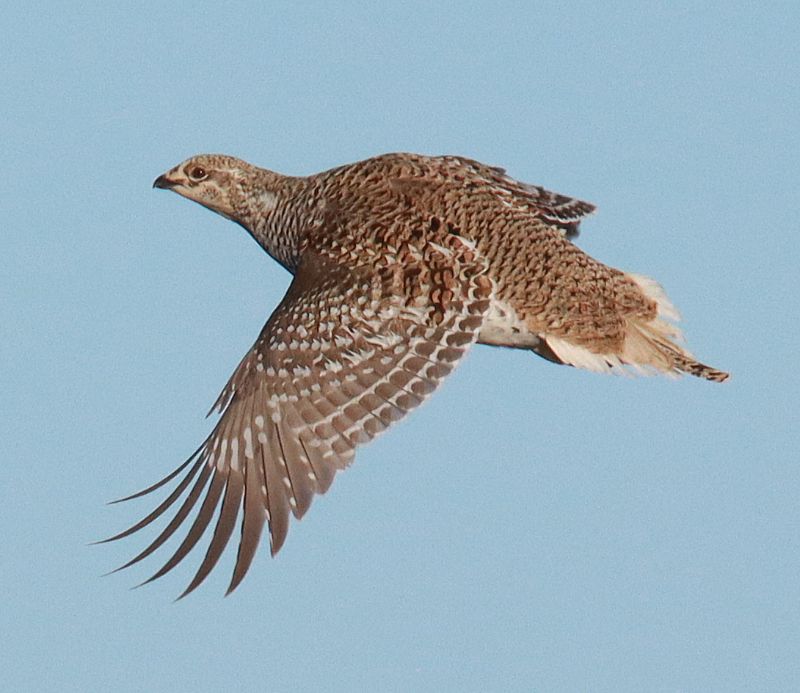
There were a few other birds along the raptor transect, including a flock of 10 Sharp-tailed Grouse and a big flock of 150 Snow Buntings. At an observation site along the Missouri River where gulls gather, a Red-legged Kittiwake was a standout among many Ring-billed Gulls and a few Bonaparte's Gulls. In open water I could see a flock of Hooded Mergansers and a single male on its own, a few flocks of Common Mergansers and Common Goldeneyes, many Mallards, a few tens of Cackling Geese, and a few hundred Canada Geese.

That Saturday birding session was so much fun that I was ready to return the next sunny day; but that quick SoDak turnaround idea changed when I encountered a group of 3 Rough-legged Hawks hunting in a 2-mile open plain just 25 miles from home. I was on my way to Fargo that cloudy afternoon, so I could only afford 5 minutes of observation time, but I would obviously return the next sunny day. In fact, I was back the following morning under a clear, sunny sky with the hope that at least 1 hawk was still on hand, but there were at least 5 Rough-legs hunting in the area, undoubtedly more considering I could identify 3 different adult males, but couldn't differentiate females except by their locations – there were at least 3 adult females, maybe more.
The important thing was that I had a chance to observe Rough-leg behavior and movements for a few hours on a beautiful winter day, and periodically each hawk provided an opportunity to photograph it in action, or at rest. The next sunny day took me by surprise when I awakened to a clear sky with bountiful sunshine considering the weather prediction was for a heavily foggy day. I was only 25 miles away from what I began calling "The Rough-leg Plain," so I was on the way in 15 minutes. It was actually foggy within 5 miles of "The Plain," but the hawks were actively hunting in the sunny open country – 2 males and at least 3 females.
The hawks weren't as active as I experienced during my first sunny visit, so after 2 enjoyable hours I decided to survey a broader area by driving west to my summer-fall "raptor route," which was raptor-less, a fact that emphasized the unique gathering of Rough-legs I was monitoring at The Plain; but I did have a chance to photograph a couple individuals on the edge of a flock of 9 Sharp-tailed Grouse. The other birds scattered along the way were Ring-necked Pheasants, which have been present along my daily drives – sometimes they are the only birds I see in the area, and they are always welcome birds to admire.
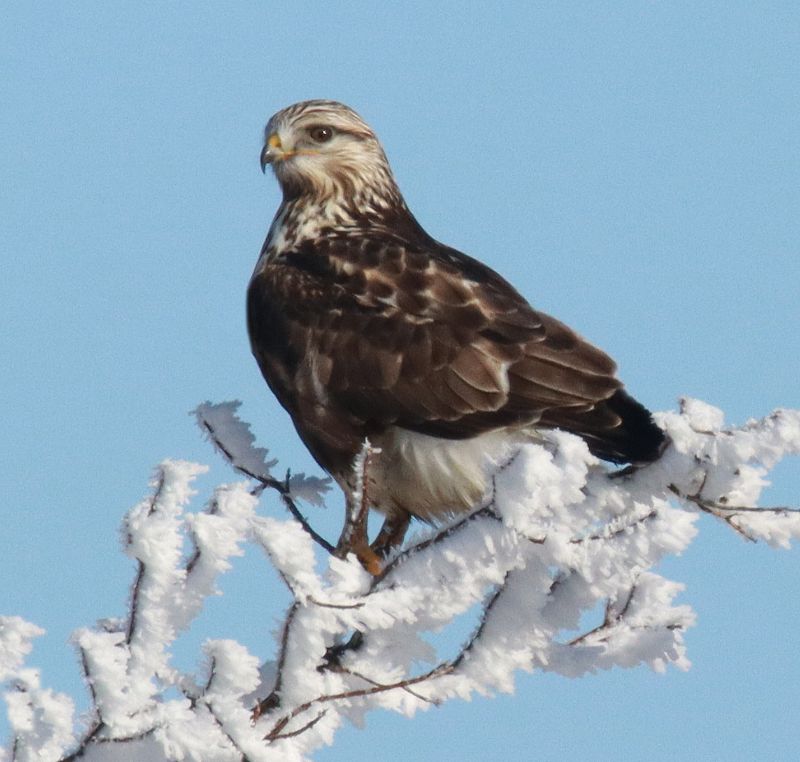
My third visit to The Rough-leg Plain was Monday, December 29, the morning after 2 nights and a day of blizzarding weather – did the hawks leave? Actually, the first bird I encountered was an adult Bald Eagle, but it seemed the Rough-legs were in hiding, or gone, until I reached the opposite end of The Plain, where an adult female Rough-leg was hunting from a perch. The regular dark-gray and white male was the next hawk to appear, then 2 more females nearer the eagle's perch. But there was more birding excitement on the way: The first Northern Shrike of winter, a young bird, appeared next; and the biggest surprise was a gray-headed first-year Red-headed Woodpecker!
It's the first Red-headed Woodpecker I've seen during winter months in North Dakota, and I found out later that it is the first sighting statewide during the month of December. It flushed from the side of the road as I was driving in search of hawks, flew low to the ground and perched only 2 feet above the snow on the side of a wooden pole. As it climbed upward, mostly on the backside of the pole, I had my camera in hand but couldn't get a photo of the fast-moving bird that flew to the next electric pole, then vanished before I could document it with a photo – darn, but what a thrill to see a favorite species long out of season.
Foggy Surprises
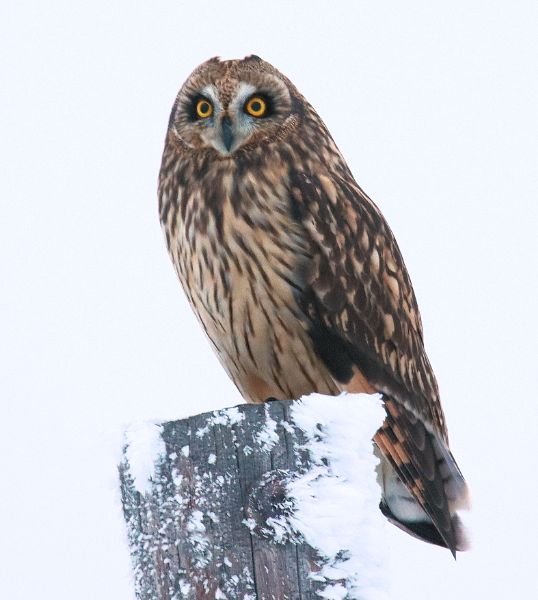
After waiting in vain for sunshine over the weekend, by late Sunday afternoon I felt the need to check back on The Rough-leg Plain, but as cloudy and foggy as it was and as rare as wintering birds have been, I was taken by surprise when a Short-eared Owl appeared before me, flying low on its long wings just 4 miles north of home. Even before I could react, a second Short-ear appeared on the wing a few yards apart. I have been alert for Short-eared Owls throughout late fall and the first days of winter, and now here they were.
As they were very actively hunting on low flights above grassy areas, I took a few documentary photos. There is something special about watching their buoyantly smooth wingbeats and aerial turns that look so graceful. One of the owls eventually caught a vole after I lost sight of the other, and I left the hunter to feed and continued toward The Plain. As I reached my friends Dave and Carol's beautiful farmstead a bird stood out among the frost-covered trees on one side of their yard. I had an idea of the species, and when I referred to my binoculars it was indeed a Merlin, an adult male – a bit too far away for a quality photo, but I documented the sighting photographically.
At "The Plain," 2 female Rough-legged Hawks were perched in the open during a quick check (January 4th) to see if hawks were still present after an initial sighting on December 23rd. After the surprise sightings on the way to The Plain my return only produced a sighting of a male Ring-necked Pheasant; but one of the Short-eared Owls was active as I passed by moments after sunset. The owl sightings pressed me to pass by home to drive a few miles south in case I might find another owl (quite a long shot!); but just a half-mile from home, my chin dropped and I voiced the words "no way."
Another Short-eared Owl was perched on a frost-covered post just a few feet from the road, on the western edge of Melody's Marsh! Under very cloudy, almost foggy conditions after sunset, I attempted some low-light photographs of the trusting owl, and while most of the photos were not very sharp, a couple made the grade, one of which I share with you here. The trusting owl was a female, denoted by her richly colored plumage, and I was glad to leave her to her frosty perch without disturbing her, but by the time I returned to my house, the Short-eared Owl was out of sight.
After expecting another foggy day, the weather predictors and I were both surprised to see bright sunshine Monday morning, so I hustled out to my car to check for any owl action, without luck. But I did find a group of 5 Blue Jays and a flock of 6 male pheasants before passing into a deep curtain of fog before reaching The Plain. One female Rough-leg was evident near the road, but the ultra-foggy conditions limited sightings there. I would suggest that the total Rough-legs in the area has probably declined by now, perhaps to 3 hawks, down from at least 6, which is not unexpected; but 3 Rough-legs is still the most I know of in the region north of SoDak. And I did see an adult Bald Eagle and a Merlin on the way back to my office.
These were not the last raptor sighting of Monday though. While upstairs in my home during an afternoon break, I peeked outside only to notice a medium-sized bird among the thick branches of my now leafless lilac bushes. As I watched, an adult Sharp-shinned Hawk materialized as it made a short flying hop to a low tree branch; but this Sharpy was an adult, meaning it was a different bird than the Sharpy that appeared outside my bay windows on New Year's Eve afternoon.
So there were at least 2 "bird hawks" that stopped by within a week, with a third Sharpy sighting on Christmas Eve afternoon – all very interesting. Other yard birds during the holiday period have been limited to the usual visitors: At least 2 Red-breasted Nuthatches, 2 White-breasted Nuthatches, and a few House Finches at the feeders occasionally; plus a couple visits by a male Hairy Woodpecker and a male Downy. Haven't seen a Blue Jay in my neighborhood since a feeder visit on December 21, but I observe a few jays periodically in tree groves at area farmsteads. Oh, but just as I was proofing this article yesterday morning (Tuesday), 2 Blue Jays flew into a tall ash tree nearby – hope they stay a while.
Well, it was quite an enjoyable holiday period, with family, while birding, catching up on some home updates, and socializing. I hope your new year is off to a fine start and I wish for a great year ahead for you, including a wealth of special bird observations through the seasons – Good Luck!
Article and Photos by Paul Konrad
Share your bird sightings and photographs at editorstbw2@gmail.com