
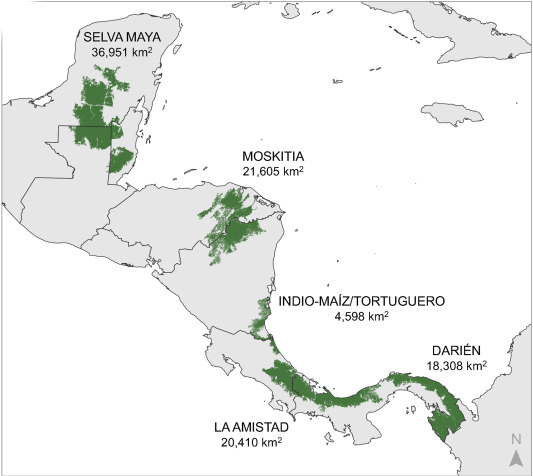
 The 5 Great Forests, located in Central America from southern Mexico to southern Panama (Biological Conservation).
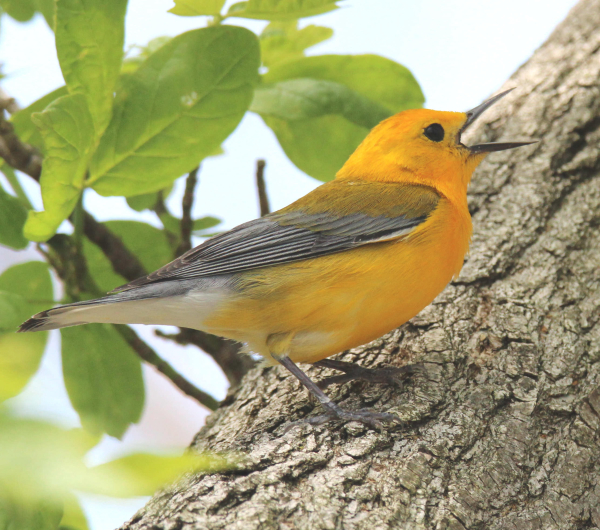 More than 40 percent of all Cerulean Warblers funnel through the 5 Great Forests during spring migration (photo by Paul Konrad).
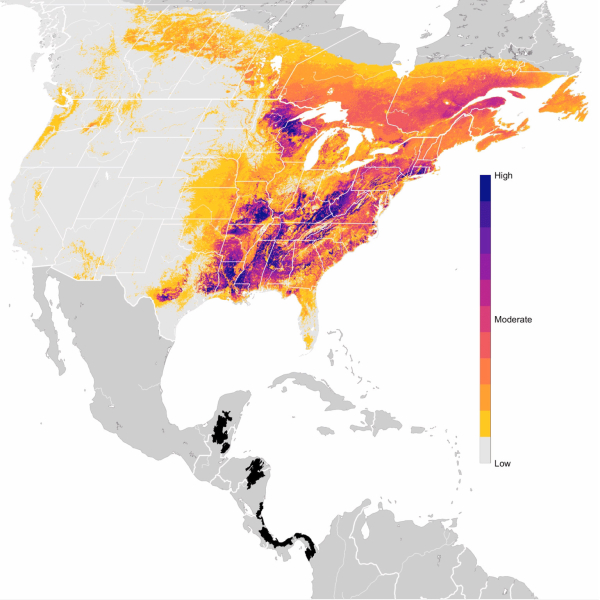 The most important nesting areas in eastern North America for migratory bird species that depend on the 5 Great Forests (Cornell Lab).
|
A new study reveals that “5 Great Forests” in Central America are lifelines for many of North America’s migratory birds. Every spring, the familiar songs of Wood Thrushes and a variety of warblers return to the woods, parks, and backyards of eastern North America. But their migrations begin far to the south in the lush, remote tropical forests of Central America that sustain songbirds and others during most of the year. The new research reveals that the 5 Great Forests of Central America – stretching from southern Mexico to southern Panama – are indispensable lifelines for dozens of migratory bird species that link the Americas.
Conducted by researchers from the Wildlife Conservation Society (WCS) and the Cornell Lab of Ornithology (Cornell Lab) by using information on where bird populations concentrate week by week each year, biologists found that these 5 forests collectively support between 1/10 and nearly 1/2 of the global populations of 40 migratory bird species, including some of North America’s most rapidly declining birds.
“What happens in Central America directly affects the birds we enjoy seeing in the United States and Canada,” said Anna Lello-Smith, lead author and conservation scientist at WCS. “These forests aren’t just tropical wilderness, they are at the heart of migration, sustaining many of our birds for more than half the year. They provide the food and shelter that allow Wood Thrushes, Magnolia Warblers, and so many others to return north to fill our spring with songs and colors.” Among the study’s most striking findings:
– More than 1/3 of all Kentucky Warblers and nearly 1/4 of all Wood Thrushes and Golden-winged Warblers spend the “winter” within the 5 Great Forests.
– More than 40 percent of all Cerulean Warblers, a species that has declined by more than 70 percent since 1970, funnels through these forests during spring migration.
– The Selva Maya forest (spanning continuous portions of Mexico, Belize, and Guatemala) and the Moskitia forest (in Honduras and Nicaragua) are the most critical tropical forests for these birds, yet they are also the most threatened, having lost 1/4 of their area in just 15 years, primarily to illegal cattle ranching.
Together, the Selva Maya, Moskitia, Indio Maiz-Tortuguero, La Amistad, and Darien form a living bridge the size of Virginia, sustaining not only to migratory songbirds but Scarlet Macaws and other tropical birds, jaguars and thousands of other species. For birds that migrate thousands of miles each year, these forests are irreplaceable rest stops and winter refuges.
“Every fall, billions of birds migrate south through the narrow land bridge of Central America,” said Viviana Ruiz-Gutierrez, Director of Conservation Science at the Cornell Lab of Ornithology and a co-author of the study. “The density of migratory warblers, flycatchers, and vireos crowded into these 5 forests is astounding, and means that each acre protected there safeguards a disproportionate abundance of birds.”
But these forests are vanishing. Deforestation, fueled largely by illegal cattle ranching, has already consumed millions of acres. In the Moskitia alone, nearly 1/3 of the forest has been cleared in just 2 decades. “If we lose the last great forests of Central America, we lose the birds that define our eastern forests in North America,” said Jeremy Radachowsky, Regional Director for WCS’s Mesoamerica Program. “But by supporting rural communities, governments, and conservation partners on the ground, we can turn the tide.”
Across the region, Indigenous and local communities are leading efforts to restore degraded land, fight forest fires, and revive bird-friendly livelihoods such as sustainable cacao and allspice production. “Imagine the possibility of linking with those efforts so that we can work together across the Americas to bring back our shared migratory birds,” said Ruiz-Gutierrez.
In the past, joint conservation efforts across borders have been limited by a lack of understanding of how birds connect habitats and people across seasons. To guide international collaboration, the study applied a framework developed by Partners in Flight and the Cornell Lab to trace “stewardship connections,” regions of North America where species that depend on the 5 Great Forests concentrate to nest.
The 5 Great Forests are tightly linked to forested areas of the Appalachians, the Mississippi Delta, the Great Lakes, New England, and around New York City, forming what researchers call “sister landscapes”: Places connected by the same bird species at different times of year.
In essence, the 5 Great Forests are the mirror of North America’s eastern forests – tropical counterparts that shelter the same community of forest-inhabiting migratory birds, from Scarlet Tanagers and Kentucky Warblers to Golden-winged Warblers and Broad-winged Hawks, during the months they spend far from their nesting ranges. Protecting and restoring these vital migratory stopovers and wintering habitats is key to ensuring the future of North America’s forest birds.
“Every acre we protect in Central America has ripple effects for birds and people across the hemisphere,” explained Lello-Smith. “The forests that sustain thrushes and warblers also support communities. We invite you to discover the tropical forests where they spend most of the year, and help protect them.”
To refer to the original article published by the Cornell Lab, see New Study Reveals Central America’s “Five Great Forests” Are Lifelines for North America’s Migratory Birds | Birds, Cornell Lab of Ornithology and you can refer to the scientific publication about the 5 Great Forests in Central America published in Biological Conservation