
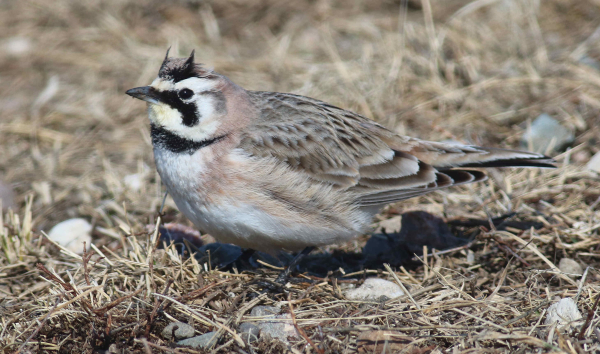
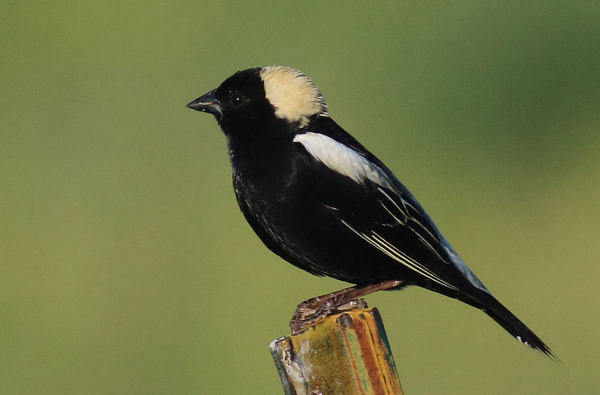
  Bobolinks and Horned Larks will be affected by current grassland trends, as described in the new Audubon plan: North American Grasslands & Birds Report. |
The National Audubon Society just published its North American Grasslands & Birds Report, a comprehensive analysis of land-use threats and climate change vulnerabilities facing grassland bird species dependent on the tallgrass, mixed grass, and shortgrass prairies in the United States and Canada along with important wintering habitat in the Chihuahuan grasslands in northern Mexico. Iconic prairie birds will be affected unless action is undertaken, including Bobolinks, Western Meadowlarks, Baird’s Sparrows, Horned Larks, and already endangered Attwater’s Prairie Chickens.
To help prioritize conservation action across these imperiled native prairies, the report identifies “climate strongholds” in North America that will provide the best habitat for declining grassland birds under climate change scenarios and ongoing land conversion.
Considering the current carbon emissions scenario, nearly half (42 percent) of grassland bird species will become highly vulnerable by the end of this century. That number drops to 1 in 12 (8 percent) grassland bird species if carbon emissions reductions surpass targets set by the Paris Climate Agreement.
“Each year more and more of North America’s grasslands disappear under the plow while our changing climate will further impact the birds of this misunderstood landscape,” said Brian Trusty, Vice President of the Central Flyway for National Audubon Society. “The good news is that we know exactly where we need to focus, who we need to work with, and how we can save this irreplaceable and quickly vanishing ecosystem.”
The North American Grasslands & Birds Report begins with a peer-reviewed assessment of the vulnerability of 38 grassland bird species under three different climate change scenarios that predict the effects of increases in global mean temperature at 1.5°C, 2°C, and 3°C. Each species was given a vulnerability score – neutral, low, moderate, and high – based on how much habitat the species was projected to lose versus its adaptive capacity to adjust to those losses.
Underscoring the urgent need to protect existing habitat and reduce emissions, 3 of 38 species are considered highly vulnerable under any scenario: Henslow’s Sparrows, McCown’s Longspurs, and Baird’s Sparrows.
“For grassland birds to have the best shot at survival, we need to get serious about climate change and immediately reduce carbon pollution. At the same time we can protect and restore grassland habitat in climate strongholds, which are places we know birds will need in the future,” said Dr. Chad Wilsey, Vice President of Conservation Science for Audubon and lead author of the North American Grasslands & Birds Report. “We must act now because the fates of grassland birds will ultimately foreshadow the fate of the grasslands themselves, along with the people and other wildlife that depend on them.”
Furthermore, the report identifies Grassland Climate and Land-Use Strongholds, key regions within North American grasslands that would retain climate suitability in all three climate scenarios as well as high land use suitability for grassland birds, based on 21st Century land-use change projections. The report also identified Vulnerable Grassland Climate Strongholds as areas with high climate suitability, but a high risk of conversion to unsuitable land uses (such as croplands, urban areas, or forests). These categorizations can be used to inform and guide conservation efforts.
For example, Audubon’s own high-priority regions for continued and expanded efforts in grassland bird conservation will include:
1. * The Prairie Pothole Region and surrounding grasslands in the Northern Great Plains (the Dakotas, Montana, and southern Canada) provide nesting habitats for grassland birds, including Bobolinks, Western Meadowlarks, and Chestnut-collared Longspurs.
2.
3. * The shortgrass prairie corridor that forms the western half of the Southern Great Plains region (New Mexico, Texas, and Colorado), that supports grassland birds such as Lark Buntings, Horned Larks, Loggerhead Shrikes, Chestnut-collared Longspurs, McCown’s Longspurs, Mountain Plovers, and Western Meadowlarks.
4.
5. * The Gulf Coast Prairie (Texas), where vulnerable grasslands inhabited by birds like Sprague’s Pipits, Dickcissels, and the endangered Attwater’s Prairie Chickens, a subspecies of Greater Prairie Chickens, are found only on the Gulf Coast Prairie.
6.
7. * The Chihuahuan grasslands (northeastern Mexico), provide wintering range for 85 percent of grassland birds found in Northern Great Plains, including Baird’s Sparrows, Sprague’s Pipits, Horned Larks, Savannah Sparrows, Grasshopper Sparrows, Chestnut-collared Longspurs, McCown’s Longspurs, and Mountain Plovers.
8.
9. “Grassland birds are down but they’re not out, and by working together with American ranchers we’re going to give them the best possible chance to succeed,” noted Trusty. Because 84 percent of the remaining grasslands are privately owned, Audubon’s grasslands conservation strategy will focus on four key approaches:
10.
1. * Technical support from Audubon staff offered to private landowners and ranchers to assist their transition to bird-friendly management practices via Habitat Management Plans, which are tailored to improve property-specific bird and grassland conservation.
2.
3. * Enhancement and protection of critical grassland bird habitat through financial incentives and acquisition of voluntary term or permanent conservation easements.
4.
5. * Catalyzing market-based incentives for grassland conservation by empowering consumers to invest in healthy grasslands through Auduon’s Conservation Ranching Initiative certification and promote emerging markets that invest in natural climate solutions, like soil sequestration. Currently, Audubon’s Conservation Ranching Initiative includes 68 ranches totaling nearly 2 million acres across 12 states.
6.
7. * Supporting incentives for grassland bird habitat protection and reduction of land use conversion through conservation-minded federal and state policies through the Farm Bill and adequately funded State Wildlife Action Plans.
Telling the story by the numbers:
* Only 11 percent of tallgrass prairies, 24 percent of mixed grass prairies, and 54 percent of shortgrass prairies that once covered portions of North America remain.
·
·* Less than 9 percent of remaining grasslands have any form of protection; only 5 percent is protected by the federal government; 84 percent of the remaining grasslands exist on private land.
·
·* 85 percent of grassland bird species that nest in the Northern Great Plains spend their winters in Chihuahuan grasslands, but only 5 percent of Chihuahuan grasslands remains suitable wintering habitat for these bird populations.
·
To learn more about the information collected and recommendations in Audubon’s North American Grasslands & Birds Report, or to print a copy, you can access the PDF at https://www.audubon.org/sites/default/files/audubon_north_american_grasslands_birds_report-final.pdf
The original article with the above information was referenced at https://www.audubon.org/news/audubon-report-identifies-priority-conservation-areas-disappearing-north