
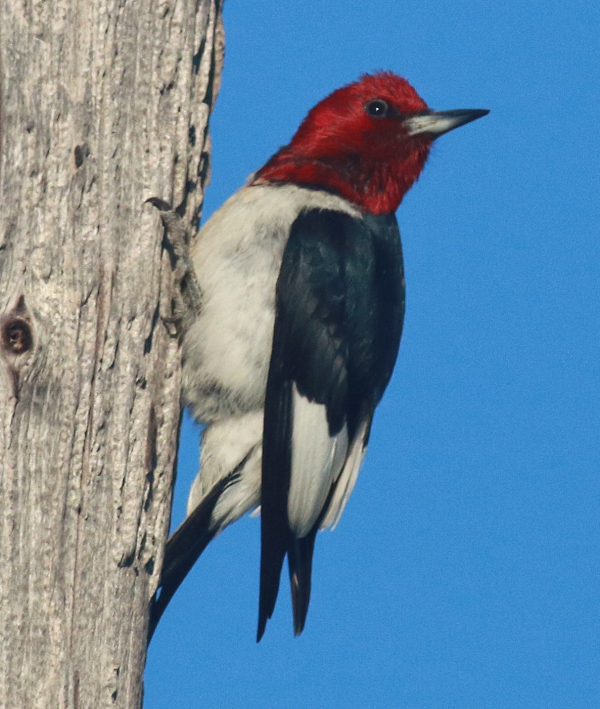
During a Friday evening drive that extended into the west side of the Drift Plain east of my office, I observed 3 Red-headed Woodpeckers along a 2-mile stretch of familiar Red-headed habitat.
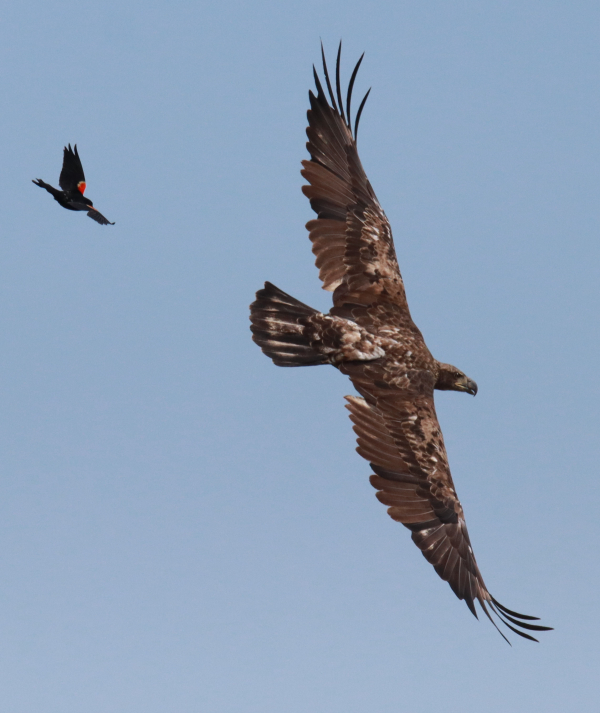
During the past week it seemed most birds of prey were being harried by blackbirds or kingbirds, such as this yearling Bald Eagle being chased by a very territorial Red-winged Blackbird.
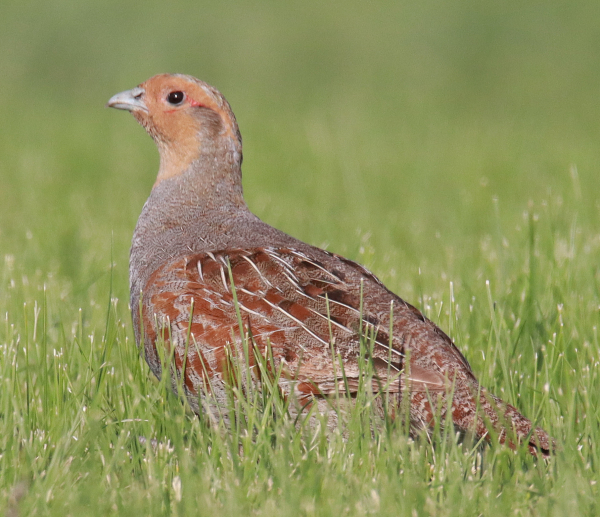
Sightings of Gray Partridges midway between home and Bismarck were encouraging after a couple years without seeing partridges in the region.
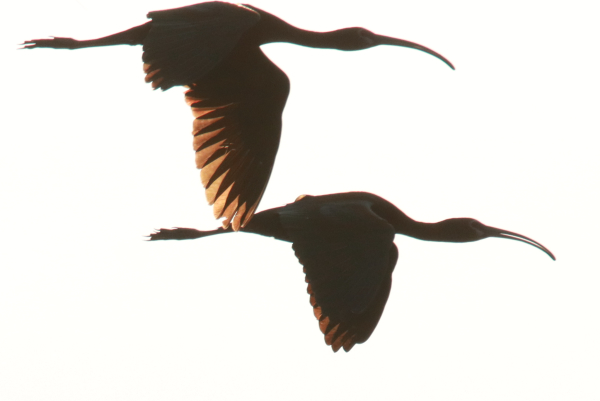
A sunset silhouette of White-faced Ibis provided an interesting photo composition.

With a single egg laid already, this Pied-billed Grebe was building up its rather sunken nest site near the edge of a shallow marsh.
|
As usual, I covered a lot of miles last week, visiting many birding hotspots east of the Missouri River and south of Interstate 94 in North Dakota, and I even slipped south of the border to Hecla Marsh. Thursday’s mission was to head northwest of home to Long Lake National Wildlife Refuge via a new route, following a rural road I haven’t driven for decades. The green prairie hills along the way were inviting, as were the marshes, each with a variety of birds on hand. I appreciated the updated view so much that I extended that route to pass through the Alkaline Lake area.
Among the highlights was seeing 3 different Krider’s Redtail Hawks, among a number of regular old Red-tails, along with several Swainson’s Hawks and Northern Harriers, plus 2 Bald Eagles. The eagles were positioned on different edges of Long Lake Refuge – an adult and a yearling. It seemed that all the raptors were being harassed by Eastern Kingbirds or Red-winged Blackbirds any time they took flight, an annual assault on birds of prey by overly territorial male blackbirds and kingbirds.
Of course, I looked for the Burrowing Owl that I photographed on the edge of the refuge during my last visit, but without luck after 3 drive bys of the locale. I was surprised I didn’t see any Western Grebe hatchlings, considering I found a pair with 2 hatchlings days before near my home. As for other birds, the species composition was essentially identical to recent visits, but with fewer individuals of each species present.
With that in mind, I continued northwest to McKenzie Slough, where White-faced Ibis and Cliff Swallows added to the central Dakota birds observed, but no hatchling grebes there either. At my last stop before heading back home, Dogtown Marsh provided looks at 2 of the 3 duck broods observed that day, all Mallards, 2 with recently hatched ducklings and 1 brood with a 3-week-old brood. I was a little surprised to see a pair of Gray Partridges in southern Kidder County, considering I haven’t seen partridges beyond southwest Fargo for some time, and a lone male crossed the road after a couple miles beyond the pair. There were occasional Ring-necked Pheasant sightings along the way too, mostly males.
Local Birding
Speaking of pheasants, Friday evening I had a 5-day-old Ring-neck hatchling hustle across the road, precipitating me to return to the spot in case I might see others. Indeed, another hatchling broke through the tall grass that lined the road, followed by a pretty adult female and at least 4 more hatchlings. They remained along the roadside, pecking at potential food, until a colorful male appeared, puffing its plumage up proudly as it approached the hen and brood from across the road. I was interested to see what interactions there might be, but the cock slipped behind the green brome grass, just about the time a darker colored female with a short tail approached the group. That’s actually when the action began.
The second female approached the hen with the brood, when surprising to me, the female pheasants bowed low and began fighting, spreading their tails and jumping toward one another in a battle that brought the male to stretch his neck and head out of the grass at the edge of the road. A moment later a local pickup truck passed by, forcing the pheasants to collectively flee into the grass – all transpiring near the Carlson farm.
Saturday afternoon I had to take a second look at the broad marsh 3 miles south of my office, which is an annual nesting habitat for a large semi-colonial population of Eared Grebes. This species has been ever-present since many arrived in April, but it was the number of larger Western Grebes that caught my attention Saturday, which made me wonder where they came from. Last week, when I saw a pair with 2 hatchlings riding an adult’s back constituted one of the only sightings I’ve tallied before at this fertile marsh, yet there were almost 50 on hand Saturday. There was also an interesting tight circle of about 10 Pied-billed Grebes interacting somewhat. With that in mind, I think I will refer to that marsh as Grebe Marsh hence forward.
Feeder Birding
The identifiable ‘yellow-orange’-and-black male Baltimore Oriole remained an irregular jelly feeder visitor most days, but female and male Orchard Orioles are among the most regular jelly eaters, as are American Robins, Gray Catbirds, and House Finches. The new American Robin fledgling continued to follow an adult to a variety of perches adjacent to the feeders throughout the week, but Sunday it made the big move to feed on jelly for itself – not from my circus feeder, but from a small bowl I use as a second jelly feeder that holds more jelly and is on a stable platform with a rim to perch on.
As the young robin was making its first feeding attempt, a Gray Catbird arrived and grabbed a mouthful of grape jelly. In response, the robin opened its mouth and begged to be fed – ha. The catbird likewise opened its mouth wide, but in defense, then grabbed another bite of jelly and evacuated. That’s when the robin fledgling reached over to take its first solo taste of feeder jelly, as if inspired by the catbird’s lead. Thereafter, the robin stopped back to feed on its own, and to be fed by an adult from time and time. To add to that breakthrough, Sunday evening 2 new House Finch fledglings were perched on a small branch above my feeding station where they begged for food from a very red adult male. That male or another was feeding single fledgling(s) Monday as well.
Hummingbirds have been hit and miss, with brief visits made after sunset last Wednesday by a female, and a similar short dusk feeding bout Thursday by a male Ruby-throated Hummingbird. There was a hummingbird vacancy thereafter, until Sunday at dusk, when a male Ruby took many drinks per visit, seemingly filling up with nectar before dark during his 2 visits. With a male here the third week of June, and a female too, it leads me to image that there must be some nesting going on nearby. Usually during this period, the hummingbirds vanish, seemingly to other areas to nest. This year may be different in that regard.
My last thrill before publishing Tuesday afternoon was seeing a Female Baltimore Oriole visit my jelly feeder, the first female I’ve seen in the area for about a month! I suspected there must be a female or 2 to keep the yellow-orange male interested in staying this long, so I hope to see Baltimores more often. Hope you are enjoying this first week of summer with some birding activities during this beautiful green period.
Article and Photos by Paul Konrad
Share your bird sightings and photographs at editorstbw2@gmail.com