
 |
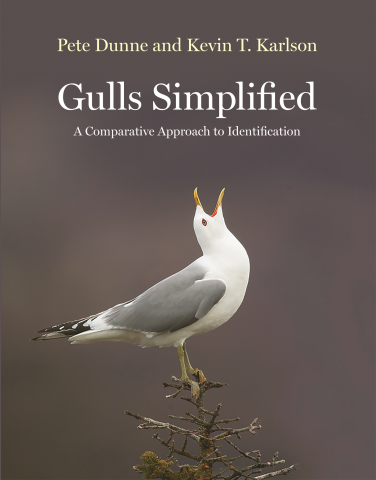
How do you react to a flock of fall gulls congregated on a beach or searching for food above a wind-blown lake. There are big gulls, little gulls and medium-sized gulls. Some are dark-colored, others white and gray, most are mottled. Even some experienced birders blanch at the sight, happy to identify a few individuals and leave the rest as “gull species.” With this new book from Pete Dunne and Kevin Karlson, beginning birders and seasoned pros will look forward to filtering through flocks of gulls. It will be fun!
The first thing to note about this book is that it isn’t just a guide with a 1,000 photos of gulls in different plumages. Dunne, drawing on his long experience of identifying birds of prey, instead takes a more wholistic approach to gull identification, focusing on a gull’s size, structure, behavior, comparisons with nearby gulls, and other characteristics – and only then going to plumage. This approach simplifies the identification process and reduces concern about the variables like age and molt, which can make gull identification so intimidating. It also makes this guide useful to both novices and more experienced birders, an unusual trait for a specialty guide.
Dunne writes that for the most part, he doesn’t really care about the age or plumage cycle of a gull I.D. He’s mostly interested to know the species, and that’s it. When I read that, I felt the stress caused by the drive to age gulls slip away. I guess I always felt that as a veteran birder, it was imperative for me to discern the age of the gull. But I agree with Dunne, I’m mostly interested in species. Sometimes, of course, it’s important to know age differences, but day in and day out, I’m just happy to know it’s a Lesser Black-backed Gull. Thank you, Pete.
Dunne and Karlson immediately turn the tables on birders who shy away from the complexities of gull identification and, instead, focus on the advantages this group of birds offer. For example, 1) gulls are large, making it easier to see key field markings; 2) gulls are often easily viewed in open bright conditions; 3) gulls are usually accustomed to people, allowing a close approach that makes it even easier to determine leg color or bill size; and 4) because gulls are often seen in flocks, it’s routine to view individuals on a side-by-side basis, a critical part of the simplified I.D. process. Comparing one gull to another can make field marks such as body size or back color easier to assess. See, gull identification isn’t so bad after all!
Following some introductory comments, the bulk of this book is made up of species accounts, arranged by the gull’s size or obvious features like a dark head. There are typically a dozen or more photos for each species that provide multiple views of key field marks, along with comparisons with similar species. Gull aficionados will appreciate the diagnostic photos and extensive text addressing key identification points.
Ace birders will also appreciate the sections on hybrid gulls and rarer species. As with many of the newer specialty bird guides, there is a quiz to polish and test your skills. The author’s quiz answers provide a glimpse as to how experts such as Dunne and Karlson assess and identify birds in the field. Reading over their answers to the photo quiz is a bit like having these two pros next to you as they study a gull and converse about what they are looking at on the bird and how it factors into their identification.
Gull identification often isn’t easy. A gull’s age and molt condition can create challenges for even accomplished birders. Gulls Simplified makes the process less intimidating. This book will help remove the “fear factor” for novices and empower experienced birders to go the extra mile to figure out whether that scraggly gray mottled bird is a first-year Herring Gull or a Great Black-backed Gull.
Although this book is not as compact as a typical field guide, it’s also not bulky. I plan to study the text and photos at home, but also take this gook into the field with me. I’ll set up my spotting scope, open the book and compare what I’m seeing in the field to the illustrations in the book. Taking this book into the field with you is almost like having a professional guide along to help with identification challenges.
No more avoiding gulls: Seek them out, search out flocks. A good-sized flock of gulls might have four or five species present, each with a few age classes. It’s easy to knock-out 30 minutes or an hour picking through a flock, and very rewarding to look over your species list when you finish. Take Dunne and Karlson with you and you’ll find the gull identification process simplified.
Review by Peter Stangel
For more information, please refer to Princeton University Press at https://press.princeton.edu/titles/13273.html