
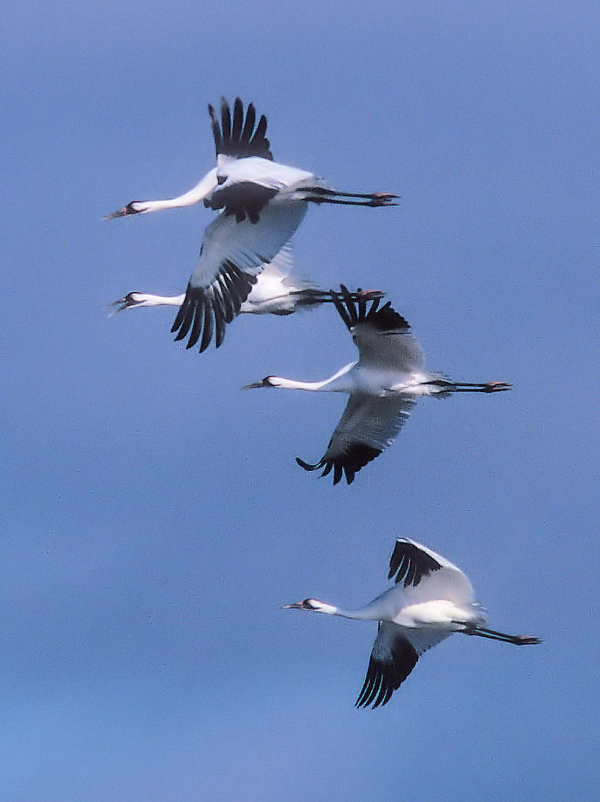
Whooping Cranes in flight are dramatic; if they call while flying, they are unforgettable!
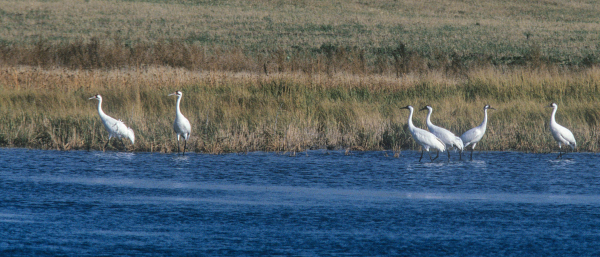
Six migrating Whooping Cranes in a prairie marsh was a sight to cherish and a wish fulfilled.
|
The loud trumpeting calls of Whooping Cranes have echoed over the passing of millennia in North America. Today, they remain one of the rarest animals on earth – only about 500 of these remarkable birds survive in the wild population that migrates across the Great Plains between northern Canada and southern Texas each spring and fall. The statistical chances of seeing Whooping Cranes during one of their migrations are astronomical considering the large expanse of the Central Flyway where these rare unpredictable birds may stop during migration. Nonetheless, for many years I remained diligent for the opportunity to observe the tallest and most majestic birds in North America during migration.
To improve my chances of finding migrating Whooping Cranes, I contacted an associate who monitored Whooping Crane migration sightings for the US Fish and Wildlife Service, who gave me a surprise telephone call late one afternoon to report a sighting of Whoopers in southwest North Dakota. Excited, I left Bismarck at 3:30am, driving 160 miles southwest through scattered columns of fog that morning of October 20th (some years ago).
I arrived near the location the Whooping Cranes were last seen shortly after 7:00 am, excited at the prospect of finally seeing Whooping Cranes during a fall migration stopover. By 7:40, I could distinguish colors in the subdued morning light, so I initiated my reconnaissance of a marsh where the Whoopers were last sighted the evening before. At first light I could make out several white forms in the water, and a quick glance through my binoculars revealed six adult-plumaged Whooping Cranes standing passively in the shallow water.
Suddenly, several hundred Mallard ducks flushed from the marsh, and I worried the Whoopers might follow. They stood alert with their heads held high for a few tense moments. Even at such a distance, these rare birds were most impressive.
After about 20 minutes the cranes became restless and some began walking a few long, deliberate steps; some exercised their broad wings and tested the wind. Suddenly they all took to the air with long, smooth wingbeats. They were truly elegant in flight – six magnificent white cranes in loose formation above the prairie wetland. Just as they elevated my jubilation to a new level, the Whooping Cranes melted into the fog as though they were exiting a dream, winging to some ethereal destination.
I rushed to search for the cranes, which might be resuming their migration south, or merely flying to a nearby feeding area. A short distance down the road a Sharp-tailed Grouse flushed from the road-side, which diverted my attention toward six white dots a quarter mile away in a harvested barley field. Closer examination through binoculars showed the Whooping Cranes were feeding on waste grain, pecking at the kernels scattered across the ground. While feeding, each of the cranes periodically raised its head to survey the surrounding area, which they shared with Mallards and Canada Geese for a couple hours.
At 11:40, the Whoopers simultaneously took flight again, winging in a tight formation back to the wetland with their bold white and black colors standing out brilliantly against autumn’s golden hues. They glided low with their widespread wings sweeping forward to break their landing as they stretched their long legs before them to touch down. Surrounded by the tranquil marsh, they drank, preened, and rested.
I took full advantage of this day and the Whooping Cranes that made it so special. I spent the entire day within sight of the splendid birds. I can’t explain the attraction I have for cranes, but they evoke a special interest for me, and for many people around the world. As the lyric flows, “It’s kinda like trying to explain rock and roll.”
I have a long history with cranes, having studied different species of cranes in southern Africa (Wattled Cranes, Blue Cranes and Gray Crowned Cranes), northeast China (Red-crowned Cranes, White-naped Cranes, and Hooded Cranes), central India (Sarus Cranes, Common Cranes, and Siberian Cranes), Australia (Brolga Cranes) and North America (Whooping Cranes and Sandhill Cranes) – that’s 12 of the 15 crane species found worldwide! My resulting understanding and appreciation of cranes and how they fit into the natural world make my time among all cranes most satisfying and rewarding.
After 5:00pm, the great white cranes became uneasy and the flock simultaneously took flight from the marsh in an amazing display of wing beats. In tandem they gracefully circled a wide area while penetrating the surrounding countryside with their keen eyesight. Ultimately, they gently settled down in the same barley field as before to resume feeding. The cranes were soon joined by a flock of 16 White-fronted Geese and flocks of 20 Northern Pintails, 9 Cackling Geese, and 15 Mallards, eventually creating a unique assemblage of migrating birds.
The setting sun lengthened my shadow and turned the grain field a brighter shade of gold. To accent the evening, just as the sun slipped below the western horizon, a full harvest moon rose in the east. In the low light of dusk the majestic Whooping Cranes took flight once more, slicing through the “man in the moon” before they returned to the marsh where I found them 11 hours before. I was elated by the opportunity to share the day with these rare cranes during fall migration, and my life seemed more enlightened, more fulfilled, as a result of this day spent with migrating Whooping Cranes.
Postscript: In case I left you wondering, the three species of cranes I have yet to observe in the wild are the Black Crowned Cranes, Demoiselle Cranes, and Black-necked Cranes. I will let you know when I cross paths with them too. For now, I’m hoping to intercept more Whoopers in the coming weeks.
Article and photographs by Paul Konrad