
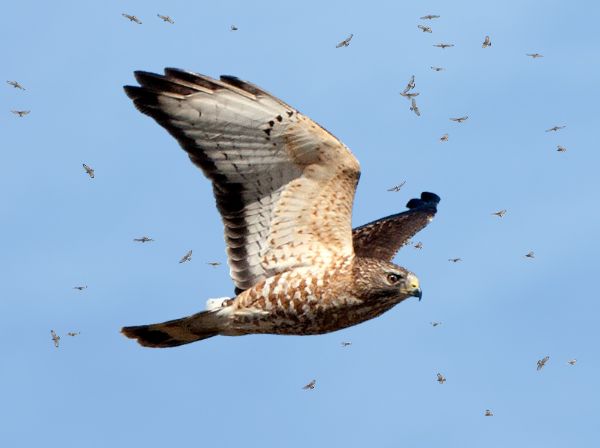
There is an obvious reason that as reported last week was designated as International Hawk Migration Week (Saturday, September 12 to Sunday, September 20), which was certainly magnified by the mass-migration of birds of prey documented last week during the peak of fall's migration flights. With daily high hawk counts and their locations provided below, you can readily see how migration increased throughout the week, and you can even see north to south numbers changing between Duluth and Detroit to Corpus Christi and Benson Rio Grande counting sites. All daily totals included huge numbers of Broad-winged Hawks migrating south in the mix of hawks, eagles, kites, and falcons observed.
Daily High Counts:
Saturday, September 12: 4,890 raptors! Hawk Ridge, Duluth, Minnesota
Sunday, September 13: 9,383 raptors! Hawk Ridge, Duluth, Minnesota
Monday, September 14: 8,416 raptors! Hawk Cliff, Port Stanley, Ontario
Tuesday, September 15: 2,729 raptors! Pack Monadnock, Peterborough, New Hampshire
Wednesday, September 16: 60,901 raptors! Holiday Beach, Ontario (south of Detroit)
Thursday, September 17: 21,552 raptors! Hawk Ridge, Duluth, Minnesota
Friday, September 18: 36,332 raptors! Detroit River, south of Detroit, Michigan
Saturday, September 19: 138,350 raptors! Corpus Christi, Texas
Sunday, September 20: 18,526 raptors! Corpus Christi, Texas
Other birds of prey being tallied at hawk count sites in addition to Broad-winged Hawks include considerable numbers of Sharp-shinned Hawks, Cooper's Hawks, Red-tailed Hawks, Swainson's Hawks, Northern Harriers, Bald Eagles, Peregrine Falcons, Merlins, American Kestrels, Ospreys, Mississippi Kites, Swallow-tailed Kites, and more.
South of the United States the land mass narrows, funneling migrating raptors more, especially along the Gulf of Mexico and Caribbean Sea through Panama and into Columbia. This funneling effect creates even larger numbers of migrating raptors at the best count sites, with Mississippi Kites dominating the flights in Mexico during the beginning of last week with Broad-winged Hawks taking over by the end of Migration Week. Farther south, Mississippi Kites continued to dominate migrating raptors from Costa Rica through Panama to Colombia. Daily high totals and their locations are listed below for the period of International Hawk Migration Week:
Saturday, September 12: 35,678 raptors! Veracruz, Mexico
Sunday, September 13: 22,753 raptors! Veracruz, Mexico
Monday, September 14: 47,999 raptors! Bocas Loma Azul, Panama
Tuesday, September 15: 9,552 raptors! Veracruz, Mexico
Wednesday, September 16: 41,548 raptors! Bocas Loma Azul, Panama
Thursday, September 17: 126,445 raptors! Bocas Loma Azul, Panama
Friday, September 18: 18,150 raptors! Bocas Loma Azul, Panama
Saturday, September 19: 45,389 raptors! Veracruz, Mexico
Sunday, September 20: 89,673 raptors! Bocas Loma Azul, Panama
Of course, there are many more hawk count sites scattered from southern Canada to northern Colombia and everyone involved at each site must be acknowledged for their dedication to providing this interesting and useful information year after year. Up to 100 sites report daily, and it should also be pointed out that there are hawk count sites in western states and provinces, but the numbers of raptors passing through are not nearly as high as many of the eastern count sites. You can refer to daily counts recorded by participating raptor count sites hemisphere-wide at HawkCount, provided generously by the Hawk Migration Association. (Click on the name of any site to view the species by species count for the day.) If you have the time, a visit to a HawkCount site is always a thrill and a learning experience shared among other birders.