
It's easy to use birds and bird feeding to bring science and nature into focus at school as students attending classes ranging from elementary school to college return. Any time is a good time to introduce a lively school project that students of all ages can participate in, but why not kick off the school year with an exciting project right outside the window: Observing and identifying birds that visit a simple feeding station. Adding bird feeding and bird study can become a weekly focus and a daily part of a classroom schedule to bring real life nature into view.
As school days progress, students quickly begin to search for more information about the birds they are seeing, such as the migration routes they take, their nesting behavior, and their varied plumages. As students are settling into new classrooms and getting familiar with new teachers, it's a great time to add a new dimension to their learning experience that will get them in touch with the nature that surrounds them. Birds are the best representatives of our natural world, and their active lives, attractive colors, varied sizes and shapes, and their ability to fly are all points of interest that attract us all.
Birds are an excellent gateway to inspire learning about science, biology, and the environment that surrounds us – as well as in areas far beyond our view. Feeding birds often leads to students spending more time outside and seeing what birds are in their yards and neighborhoods, and it gives young people a break from the routine (and their cellphone, tablet, or computer screen). Birding is a natural fit with science lessons, but it also promotes cognitive abilities related to discovery and physical activity.
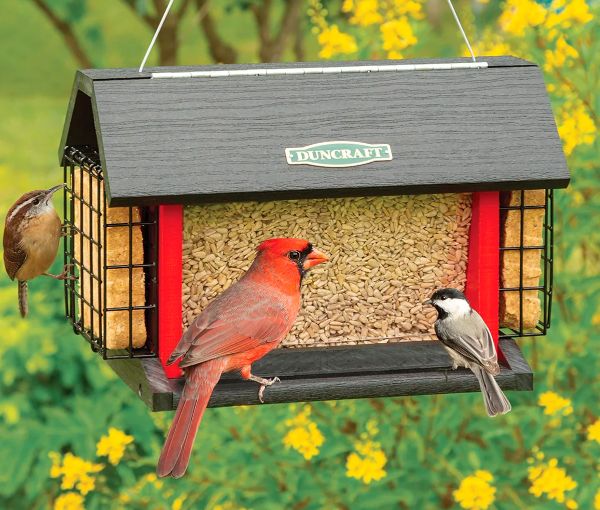
Adding a birdbath and a specialized feeder outside a class window can be all students need to become interested – a hummingbird feeder can be a learning magnet, just like a suet feeder can. A hopper feeder for shelled black oil sunflower seeds will also bring an interesting variety of birds into view. And once installed, the fun begins: What birds will arrive next – cardinals? goldfinches? a woodpecker? A feeding station can encourage students to become more interested in science class or a biology lab, but teachers who have added a feeding station have seen a marked increase in interest in all aspects of the coursework they present when feeder watching activities are a part of the curriculum.
Students can also practice a level of responsibility when tasked with adding food to the feeders and filling a birdbath with fresh water. And be sure to provide a field guide to identify the birds and at least one binocular for students to get a magnified view. Keeping a class list of the birds that students see will add even more value to their birding experiences.
Teachers across the continent have long recognized that bird feeding and the resulting observations and conversations are beneficial to their students and class participation. For an interested student, a highlight of any day can be created as a result of observing birds, or seeing a special bird that the student hasn't seen before – and that can enhance the rest of the day for a student that may not be engaged otherwise. Birds also bridge cultural and geographic barriers, offering connections to everyone in class; plus any student of any age can take part in this activity. Home schooling parents also appreciate the interest generated by birds attracted to bird foods and water. Some students who are introduced to bird feeding at school become so interested in the activity that they begin their own bird feeding activities at home. This can lead to seeing new species of birds, and that can lead to learning more about the new bird species, then sharing the information with the class.
An increased exposure to birds often leads students to learn more about other animals, plants, and landscapes. For a few students, a bird feeding station has helped to pique their interest to pursue future study in science and natural history. Teachers can also develop bird-based projects that students can research via the internet to learn more about certain species of birds. Just by checking the "All About Birds" website, a student can access a wealth of information about any North American bird species. Students can also learn about migration, anatomy, nests, eggs, and much more. Birds can also be a focus of learning more about geography, creative writing, speech, and other subjects.
Adding a feeding station may be most appropriate if led by a teacher, an instructor who is a birder, a science teacher, or a school administrator. But it can also be introduced to a school principal by a parent or someone in the neighborhood who would like to add to the students' experiences. In that case, it would require obtaining the cooperation and interest of a teacher or administrator at the school, and may even require that person (maybe you) to provide the initial feeders and birdbath, and some initial foods. It may also be a good idea to organize a funding method in advance, perhaps calling on a local birding group, Audubon chapter, or area businesses to provide a bit of financial support for a school feeding station to cover shelled seed costs. Eventually, students may become so enthused that they might hold a bake sale or sell T-shirts to raise funds for bird foods.
A good example of how some students have reacted to adding birds and bird feeding to their learning experience at school are some classes that participate in Project FeederWatch (see Educator Resources - Project FeederWatch). To learn more about providing bird-related curricula and information for students, start by checking out K-12 Education, provided by Cornell University's Lab of Ornithology. Keep it simple, or take a deep dive, but at any level of education, birds can add a lot of enthusiasm to get students back into the swing of things as schools across the country resume classes. There is no question that feeding and studying birds makes learning more enjoyable and readily ties our youths to nature and the outdoors.
Share your schoolyard birding experiences and photos with The Birding Wire at editorstbw2@gmail.com