
In the cloud forests near the peak of remote Mount Kapalatmada on Buru Island, Indonesia (located between New Guinea and Borneo), an expedition team observed and photographed a bird that had only been documented once since its discovery more than 100 years ago – the Blue-fronted Lorikeet. In April, a team of dedicated explorers, biologists, and birding experts embarked on a 14-day trek to search for the small species of parrot that has only been found once before since its original discovery in the 1920s.
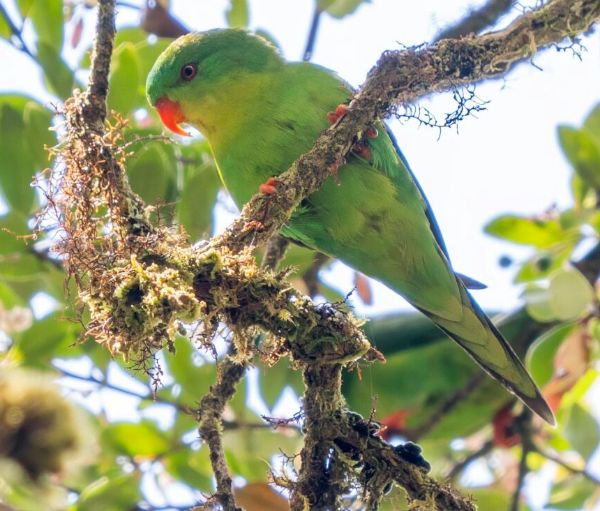
During the following century, the Blue-fronted Lorikeet has only been documented by a few sketchy photographs that were taken a dozen years ago, but in April the especially rare and elusive parrot species was observed in very limited numbers during an expedition deep into Buru Island's most unexplored and challenging landscape of the island's highest mountain. "When we saw the Blue-fronted Lorikeet, I couldn't hold back my tears," explained Sumaraja, who is a Birdtour Asia guide and tour leader. "Every day, I almost cried with joy at seeing that these birds still exist."
The team was led by the Indonesian mountaineering group Kanal Buru and expedition leader Handoko, and included John Mittermeier, Director of the Search for Lost Birds at the American Bird Conservancy (ABC); Sumaraja, the Birdtour Asia guide; James Eaton, also from Birdtour Asia and lead author of Birds of the Indonesian Archipelago; and Adam Miller of Yayasan Planet Indonesia, all of whom witnessed the Blue-fronted Lorikeets and documented their sightings with photographs and the first recordings of their high-pitched calls.
The Blue-fronted Lorikeet is a small endemic parrot found only on the island of Buru and distinguished by its lime-green plumage, an orange bill, a blue crown, and an elongated pointed tail. Despite extensive surveys in the lowland and mid-elevation forests where the original birds of this rare species were found and described by scientists, the endemic lorikeet went undetected for nearly a century until it was observed and photographed by Craig Robson and a Birdquest birding tour in 2014.
It was long speculated that the Blue-fronted Lorikeet may simply exist at higher elevations in Buru's inaccessible montane forests. But this idea remained untested until recently, when improved access to the highlands finally made new exploration more possible. That was accomplished last fall, when local mountain climbers mapped a new route to the island's highest peak, opening up the 8,900-foot summit to explorers – including expeditionary birders.
During the April lorikeet quest, after 6 days of climbing the landscape transitioned from jagged limestone covered in thorny plants and fighting through biting insects the team transitioned into a charming mossy cloud forest with a park-like clearing filled with birdsongs. Within hours, a lorikeet unexpectedly appeared. "We noticed 2 small birds fly into a nearby tree, so I picked up my binoculars to see what one of them was," said John Mittermeier. "I short-circuited with excitement when I realized it was a Blue-fronted Lorikeet."
The birds left before anyone could take a photograph, but 2 days later another lorikeet emerged from the forest while the group gathered for breakfast. Even without binoculars, they noticed its bright green feathers glistening in the morning sun and rushed to photograph it, marking the first documentation of a Blue-fronted Lorikeet in more than a decade. On their final morning in the highlands, the group spotted 2 more lorikeets darting between flowering trees and managed to record the first sound recordings of the lorikeet's high-pitched calls. Although it's not immediately clear how many individual lorikeets the recent detections represent, the theory that the species is now restricted to Buru's high-elevation habitats appears to be accurate.
"Rare sighting records suggest a highly restricted habitat use," said Benny Siregar, the Maluku Coordinator at Burung Indonesia. "The primary challenge facing Blue-fronted Lorikeets is that they are facing threats that remain largely unknown. This species inhabits areas under continuous pressure from deforestation, with a population estimated to be exceedingly small and vulnerable."
"There is a need for a collective approach and action from all stakeholders to protect the remaining habitat of this incredible bird," added Dwi Agustina, Conservation Program Coordinator for Konservasi Kakatua Indonesia, which conducted surveys from 2023 to early 2025 that documented potential threats from habitat destruction and hunting for consumption and pet trade. "Buru is home to many endemic birds, and the logging and mining companies that have acquired much of the island's forest represent a major threat to the survival of endemic birds and wildlife."
Nevertheless, the inaccessibility of Mount Kapalatmada's highlands has served as the Blue-fronted Lorikeet's greatest protection. Finding this species offers hope for similar rare lorikeets on other islands, including the lost New Caledonian Lorikeet and Red-throated Lorikeet that are feared to be on the brink of extinction. The rediscovery shows that some species considered to be "lost" may persist in landscapes that don't receive enough scientific or birding attention. With a new route to Buru's summit, the future of its habitat depends on thoughtful stewardship and collaboration with the people who know the mountain best.
"In the future, I certainly hope more people will be able to see and learn more about these birds," added Sumaraja. "At the same time, I sincerely hope more people will care about and participate in preserving the remaining forests on Buru Island."
"This expedition helped me and the members of Kanal Buru gain new perspectives and knowledge about Mount Kapalatmada, especially about the birds and the ecosystems there," said Handoko. "I hope to share these experiences to empower people in Buru to protect this unique area."
During this monumental trek, the team also encountered and recorded one of the region's most interesting songbirds, a Madanga, which may be a member of a potentially new taxon of Island Thrush. The team also observed a Meyer's Goshawk, which established a new island record of one of the most elusive raptor species in the world. (The original article was published by the American Bird Conservancy at After a Century With Only One Sighting, Indonesia's Blue-fronted Lorikeet Found in Unexplored Forest - American Bird Conservancy)