
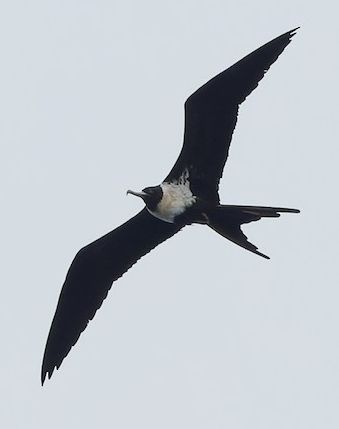
One of 5 species of frigatebirds found worldwide, the Lesser Frigatebird is relatively small among the frigatebirds, as its name implies. The species is primarily found in the southwest Pacific Ocean and Indian Ocean with offshore waters of northern Australia being a center point in their distribution between South Pacific islands and the coast of East Africa. In the Western Hemisphere, a Lesser Frigatebird is considered an extremely rare vagrant, and in the United States, only 5 records of the species existed – until last month!
Sightings of Magnificent Frigatebirds are fairly regular along the coast of southern California, and a video of a frigatebird foraging near a boat offshore from Dana Point, California was taken Monday May 18. But like the next photo documentation on Wednesday May 20, the frigatebird was initially identified as a Magnificent Frigatebird. After sporadic sightings were reported in the area during the next 3 days, an astute birder took a closer look at the available photos of the frigatebird on the evening of May 23, and whamo – he realized this was actually an astounding Lesser Frigatebird!
Fortunately for local birders, the bird remained in the area throughout the day of May 24 and many birders observed it and photographed it from the San Clemente Pier. That evening, the adult female Lesser Frigatebird was reported and photographed from the mouth of San Onofre Creek, at the northwest corner of San Diego County, where the frigatebird was gliding south before turning north toward Orange County. Despite extensive efforts by birders, there were no sightings thereafter.
Although this was not the first sighting of a Lesser Frigatebird in the United States or California, it was only the Sixth North American Record of a Lesser Frigatebird north of Mexico, and the Third State Record Lesser Frigatebird documented in California. What should have tipped people off to double-check the frigatebird's true identity was a documented sighting 15 months earlier on February 4 and 5, 2025. But now everyone is better aware of the possibility of seeing another species of frigatebird along the Pacific Coast, and perhaps more Lesser Frigatebirds will be documented in the near future.
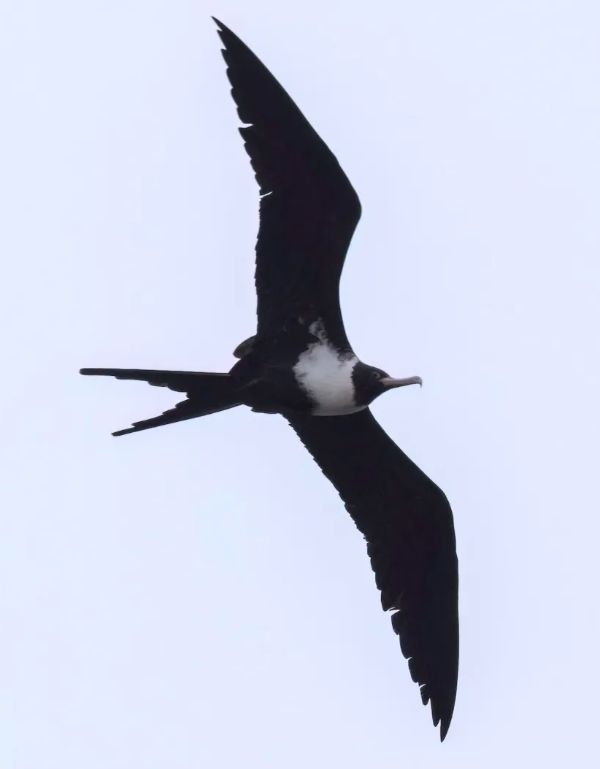
Ohio's First Record! Rare as they are, Lesser Frigatebird sightings have not been limited to oceanside sightings. In fact, 2 of the 5 earlier records were documented in Wyoming, and Michigan. So just as with any other super-extralimital rare bird sighting – almost anything is possible. And just as California birders were observing the ultra-rare Lesser Frigatebird along the Orange County-and-San Diego County line, on Saturday evening May 23 a frigatebird suddenly appeared at a suburban park lake in Canton, Ohio! Like the California Lesser, the frigatebird was assumed to be a Magnificent Frigatebird, but 2 birders photographed the bird from different locations at different times as it soared above Sippo Lake.
The frigatebird was still present at 8:50pm that night, and although it was initially identified as an adult female Magnificent Frigatebird – rare enough, especially for north-central Ohio – it soon came to light that this was a much rarer bird. After sharing their sighting and photos on eBird and a regional Facebook group, luckily, 1 photo showed white axillar feathers in the "armpit" of the wings of the frigatebird, which is a key field mark to identify the species as an even rarer Lesser Frigatebird! When the photos were circulated to a number of seabird experts, all of them concurred that the bird in question was an adult female Lesser Frigatebird.
The next morning the Lesser Frigatebird was relocated at 6:00am by many birders who arrived early to search for the exceptionally rare bird – a First State Record and the Seventh North American Record! After soaring above the lake for about 25 minutes, the Lesser Frigatebird glided north, out of sight, and wasn't observed again despite coordinated efforts to relocate it. In both cases, the rare frigatebird was initially misidentified, partly because the chance of such a rare bird arriving in extremely unlikely places beyond its normal range was soo remote. Magnificent Frigatebirds are simply more commonly encountered in the United States, although they are always a relatively rare bird to witness.
Frigatebird identification can be quite tricky, and some juveniles are difficult to identify at the species level. When it comes to the Lesser Frigatebird, a few key features are important to remember for an accurate ID. The first of these features, and the one that was the most apparent on the Lesser Frigatebird in Ohio, was the white group of feathers formed by the axillar feathers; this feature is present in both sexes and all ages of Lesser Frigatebirds.
The other feature that is even harder to check for is to try to check for the color of the orbital ring around the eye, which is pink on Lesser Frigatebirds, but bluish on Magnificent Frigatebirds. In addition, the Lesser Frigatebird is the smallest of the 5 frigatebird species found worldwide, and while size can be helpful when a Lesser is seen in close proximity to other frigatebirds, size can be notoriously misleading in the field when a bird alone.
With the May sightings of Lesser Frigatebirds in Ohio and California, it's obvious that any vagrant frigatebird should be scrutinized carefully to take into account all field marks that help to distinguish similar species. Plus, it is imperative that we birders try to document any rare sightings to document the interesting and exciting rare birds we find in the most unusual places. Congratulations to the astute birders who initially observed and documented the frigatebirds, and to everyone who had a chance to follow up on the birds as long as they stayed in their respective areas of California and Ohio.
The above article was inspired by the American Birding Association article written by Alex Eberts, and much of the above information is based on Biologist Eberts' excellent research and presentation, published at Lesser Frigatebirds in Ohio and California in May 2026, plus a Compilation of Prior Records in the Continental U.S. - American Birding Association