
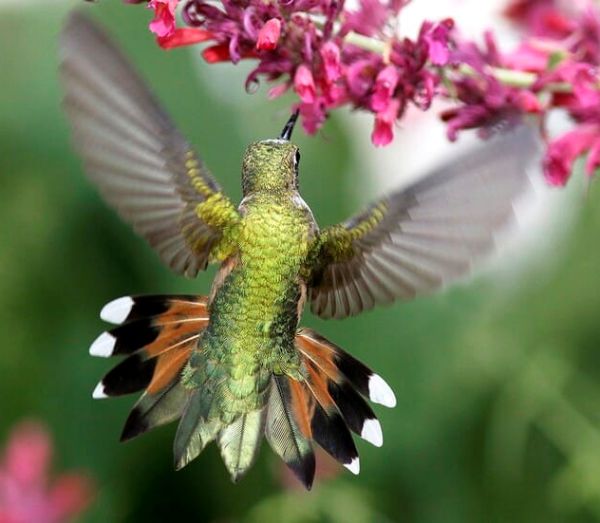
While April showers bring May flowers, shopping at an area greenhouse in May is another way to add May flowers to your yard – just in time to coincide with hummingbird migration and nesting. Local greenhouses and nurseries are filling with the colors of spring and the promise of bountiful spring and summer flowers ahead. That makes it easy to add touches of color and the beauty of flowers by activating your garden with new plants or adding a new planting circle with something simple like a hummingbird flower garden, or a goldfinch seed garden by providing nectar-producing flowers or seed-producing sunflowers.
Starting with a hummingbird garden or two, you ideally want to emphasize red tube-shaped flowers, which are proven to be the best at providing sugar-based nectar that attracts and benefits all species of hummingbirds. The hummingbirds that visit our yard really zero in on red salvia, red trumpet vine, red cardinal flowers, and bee balm blooms.
After selecting red tubular flowers as a base attraction for a hummingbird garden, you will probably want to add more color to brighten this special garden spot(s). The good news is that hummingbirds are secondarily attracted to pink, orange, and yellow tube-shaped flowers, so that means you will have a lot of colorful options to make it your personal creation. In fact, watch to see which flowers hummingbirds prefer – and especially which colors they prefer.
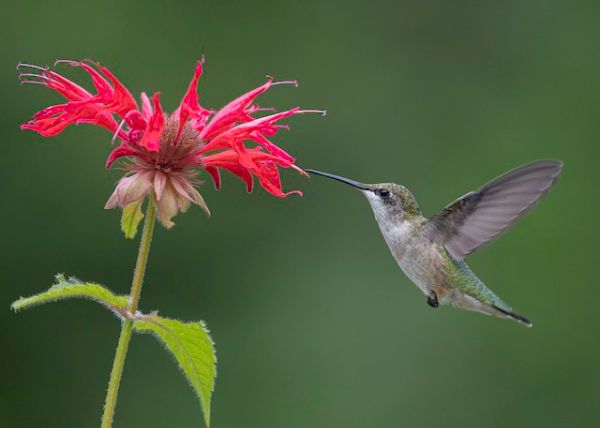
Also, when you take a walk around your neighborhood or any residential or public area, watch to see what flowers hummingbirds are visiting to get some more ideas about what to add next to attract and benefit hummingbirds in your yard. To add protein to their diet, hummingbirds will also feed on very small insects that are attracted to the flowers and leaves of plants in your hummingbird garden(s).
Of course, you have the option of creating a hummingbird garden contained in pots that can be positioned on a balcony or deck – anywhere actually. And by using pots, your hummingbird plants are mobile. You can position the pots or planters wherever you wish, or simply rearrange them within a group of 3 or 5 – however many you wish to maintain. Planting in pots adds another level of design and color that you can add to your gardening project too. You can keep your pots uniform in size, shape, or color, or you can vary the sizes and heights of the pots. You can choose a variety of colors or designs and remix their positions in the group from time to time to keep the look fresh.
Then, while you enjoy the new flower garden and the hummingbirds and butterflies that visit it, you can also plant the seeds of red, pink, and yellow tubular flowers that you can nurture as they grow and eventually flower later in the season. You may even be interested in giving your feeding station an enhanced look by adding potted or planted flowering plants around or in front of the area. Or you can add a hanging planter or two on the edge of your feeder area.
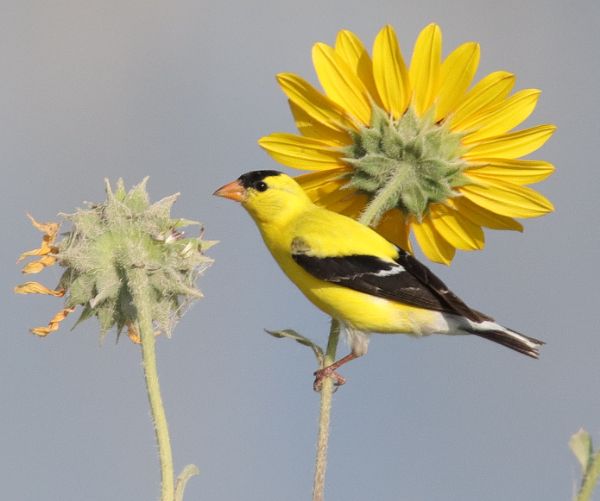
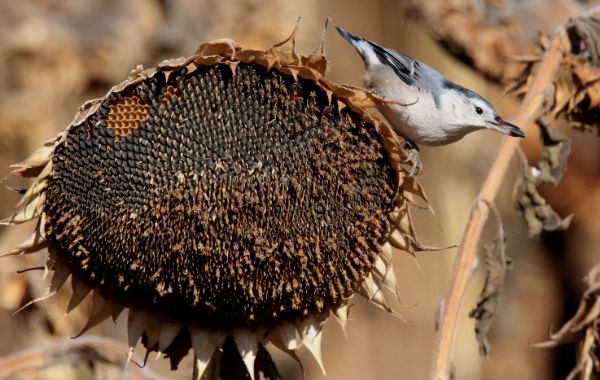
A Goldfinch Garden: Similarly, you can plant a "seed garden" with a variety of sunflower plants, including giant sunflowers mixed with smaller varieties of sunflowers that goldfinches and other birds will appreciate when the seeds mature. Later in the season, perhaps during the first days of summer, greenhouses will begin offering smaller sunflowers in bloom for you to add to your goldfinch garden(s).
In the cases of both hummingbird gardens and goldfinch gardens, you can have a little extra fun by adding a little more design and flare to your yard by adding some new circles and ovals of flowering plants to break up what may be a monotony of mowed grass. We have found these "flower circles" and "seed circles" add a lot of character to our yard that just wasn't there before, and it gives hummingbirds, goldfinches, and other birds another location to search for food. From a design standpoint, we found that most gardens are created with straight lines in the form of rectangles and squares, but ovals and circles seem to add better design elements.
When planning what plants to add to your yard and where to plant them, it's important to consider what parts of your yard are sunny and where there is shade. Some plants prefer one or the other, so you will want to plant them in an appropriate location. Then too, sunny areas and shaded areas will probably change from morning to afternoon and evening, so keep that in mind too. Another basic design consideration to consider is to arrange gardens by the height of the plants: Short plants in front or sides, with taller plants in the rear; or tall plants in the middle surrounded by medium-sized plants and smaller ones.
As migrating birds are bringing new colors, songs, and activity to our yards with the promise of more to birds to follow, enjoy the spring birding season, even as you may be doing a little gardening for birds in your yard. Share your backyard birding experiences and photographs with The Birding Wire at editorstbw2@gmail.com