
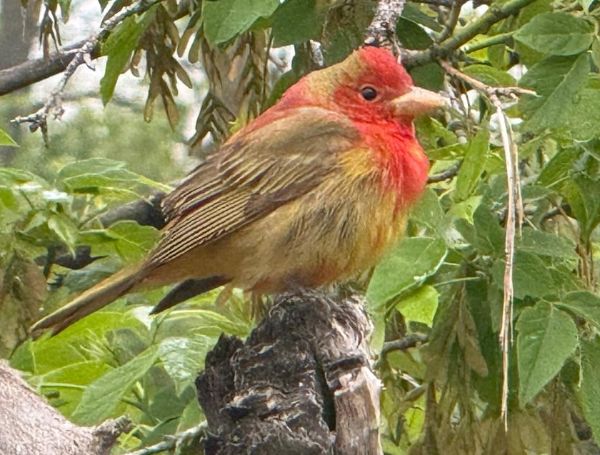
One of the really exciting things about birding is that you can see a new bird – one you haven't seen before, or one that is especially rare in your state, region, or nation. It is also great fun to share the excitement provided by a friend, especially when they need a little help from birding friends to identify a bird they have never seen before. Of course, the first thing you want to do when you see a new or rare bird is to photograph it in case you need a little help from your friends. That's exactly what Jim did, and they turned out to be some very special photos of a very special bird.
At the same time, Jim then had documentary proof of the bird in case it was beyond its normal range – a rare bird in the state or region. In this case, the birder lives in rural west-central Minnesota, and Jim isn't just any birder, he was one of my ornithology professors (our editor, Paul Konrad wrote this article). Last Saturday, it was great fun to be a part of a text thread of a few people Jim figured would be able to confirm his new bird, which he saw feeding on suet at a feeder in his farmyard. Because I wasn't monitoring my phone for a couple hours Saturday afternoon, I just got in on the text interactions and photo string after the others agreed on a positive ID, but it was no less exciting to see the photographs of a bird I hoped to photograph – some day.
The red and yellow oriole-sized bird was a tanager, a yearling male in the midst of his spring molt. But in Minnesota it would most likely be a Scarlet Tanager at the western edge of the species' range. But the wings and tail weren't black like a male Scarlet Tanager, which made the next identification step all the more interesting – if not a Scarlet, what tanager? There was a bit of discussion, but what do you think? You are right, it's a young male Summer Tanager molting from its basic plumage to the alternate plumage of spring and summer.
Summer Tanagers are a bit larger (bulkier-looking) than Scarlets and they show a bit of a crest at times; this young Summer Tanager has its plumage puffed up a bit to stay warmer during the cool morning temperature so it looks especially "bulky." The other red tanager north of Mexico would be a male adult Hepatic Tanager, but that would be an even more off-course bird, and while their beak is pretty defining, their nesting range extends no farther north and east than south-central Colorado.
This Summer Tanager is far north of the most northern extent of the species' range in southern Iowa, so it is certainly a rare bird sighted beyond its normal range. It is also a very special bird due to its interesting mix of basic olive-colored plumage mixed with new red alternate plumage. Jim reported that the molting Summer Tanager was feeding on suet periodically Sunday morning, and then it was gone. How lucky can you be to have an experience like this in your yard – albeit a rural farmyard – but around the country, wooded farmyards attract a lot of interesting birds, and this was surely one of them!