
While birding this spring, be sure to look for bands on the birds you observe. Although a very small percentage of birds we observe are banded, if you do see a banded bird, especially a bird with colored bands, try to record all the information you can – and start by taking a photograph of the bird and its band(s). Bird banding has provided a wealth of information about the birds of North America and beyond, and while biologists can use much more sophisticated methods of monitoring bird migrations and behavior in the form of telemetry, bird bands continue to provide new and interesting information.
The Bird Banding Laboratory is part of the of the US Geological Survey (an agency of the Department of Interior) that collaborates with the Canadian Wildlife Service's Bird Banding Office to administer the North American Bird Banding Program. The Lab was established in 1920 and provides information about banded birds and shares data for bird-based science, management, and conservation. By submitting a sighting report to the Lab, you will not only find out more information about that individual bird, but you will also be assisting with the understanding and conservation of that species. To learn more you can refer to Report a Band | U.S. Geological Survey
Banding a bird has been likened to putting a note in a bottle and tossing it into the "sea of migration." But the note (band) only gives us information if someone reports it. Each banded bird provides the potential to help us learn more about the movements, populations, nesting success, and age structures of species of birds.
If you see a banded bird: Take Photos! Digital photos provide still images of the banded bird that can be much easier to read on a computer screen than in the field with binoculars or even through a spotting scope. Digital photos can easily be enlarged to help read the band's numbers and/or letters. Also, write down the following information in the field after photographing:
1) Identify the species.
2) Note the color of the band(s) if colored.
3) Describe where bands are located – high or low on the leg.
3) Check which leg or legs of the bird has a band(s).
4) Try to read the band's numbers and/or letters and write them down.
5) Record the date, time, and location (with GPS if possible) of the banded bird.
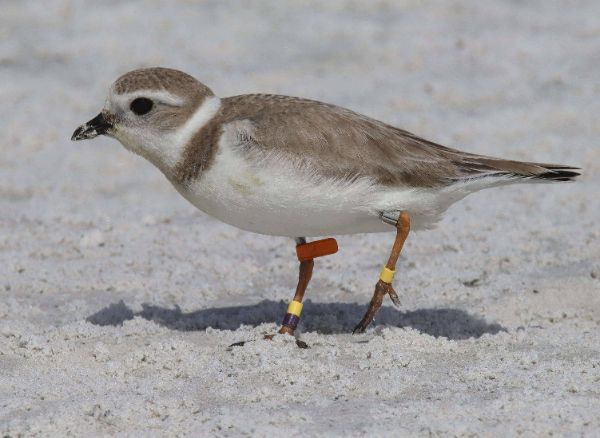
A couple interesting examples of recent sightings of banded birds that provided new information came from Audubon Florida recently. While surveying birds at Flag Island on the Florida panhandle in early January, biologist Zach Matchinski saw a Piping Plover with a yellow band. Zach immediately photographed the plover to document it and so he could read the code on its band more easily. Through his photographs he determined that the code on the yellow band was 62Z.
After reporting the Piping Plover's band to the Bird Banding Lab online, the office reported that this individual was banded as a hatchling on the shore of Lake Sakakawea in central North Dakota in July 2016. While that was an interesting fact in itself, the date indicated this Piping Plover was more than 9 years old; very old considering the average life span of Piping Plovers is 5 to 7 years. To read more about this encounter with a banded bird, you can refer to An Unexpected Meeting Made Possible by Bird Banding | Audubon
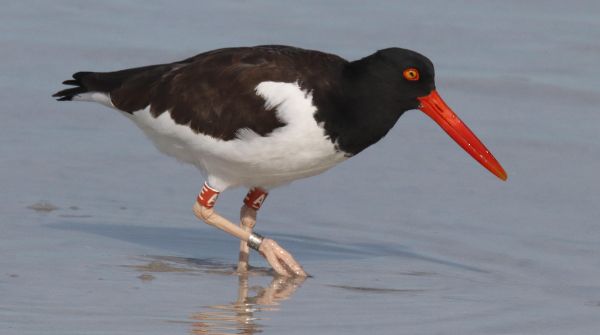
Another interesting example of band sightings happened after a flock of about 100 American Oystercatchers arrived at "Union Bay" (Bahia de La Union) on the Pacific Coast of El Salvador in Central America. There, Victoria Galan photographed 2 oystercatchers that were banded, 1 with a red band lettered V06 and another with a black band lettered ATA.
It turned out that the American Oystercatcher with the red band on its leg was banded as a hatchling on May 22, 2022 at the Old St. George Causeway on the Gulf Coast of the Florida panhandle – a protected wildlife area known for its abundance of shorebirds and as an important Audubon conservation site. Also, it turned out that the other banded oystercatcher was banded as a hatchling at Assateague Island National Seashore on the Atlantic coast of Maryland on July 12, 2022. These interesting examples show how important it is to report banded birds we can encounter. You can read more about the banded oystercatchers at Banded American Oystercatchers Link Florida's Panhandle to Central America | Audubon