
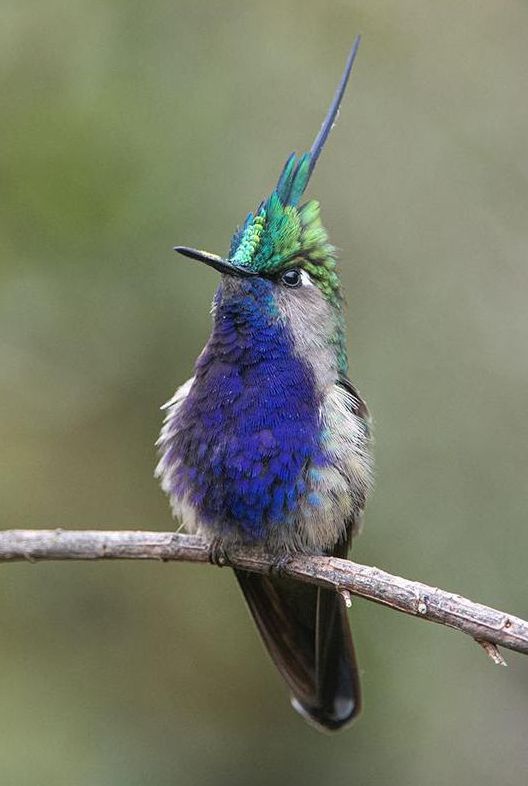
Even if you still have snow on the ground, here's an article to get you thinking about warmer days ahead with some information about how to transform your garden into a Hummingbird Haven. And if you are a Sunbelt birder, you can start planning and planting a hummingbird garden today. But first, we wanted to introduce you to a stunning example of the 363 different species of hummingbirds found in the Americas – a Green-crowned Plovercrest. Endemic to Brazil, Green-crowned Plovercrests are found in the Atlantic Forest of southeast Brazil.
Shared with us by the International Hummingbird Society, the photograph of this male Green-crowned Plovercrest was taken by Sergio Gregorio, who pointed out that this hummingbird species "holds a special place in my heart because it symbolizes the resilience and splendor of Brazilian nature."
A theme of the International Hummingbird Society is that seemingly small efforts can make a big difference, such as planting flowering plants that hummingbirds prefer along with maintaining clean, healthy feeders with sugar-water nectar. Simple enough, but it's also important to share the information that you learn with friends and neighbors who can also make a meaningful difference for hummingbirds.
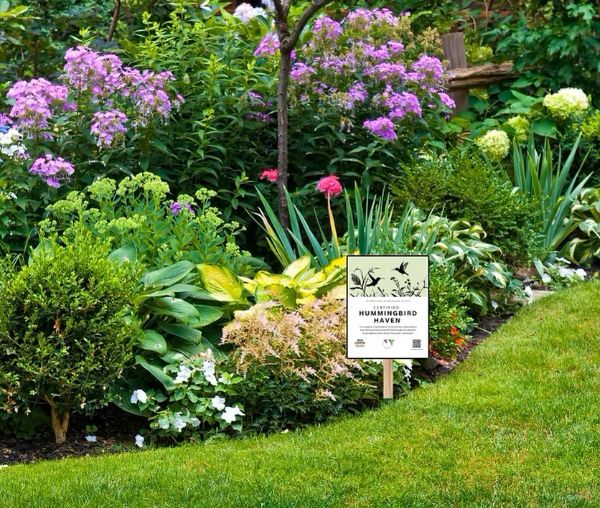
This week we are going to follow the lead of the International Hummingbird Society's mission to inform people about hummingbirds and work internationally to protect them. It starts with a simple explanation about how you can benefit hummingbirds in your yard – whether you have the potential for hummingbirds to visit year-round, during migration, or during the nesting period. One of the interesting programs of the International Hummingbird Society is the Certified Hummingbird Haven garden program that continues to grow annually, with gardens in 38 states and 4 countries earning certification during 2025 alone.
The Society contends, and rightly so, that anyone can transform their garden into a haven that provides resident, migrating, and nesting hummingbirds with food, water, sanctuary, and an eco-friendly environment. 1) Starting with food, you can select and grow plants that attract and nourish hummingbirds with the sugar-nectar they produce in flowers. The addition feeders to provide fresh sugar-water nectar also enhances hummingbirds' natural diet. 2) Provide a fresh water source for drinking and bathing. 3) Establish a refuge by providing trees and bushes in your yard for resting and nesting; and keep cats indoors. 4) Maintain a safe environment by avoiding pesticides, herbicides, and chemical fertilizers in or near your garden.
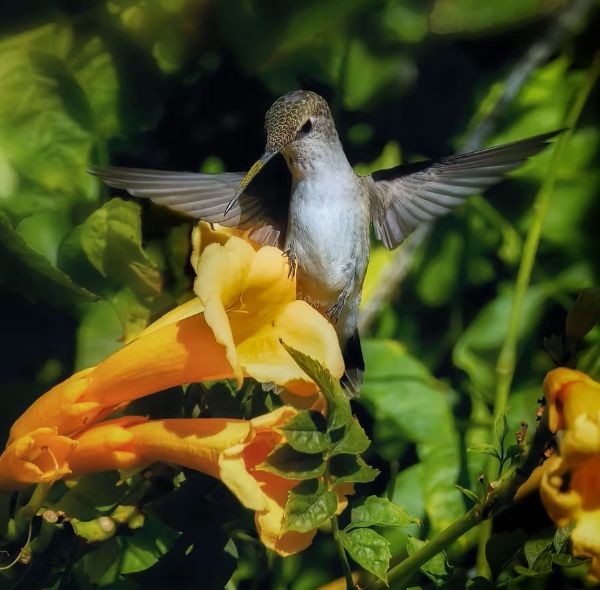
To find out more about how you can certify your garden as an official Hummingbird Haven, see Certify your Garden | Hummingbird Society. At the same time you produce a better place for hummingbirds, you will be creating a more beautiful yard, and a more attractive space for other birds. You will also have new opportunities to photograph hummingbirds in your own yard, either as they perch or as they hover in mid-air to feed from a nectar-filled flower.
Of course, every hummingbird garden is different, and they tend to evolve year by year, even month by month, often depending on your location and your plant selections. Native plants are a good place to start, but don't limit yourself – a lot of effort has gone into developing flowers that hummers prefer. Favorite hummingbird flowers usually have tube-shaped blossoms, partly because the elongated shape limits access for insects to the nectar inside the flower. Hummingbirds also prefer to visit red, orange, and yellow flowers because they produce the best sugar-nectar.
Ask people in the know about hummingbird flowers at your local nurseries and check with a garden club about what flowering plants they recommend to attract and benefit hummingbirds. Also, watch what flowers you see hummingbirds feeding at in your neighborhood. Flowering red trumpet vines, red salvia, red cardinal flower, bee balm, honeysuckle, and lupine are good plants to check into – if they can survive in your climatic region. Discovering the attraction of red salvia in our yard has been a real game changer in attracting hummingbirds to our garden areas.
Nectar feeders are a great supplement, but there is nothing better than natural flower nectar for hummingbirds. Nonetheless, sugar-water feeders are an integral part of any feeding station in season. Mixing sugar-water is simple, just add 1 part white cane sugar to 4 parts of fresh water – it's a simple 1-to-4 ratio recipe. We make just enough to fill our feeder at a time, but always make sure we are providing fresh sugar-water nectar.
Alice Madar, the Executive Director of the International Hummingbird Society recently wrote: "We are continually working to reach more people and expand our message of how, together, we can create a better world for hummingbirds." To learn more and to consider becoming a Society member, refer to Home | International Hummingbird Society
In case you need a little more incentive, enjoy a view at the usually bustling hummingbird feeder at the Canopy Lodge in Panama at Panama Hummingbird Feeders | Cornell Lab Bird Cams
Share your backyard birding experiences and photographs with The Birding Wire at editorstbw2@gmail.com