
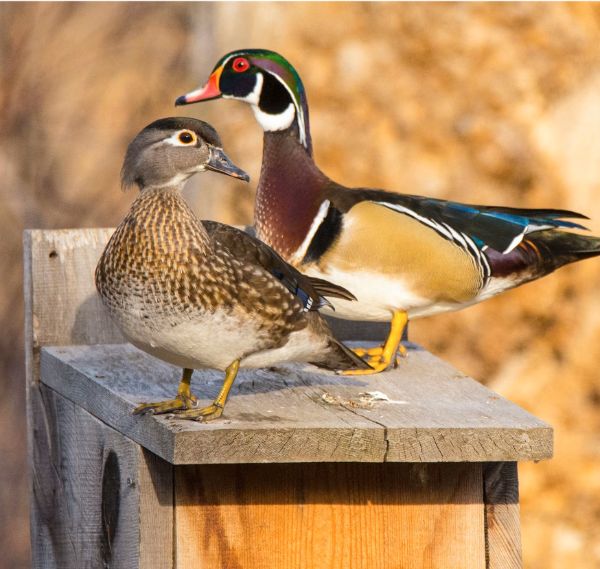
There is probably no greater level of nest box excitement than when you are successful in attracting a small owl, kestrel, or duck to a Big Nest Box on your property or a nearby location. Imagine the thrill of attracting larger cavity nesting birds, like a pair of colorful Wood Ducks or impressive Hooded Mergansers – or screech owls or a pair of American Kestrels – all exceptional birds that anyone would be thrilled to assist by providing a sturdy, safe, and dependable nest site. Adding a big nest box to the local environment is very positive way of joining in a true conservation effort because you will help cavity nesting birds during the most important part of their life cycle – the nesting season – by ensuring there is another safe nesting site available each spring.
Installing a single big nest box is not an overpowering effort for most birders, but when birders across a state or around our nation make that effort, it can make a huge difference to birds looking for a nesting cavity each spring – especially considering the short supply of suitable large natural nesting cavities. Although many of us don't have a larger property or the right habitat to attract one of the big cavity nesting species, you can check with staff at a city park, local nature center, a wildlife refuge, or an area farmer or rancher you may know to begin a cooperative project to install a big nest box. Members of a local birding club or Audubon chapter may be interested in helping to install a big nest box in an appropriate location. And you never know how enthused the people you contact might become; if they enjoy the process, one nest box may lead to more in the future.
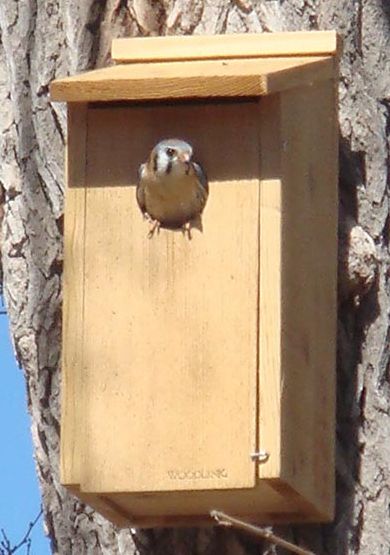
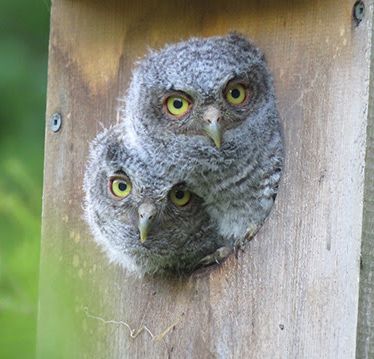
Among the 88 species of cavity nesting birds in the United States and Canada, 17 would be considered big cavity nesting birds. In this article we will emphasize 5 species that tend to be the birds that birders enjoy attracting by providing standard big nest boxes: Wood Ducks and Hooded Mergansers, Eastern and Western Screech Owls, and American Kestrels. These are the most wide-spread and most common birds among the big cavity nesters, and the birds most likely to take advantage of a Big Nest Box.
Realistically, all 5 of these cavity nesting species will utilize the same size and shape of nest box, depending on the habitat where the big nest box is positioned. The ducks want to be close to a suitable marsh or lake that they can lead their ducklings to after hatching. Especially for the ducks, it's important to have a wider entrance hole that measures 3 inches high and 4 inches wide; see Wood Duck - NestWatch and Hooded Merganser - NestWatch.
Kestrels prefer a woodland edge leading to a mostly open grassland or hayfield where they can hunt for large insects and small rodents; see American Kestrel - NestWatch. Screech owls are most likely to adapt to the habitat where they find a big nest box, although they prefer an open woodland or tree grove adjacent to a meadow; see Eastern Screech-Owl - NestWatch or Western Screech-Owl - NestWatch.
The 5 species all prefer a big nest box positioned 10 feet high or more, and it's best to position the nest box on a post or pole fitted with a metal sheet of "stove pipe" metal wrapped around it to prevent predators from accessing the nest box. Because an entrance hole with a 3-inch diameter is recommended for screech owls and kestrels, they will equally use a 3x4-inch entrance recommended for Wood Ducks. Therefore, to provide a fairly universal big nest box, it's best to provide a Wood Duck nest box with a 3x4-inch entrance that all 5 species can use.
In fact, a few other big cavity nesting birds will use a Wood Duck nest box when it is installed within their nesting range, at the right height and in the preferred habitat. These birds include other duck and owl species – Common Goldeneyes, Northern Saw-whet Owls, and Boreal Owls – although these birds tend to nest farther north in areas of Canada and Alaska.
Important Big Nest Box Features
As with any nest boxes, big or small, it's important to be able to access the interior of the nest box through a hinged panel – to clean and maintain the nest box. It's also best to add a layer of wood chips to cover the base of the nest box. A nest box should also be made with wood; pine and cedar are commonly used to build nest boxes. But we should avoid using plastic nest boxes because they can overheat or retain cold; even if it's recycled plastic, which is an attractive quality, a wooden nest box is the best product to use or buy for nesting birds.
One more consideration, especially for nesting ducks, is to provide a "ladder" below the entrance hole so newly hatched ducklings can climb out of the nest box a day or so after breaking out of the egg to join the female for a walk to the closest wetland. The ducklings climb using the toe nails on their webbed feet, and a board may be too smooth for them to get a grip in the wood. A climbing ladder can be provided by carving horizontal grooves into wood below the entrance hole so ducklings can climb to the top more easily. Some birders attach a piece of metal mesh wire as a ladder inside big nest boxes, and some ready-made Wood Duck nest boxes already have the mesh attached below (see the Wood Duck nest box described in the Products article in this issue). If you are looking for a big nest box, a good starting point is BestNest at BestNest.com: Duck Houses and Owl & Kestrel Houses at BestNest!
Birders who already have a big nest box or two that are being used by ducks, owls, or kestrels have found that a big nest box increases their enjoyment of backyard birding, and now they are waiting with a level of excitement to see when the next pair of big cavity nesting birds will claim to their nest box this spring. We offer a big Thanks to all the birders who consider adding a new nest box to the mix as a true conservation-minded effort on behalf of cavity nesting birds.
Share your backyard birding experiences and photographs with The Birding Wire at editorstbw2@gmail.com