
How did you begin the new year? After waiting for a sunny day over the holiday period rather impatiently, I eventually followed an Alberta clipper weather system New Year's Day, driving east toward Duluth with the promise of a sunny day January 2nd. This was my winter pilgrimage to the Sax-Zim Bog region north of Duluth, fueled by the hope to find Pine Grosbeaks, Evening Grosbeaks, a northern owl, a Boreal Chickadee, Ruffed Grouse, a northern woodpecker or hawk, and other exciting Northwoods winter birds and other wildlife. To start the fun along the 400-mile, 7-hour drive to The Bog I managed to find a rare Northern Hawk Owl 90 minutes before reaching the Bog, a few miles east of Aiken, Minnesota.
The owl only offered a long-distance view as it perched in a tall tree in an isolated grove about 300 yards off the road in the midst of a frozen marsh. Other birds along the way included 7 Bald Eagles (3 in southeast North Dakota and 4 across Minnesota), a flock of 25 Snow Buntings that materialized just inside Minnesota, 2 trios of Horned Larks in southeast NoDak, and Blue Jays were scattered along the drive from the Plains to the Northwoods in groups of 2 to 5.
The sun broke above the horizon Friday morning to eventually warm the –8F temperature to +8F, but my mobile blind was warm and the birds were remarkable from the very first sighting forward. While ambling slowly to my first Bog stop I was thrilled to be in the Northwoods, motoring past towering stands of black spruce that gave way to aspen forest that led to tamarack bogs, and frozen wetlands. Suddenly, my thoughts were broken by the low flight of a Pileated Woodpecker, close, pointed in my direction – plus it landed on the top of a low stump just above eye level a few yards away! I needed a moment to ease past the elite woodpecker to get to the sunshine side of it and past an ash tree – this could be my big Pileated break – but even as I raised my camera the early morning woodpecker was off, melting into the pines.
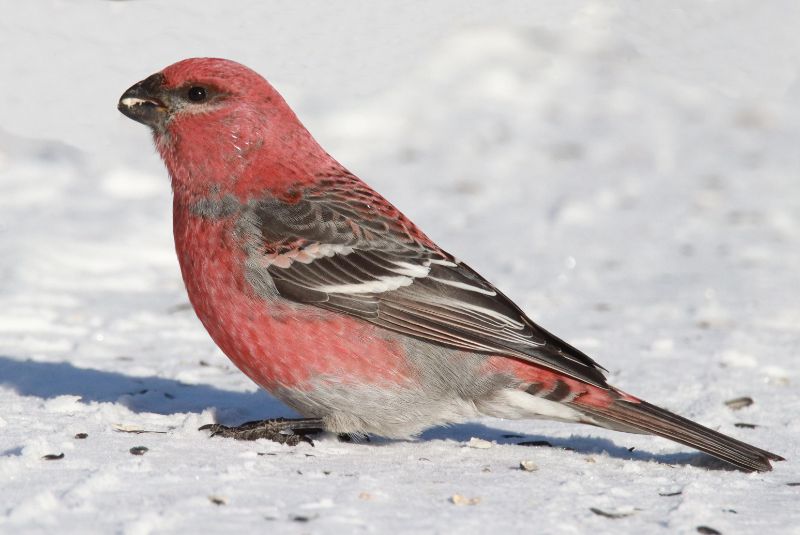
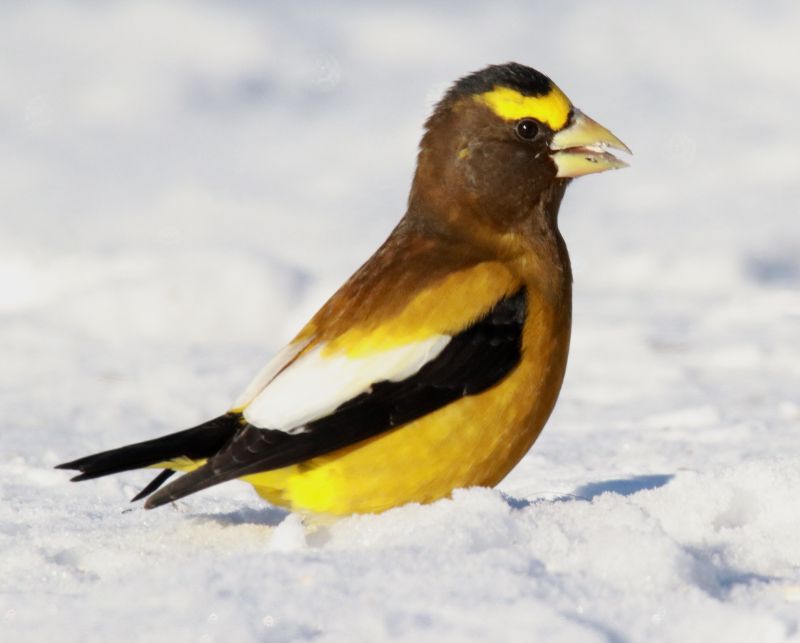
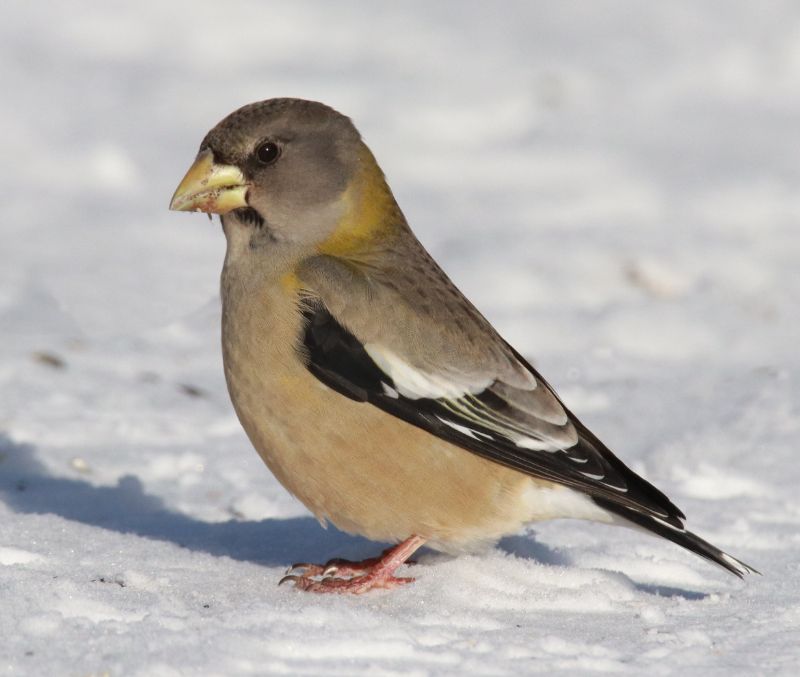
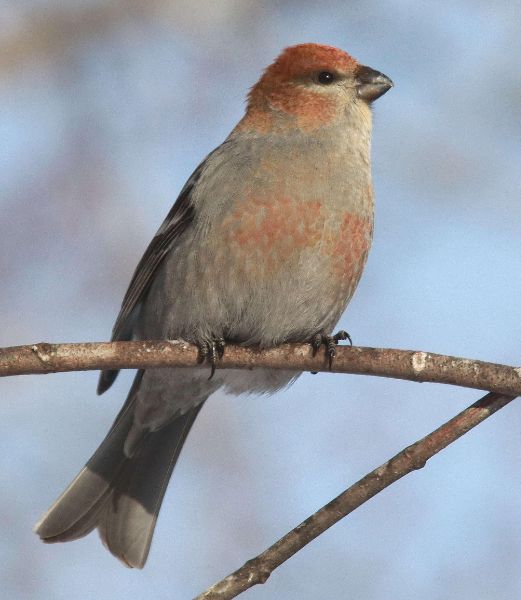
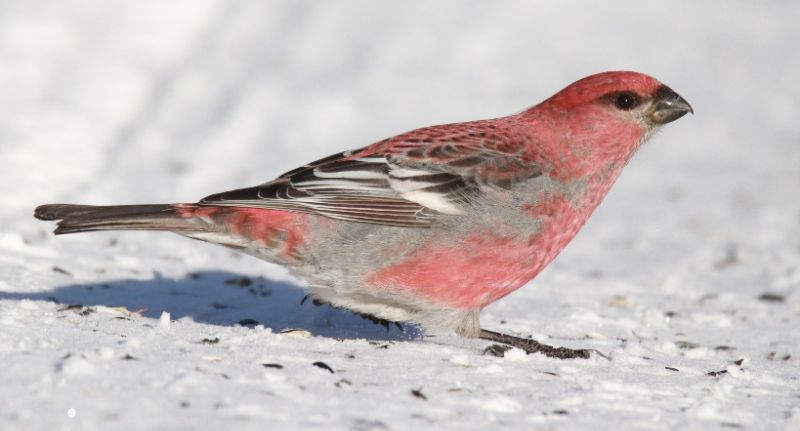
There was not a second for remorse though as a flock of 5 Pine Grosbeaks flew into sight and perched in an even closer ash tree. As I focused my camera on a male, 3 females dropped down to the road to search for seeds and grit – right next to my position! Even as I took my first photos of the females, 6 more Pine Grosbeaks arrived, and they were joined by a tight flock of about 20 Evening Grosbeaks – WoW – all positioning in photo range! I zeroed in on a close male Pine Grosbeak with stunning red-pink plumage as about 20 grosbeaks were active on the newly fallen snow beside the road. I couldn't have orchestrated this initial photo opportunity better!
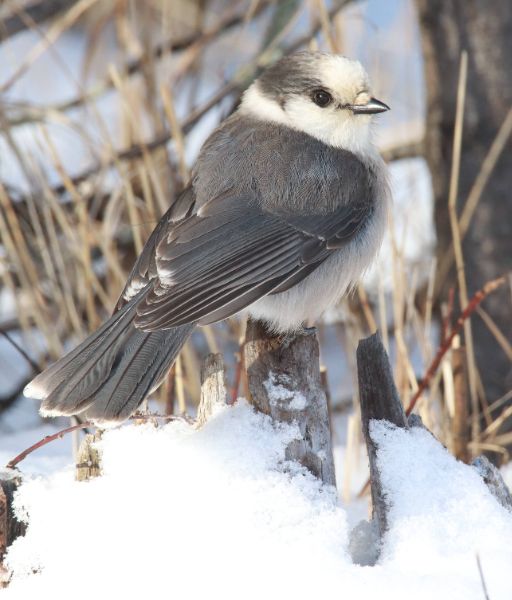
The rarest sighting of the day was of a Boreal Chickadee, a species I haven't seen in years, and there were also Canada Jays, Blue Jays, a couple Redpolls, Hairy and Downy Woodpeckers, Black-capped Chickadees, a Red-breasted Nuthatch, a White-breasted Nuthatch, Common Ravens, Wild Turkeys, and my last species sighted was a Northern Shrike. Other species that would be possible included Ruffed Grouse, Purple Finches, White-winged Crossbills, a Black-backed Woodpecker, a Great Gray Owl, Northern Hawk Owl, Snowy Owl, Rough-legged Hawk, an American Goshawk, and a few longer-range possibilities.
You can get more information about recent sightings in the Sax-Zim Bog area at Bird Report : Friends of Sax-Zim Bog. I also want to share how enjoyable it was to spend time among other birders in the field again, at feeder locations, and at the new Welcome Center. The Center is quite a remarkable oasis in the forest that is a must-see facility for birders – and it gets more impressive each time I stop there to see what's new and check in with the staff for recent bird sighting information.
When I made the move to start driving home, there was still sunlight as I drove west from Hibbing to Bemidji, a drive I was sure would yield some interesting birds, but there were no birds (including no Bald Eagles). It was a whirlwind tour, but it was fulfilling and especially successful considering how I was surrounded by beautiful grosbeaks, jays, chickadees, woodpeckers, and more at times. (There is more information and photos about my trip in this issue in the Photography feature and Backyard Birding article.)
Surprise Hawks & More
Among the most exciting things about birding are the surprises! Whether it's a single bird that suddenly appears before you, or a number of unexpected birds revealed during an especially productive outing. Last Thursday, similar to when the group of at least 6 winter Rough-legged Hawks surprised me during the end of December at "The Rough-leg Plain," a new 5-some of Rough-legs added a new level of enthusiasm for birding closer to home. The first new Rough-legs were hunting the grasslands adjacent to Rainy Marsh, located 12 miles north, including a male and female. And I found 3 more between 7 to 8 miles south hover-hunting in the grasslands on the west side of Hille Lake – quite a surprise.
That's when the question became: Would the new hawks stay a while? Intense northwest wind Friday made me question spending the time to check back to see if I could find any of the new Rough-legs, but how could I resist? So I drove a dozen miles north to Rainy Marsh, where I was happily surprised to see the male from the previous afternoon perched on the same low post where I sighted it initially. The hawk flew into the wind prematurely it seemed, but perched a few posts down the way, then took flight to begin hovering into the strong northwest wind.
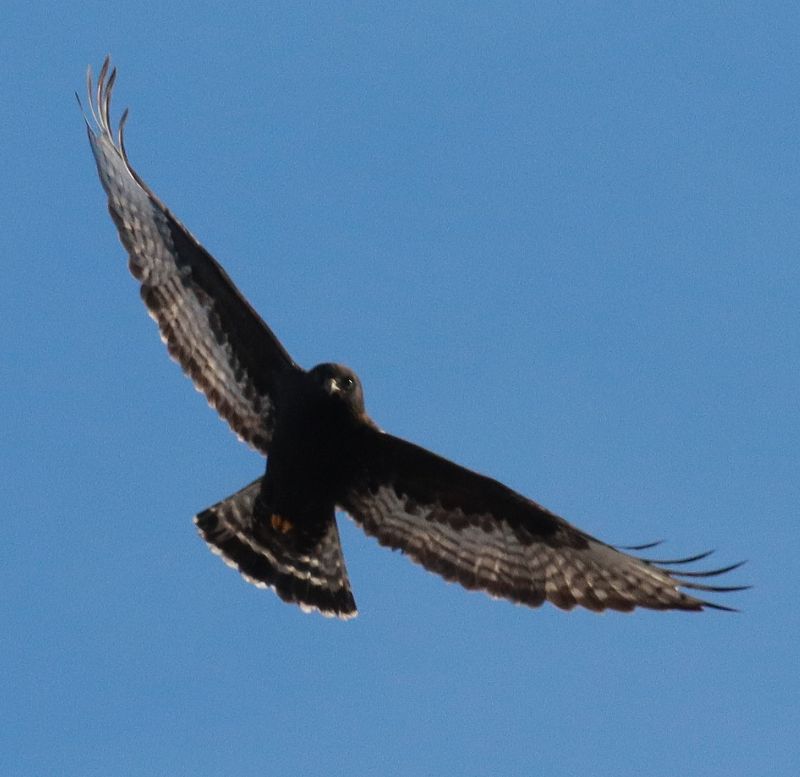
The male circled back to within a few feet of its original perch, but just before it landed a second hawk raised up from the ground to perch in an adjacent cottonwood tree, an adult female. I drove the rest of the way across the mix of grasslands and frozen marsh areas thinking there might be another hawk in the area, but seeing the 2 suggested the same male and female were still present. I returned toward my office, but passed by it to drive another 7 miles south, only to find the same male Rough-leg hovering in the same spot as I found it the previous afternoon – I was surprised, but appreciated the chance to photograph it and observe its moments across the surrounding grasslands. Its crop was fully extended, indicating a number of successful vole hunts in the area.
Deciding to circle around the adjacent lake and its prairies, I was intercepted by an adult Bald Eagle that seemed to be riding the swift wind toward South Dakota. Returning to the circle's starting point, I was met by another Rough-leg on the hunt – this time an adult female was on the hunt like the male before her. The 5 raptors provided the only birds to be seen in the area during my windy hawk check that revealed 4 of the 5 new Rough-legs from the previous day.
Saturday the female Rough-leg south of my office was obvious during a half-hour observation period, but she "vanished," as these hawks seem to do. And that turned out to be the last time I'd see her there, and the male didn't reappear after Friday. Similarly, I didn't see the Rough-legs at Rainy Marsh Saturday afternoon, and there were no Rough-legs to be see at The Rough-leg Plain, which gave me the impression that hotspot cooled off royally.
But not so fast; sunny Monday morning I awoke with renewed enthusiasm to check the overall region for hawks, eagles, owls, and other wildlife. I observed 2 male Ring-necked Pheasants south of my office, but the only other birds observed were at The Rough-leg Plain. First a female, then the regular male that I hadn't seen in a week's time; and after driving 2 extra miles, upon my return to the west side I saw a hawk on a familiar but distant perch and figured it was the female. But from my distant position, and with the help of my binoculars, the hawk looked very black, which made me think it might be a dark morph Rough-leg. Having raised the question, I felt the need to wait to try to get an answer, because I haven't see a dark morph Rough-leg this fall or winter. I became a bit uncomfortable waiting for what seemed like too long, but suddenly the bird took flight and began a hovering hunt – and that's when I could ascertain: This was a black-colored dark morph Rough-legged Hawk!
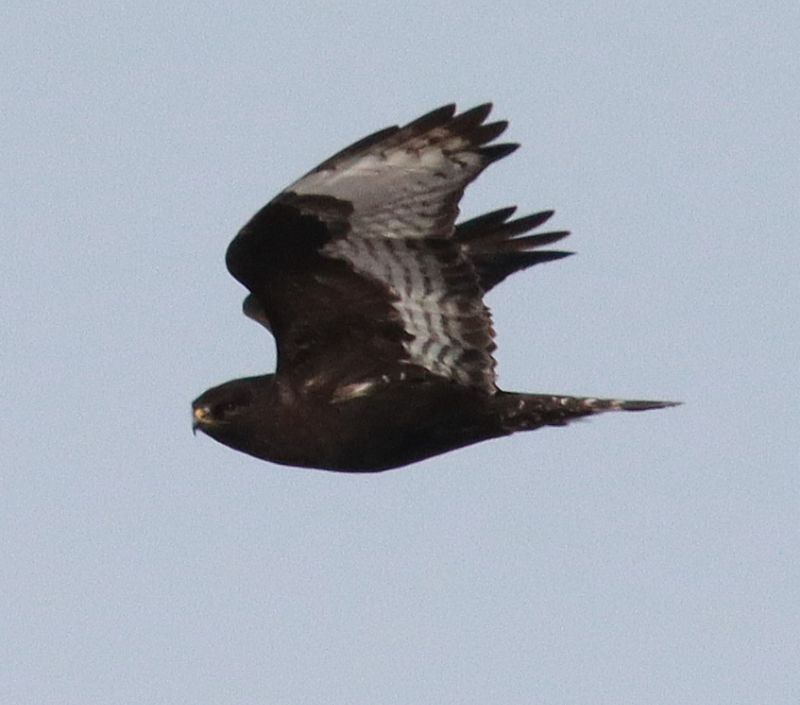
Eventually, the black hawk flew in my direction and I was able to take a few long-range documentary photos of it on the wing. It soared over the open grassland to the south, then turned back to the north, providing a couple more long-range photos and continuing north. As it turned out, I was able to parallel the black hawk's flight for more than a mile before it circled low over a frozen marsh, and that's where a second Rough-leg took flight to begin soaring in tandem with the black hawk. Was this a black morph hawk too? My long-range photos suggest it was another black one! How rare is that – 2 black Rough-legs soaring in tandem! And then they began gliding north from the apex of their soaring circles at long range, and out of sight.
Well, that was mighty thrilling, but the only other bird I would see was an adult Bald Eagle perched on the eastern edge of The Plain. In retrospect, just when I thought the area was devoid of raptors, I sighted 4 Rough-legs and a Bald Eagle, definitely making The Plain worthy of more return trips. But sure enough, there are fewer birds to see these mid-winter days, but the birds that I do cross paths with are certainly exciting to see and occasionally photograph. I say that knowing that in other areas – north, south, east, and west, there are exciting birding sites where hundreds and even thousands of birds with wintering flocks bolster winter residents. It's a great time to plan a special trip to a birding hotspot near you, or beyond your normal reach. In the meantime, enjoy the birds around you, and keep alert for a new sighting that may be unexpected – Good Luck!
Article and Photos by Paul Konrad
Share your bird sightings and photographs at editorstbw2@gmail.com