
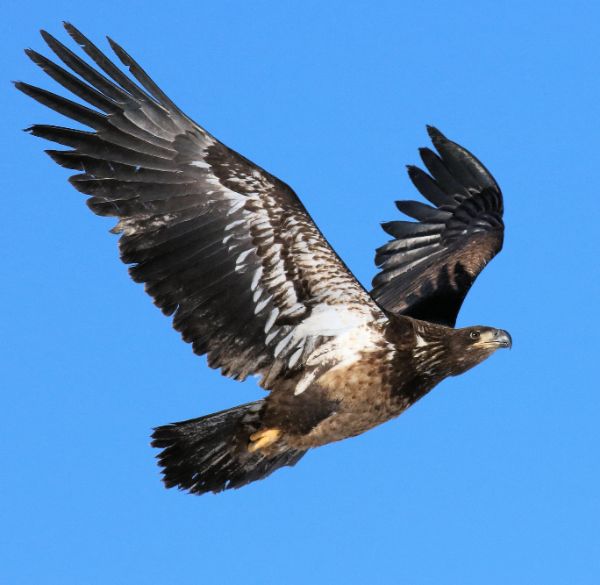
Biologists who have been tracking Bald Eagles that fledged from nests in Arizona found that most migrate north after the nesting season, sometimes extending their movements into southwest Canada during summer and fall. Rather than making a southbound post-nesting migration used by most migratory birds, the Arizona population of Bald Eagles showed they follow northbound routes where the young eagles made stopovers at lakes and rivers. These discoveries point to the need for targeted conservation of critical travel corridors and feeding areas beyond Arizona nesting territories.
A new scientific article published in the Journal of Raptor Research describes how Bald Eagles that fledge from nests in Arizona shows they are highly exploratory, likely so they can locate short-term food sources during summer and fall. From 2017 to 2023, the Arizona-based research team fitted satellite transmitters onto 24 soon-to-fledge Bald Eagles to follow and map their movements within and beyond the state. The researchers tracked individual eagles for as long as the GPS-tracking devices continued to function, in some cases for up to 4 years during the 7-year study period. The tracking data collected provided important information that has broader implications for conservation strategies for the Arizona population and the species.
Nesting Bald Eagles in Arizona are generally believed to remain near their nesting territories for much of the year, but there has been little information about what young non-nesting eagles do (Bald Eagles usually begin pairing and nesting 4 to 5 years after hatching). Because survival varies across different life stages, comparing movement patterns and survival rates of sub-adult Bald Eagles with those of adults gives biologists a more complete view of how the species is faring across its range and at the population level.
Bald Eagles that nest in the state of Arizona lay eggs and raise young during winter and spring, so their post-nesting season actually takes place during the summer and fall. Lead author Dr. Caroline Cappello was intrigued by the different timing of seasonal movements and noted that "northward migratory behavior raises interesting questions about the recent and historical pressures that shape these movement strategies."
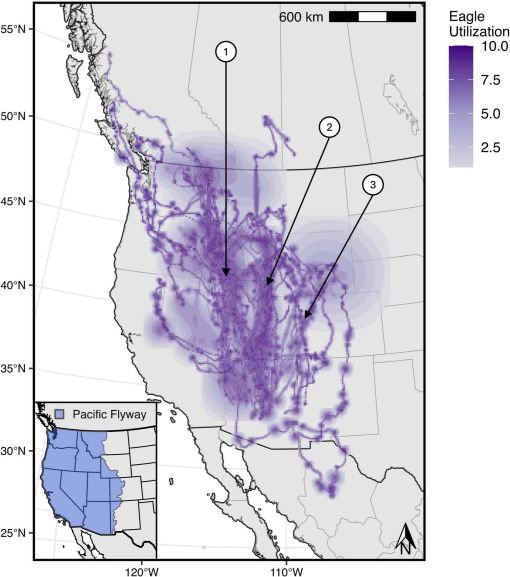
The research identified common migration routes, stopover locations, and migration phenology. The GPS-tagged Bald Eagles migrated north along 3 primary routes: (1) Along the Wasatch Mountains in Utah and extending into the Rocky Mountains of southern Idaho; (2) through eastern Nevada and along the Rocky Mountains in western and northern Idaho; and (3) through western Colorado and Wyoming. The researchers also reported that the Bald Eagles they tracked made stopovers at many of the same lakes and rivers that a study in the 1980s identified as important stopover sites for the species. This overlap supports the idea that these habitats have remained crucial gathering points for multiple generations of Bald Eagles.
Beyond confirming a strong use of the Intermountain Flyway and a historic dependence on lakes and rivers along their routes, the study showed that eagles of different ages migrated to northern states and southern Canada. Co-author Dr. Javan Bauder emphasized the significance of this new information, stating "Managing and conserving wildlife populations requires that we understand the movement patterns of individuals of all age classes within these populations."
The team also observed that as the Bald Eagles aged, their migration pathways became more precise and refined. Most of the eagles that were tracked for at least 2 years came back to Arizona in the fall of their hatch year after spending the summer roaming farther north. The researchers suggest that these young eagles could be taking advantage of seasonal food sources supplied by spawning salmon, nesting waterfowl, or carcasses of large mammals. Determining whether this is true will require additional research into a number of topics, but the new data already provides important insights into this interesting population of Bald Eagles that nest in Arizona.
To reference the Journal of Raptor Research publication, see Northward Migrations of Nonbreeding Bald Eagles from Arizona, USA. The information for this article was largely based on that source and this Science Daily article: These Bald Eagles fly the wrong way every year and stun scientists | ScienceDaily