
American Avocets must be considered among the most elegant and graceful of all shorebirds, topped off with their long, thin bill that has a uniquely upturned curve, especially in female avocets. And during the nesting season, they are among the most colorful shorebirds too, with their standout alternate plumage that catches everyone’s eyes when their bright cinnamon-colored head, neck, and breast sets off their pied black-and-white body plumage and long pale-blue legs and feet. But months after the nesting populations left the region, a recent upsurge in stopover avocets has assembled at a few chosen wetlands. Some appear as lone birds, others in small flocks, and in some cases, especially large gatherings of feeding American Avocets concentrate.
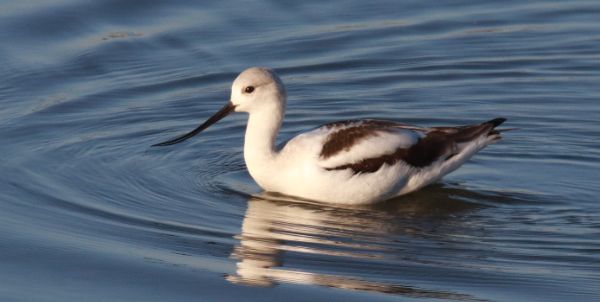
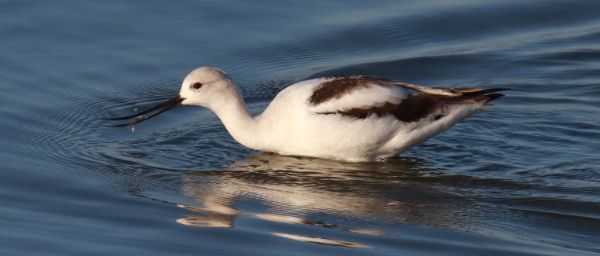
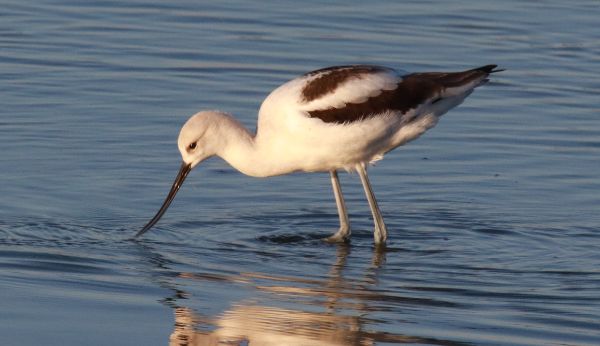
But now, the avocet crowd is back to basic plumage, that notably lacks the showy cinnamon-colored plumage of spring and summer; replaced by white plumage on the underside and white accented with a gray shadow on the dorsal side. While a bit less colorful, they are still very striking birds and no less elegant for the change. Avocets have always been among my favorite birds to observe, even during simple feeding activities, while wading, picking at tiny aquatic “bugs;” or sweeping their long bills back and forth to locate invertebrate morsels. At times their searches extend to swimming food searches, utilizing their partially webbed feet to navigate deeper waters beyond the reach of their long legs.
During a recent birding drive to Hecla Marsh and Sand Lake National Wildlife Refuge, a highlight during my return home was finding a large concentration of American Avocets that numbered 80 or more at Erickson Marsh, a few miles west of the refuge. It was an exciting find, but the day’s sunlight was nearing an end, and the birds were all fairly distant – but I’d be back for a focused avocet photo effort. With a beautiful period of late afternoon sunlight at hand a couple days later, I returned to the marsh that I suspect is rather saline considering the lack of vegetation along the shores – just the kind of wetland where avocets and other shorebirds and ducks find tiny shrimp and similar small crustaceans in abundance.
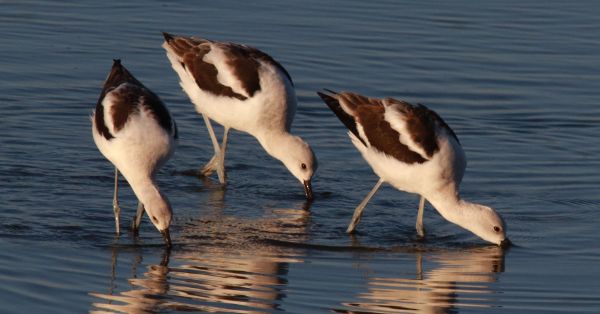
When I arrived, the avocets were still on hand in similar numbers, and this time they were scattered on both sides of the road, which was a big plus for the potential of photo success. With the sun’s arc farther to the south these days, the presence of a few American Avocets foraging along the shallows on the north side of the road was a best case scenario. And the avocets were in no way concerned with the stealthy but obvious approach of my mobile blind well off the side of the road. The light was right and I steadied my camera lens on the slightly raised window of my car as 1 to 4 avocets were in constant motion before me, wading and swimming within 20 feet of the shore. I repositioned my car as needed to keep in photo range of the avocets, and used a wider than usual f-11 aperture to accommodate more than one bird within the range of focus, which also provided an amply fast 1/1000 shutter speed to stop feeding motions.
Occasionally, a few distant avocets would take flight, even crossing above the road; but all at a considerable distance from my position. At one point I repositioned with an interest in photographing avocets in flight, but that option didn’t materialize – until my next avocet photo trip. Last Friday afternoon, in spite of a wind factor, I headed for Erickson Marsh again, and even before I could assess for birds along the shore, I saw a number of avocets flying and immediately decided to try to get into position in case the flight activity continued. As I pulled into a safe position to park with the “usual” flight path before me, I noticed the low, slow flight of a Northern Harrier as it winged toward 2 resting flocks of avocets to the north.
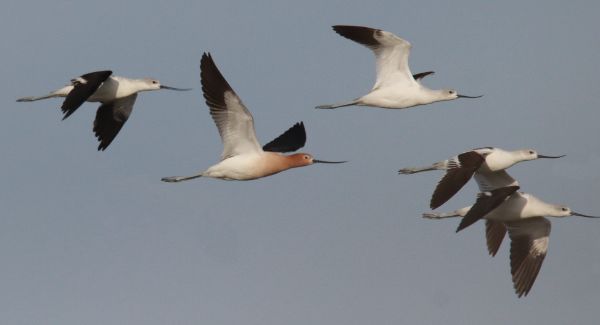
Thinking this could be a good opportunity, both of the flocks of avocets took flight as the hawk approached. The first flock showed promise as the birds were initially pointed in my direction, but they turned to the east, rising into the blue sky background. The second flock of avocets was right behind the first, but they continued flying in my direction and I began focusing on the group and following their movement as they approached and elevated into the blue sky. Thinking this could be a perfect flight photo scenario, I began photographing as a number of the avocets approached, and as they passed before me and leveled off, I hoped for the best as the south wind seemed to slow their progress.
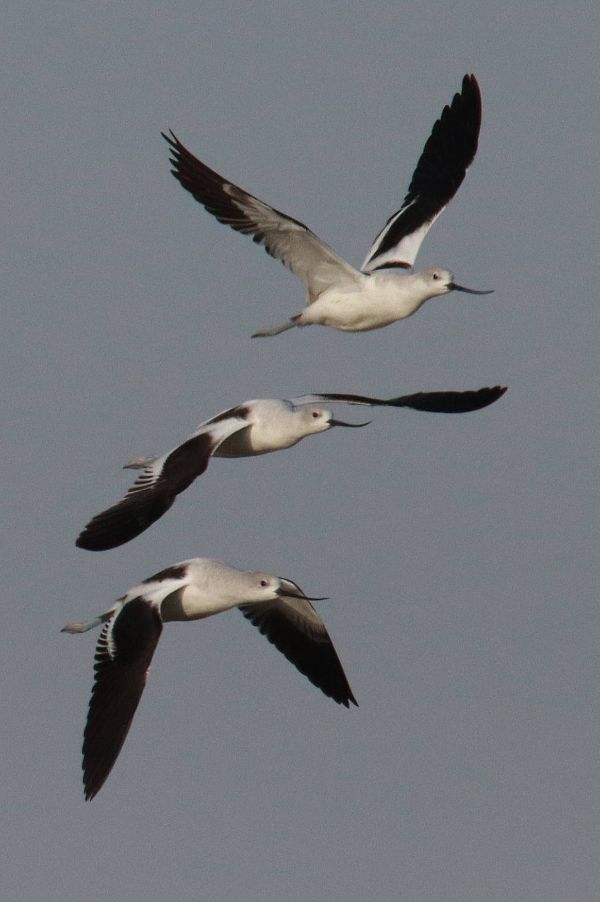
In the midst of the group was an obviously colorful American Avocet, and after some initial photos I characteristically focused on the unique individual for the next couple photos – and in another 2 seconds, the avocets had passed. Woo-weee! That was exciting, and I imagined there could be a couple keepers among that group of flight photos. I checked for other birds in flight, saw none, so referred to my camera’s playback screen. The miniature photo replay made me confident there could be a couple winners in that group of flight photos. The avocets remained active, taking flight periodically, individually and in small groups, and I had a couple photo ops thereafter; but they didn’t show the promise of the first series of flight photos. I spent some additional time waiting for some action among a group of a dozen avocets at rest and preening, hoping for a bird to stretch its wings high above its back in avocet fashion, or do a wing flap at the end of a preening session, but didn’t have much luck with that.
Back in my office, I was excited to review the new flight photographs, and was thrilled with the results! The lighting on the avocets was perfect, and the birds provided a couple exceptional photographs as they winged before me that afternoon! As for the fully colored American Avocet whose hormones were obviously out of balance for October, I couldn’t be happier to have it add a very special accent to the images it appeared in! Its alternate plumage couldn’t have been brighter or more colorful if it was May. I had seen a colorful avocet among the many viewed during the previous photo period, but always at a far distance. During the second photo session I documented it in an exceptional way, in flight among other avocets in basic plumage.
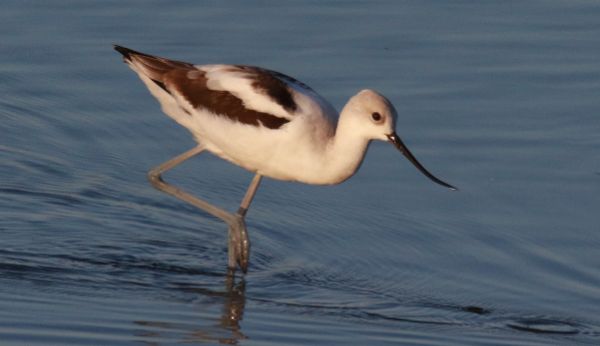
One point of note: Because I arrived during a flurry of flight activity, I didn’t have a moment to double-check or revise my camera settings. As a result, I took the flight photos using my usual preset f-8 aperture setting. In hindsight, if time permitted, I would have adjusted the aperture to f-11 to have a wider area in focus to accommodate several birds as they flew in close formation. But as it stands, all the birds are in focus in most of the photographs, and everything worked out fine digitally. I doubt my time photographing at the avocet gathering is done, especially considering that each time I visit the marsh the avian activities and positions of the birds and flocks are different, which makes the photographic potential especially interesting. Then too, there are other shorebirds, ducks, gulls, and other birds on hand at this avian concentration site. Good Luck in all your October birding activities, at home and in the field; and take advantage of the fall colors and weather that makes nature all the more enchanting.
Article and Photographs by Paul Konrad
Share your bird photos and birding experiences at editorstbw2@gmail.com