
During my first of October birding trip into areas of early peak autumn colors in northern Minnesota, stretching to Bemidji to Audubon, the Northwoods were colored bright yellow to golden as even maple trees were in their earliest golden beauty before turning red. As the sun was low, it was clear that my last stop would be Tamarack National Wildlife Refuge, which turned out to be one of the most colorful locations on my expansive circle through the region. As I passed through thick deciduous woodlands of aspen, birch, maples, and oaks, in the back of my mind I was recalling a small blue-water pond that held a pair of Trumpeter Swans when I passed by in May. But the deeper I drove into Tamarack, jays, ravens, and juncos were catching my attention as the spring vision faded – until, as I rounded a corner, a single white swan at rest punctuated a pond’s edge.
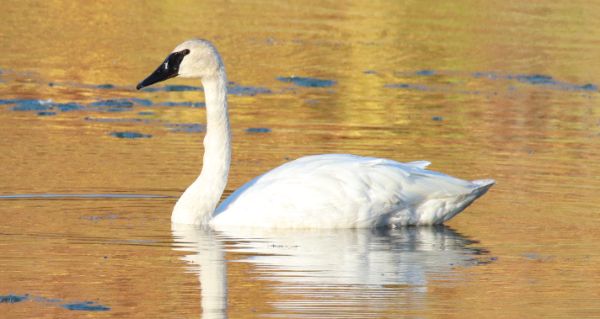
As the dormant bird laid motionless in the shade of a green pond edge, the road curved round the waterway and a break in the trees revealed another adult, and 3 young but full-sized gray Trumpeters. As I circled into a safe parking position with a view of the swans, I realized the side of the pond where the sun was shining was adorned in a beautiful shade of gold, reflected from the curtain of yellow leaves on the opposite side of the water. As the 3 young swans swam away from the sunlight, the adult female glided into it, providing a classic swan image surrounded by golden splendor. That image translated beautifully onto my camera’s digital memory as it touched my heart and soul in the crowning touch of a wonderful day among golden trees in northern Minnesota.
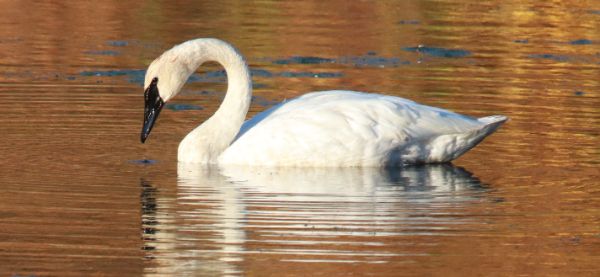
That said, the tranquil photo session continued as the swan dipped her head into the water in feeding motions, and I could see water moving behind her as she paddled the mud to reveal plant tubers below. In the process, she moved into an area where the water reflected a deeper shade of amber color that added another aura of beauty to the statuesque white bird, among the biggest birds in the world. Moments later she slipped unceremoniously out of the sunlight, and the magic moments dissolved into memory, but remained as fall photographs. As bird photographers, we can’t direct a scene, the sun, or a bird; but nature surely produced the best photo ops of the day, just as the sun slipped behind the tall mass of trees in the west.
In this case there isn’t much to describe from a photographic standpoint; I simply used my basic pre-set f-8 aperture, and given the available light on the bright white swan plumage, the sunlight provided shutter speeds of 1/500 and 1/800, plenty fast to stop the relaxed movements of the swan ballet. On a day when I expected more songbird and raptor action, with some Wood Duck possibilities, the mature white swan’s elegance won the day amid liquid gold and amber waters.
Article and Photographs by Paul Konrad
Share your bird photos and birding experiences at editorstbw2@gmail.com