
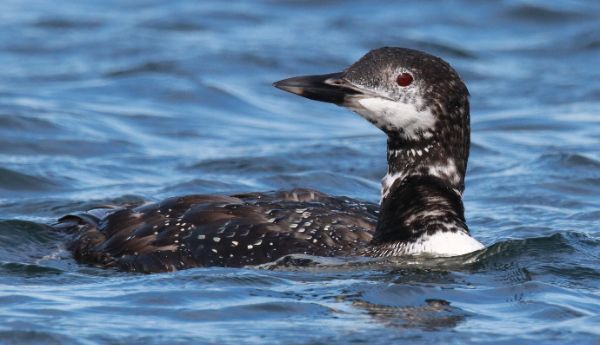
As the very first leaves showed hints of yellow and orange coloring among the many shades of green in the Minnesota woodland bordering Little Pelican Lake, the first loon of the afternoon showed dramatic differences in its adult plumage from our previous lake outing. The first loon sighting was from shore as I caught sight of a distant loon flying low above the lake, and a binocular view showed it as a heavily molting adult flying rapidly just above the water, then skimming the surface with white splash-water spraying to the sides and behind the big Common Loon as it landed. I believe that was the first time I have seen a loon land, and it was a delight to view, even from a distance.
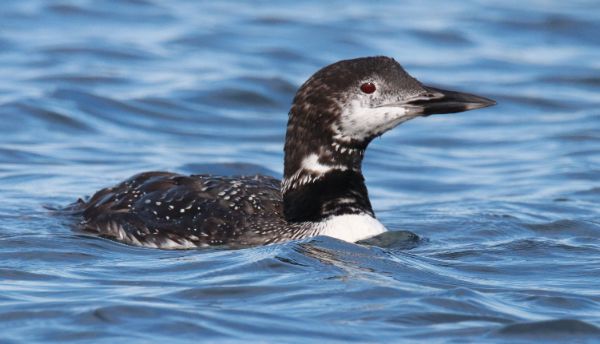
After Andy and I both made trips to get battery-charging equipment to jump start the Loon Pontoon’s battery, we left a charger on it and opted to take the much smaller 2-seat fishing boat that we commandeered from Andy’s son Dustin, who was unaware. No sweat, and we were glad to be on the water after looking forward to this loon outing. During our slow search of the opposite shore, the loon I observed landing eventually showed above water to add another level of excitement to the moment. The loon was well into a molt from its basic plumage toward its very different alternate fall and winter plumage, looking pretty motley as it was about ¾ of the way through its molt period. At this point you never know if this is a summer resident or a loon from central Canada or another Minnesota lake to the north, but here it was!
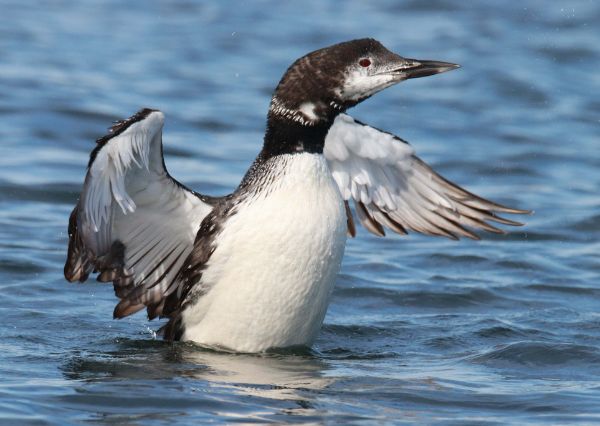
Andy steered the little 25 horsepower motor into position by hand with the sun behind us and the loon in front of my camera lens as the impressive loon permitted a minute or so of photo ops before it dived deep into the lake water. Thereafter, the loon kept a considerable distance from the little blue boat, and that would turn out to be the norm for other single loons we would encounter that afternoon – they would provide a brief photo session, then dive below the surface for extended periods, returning to the surface a considerable distance away and diving again. As for captaining the small watercraft, the wind was a factor, as expected; especially with the light aluminum boat and mini-Yamaha motor. But the loons were getting the same wind-blown action, and Andy did his usual great job of steering and trying to keep us in prime photo position without affecting the loons activities. I asked him how often he used this boat, and he held up one index finger and said: “first time,” and we chuckled.
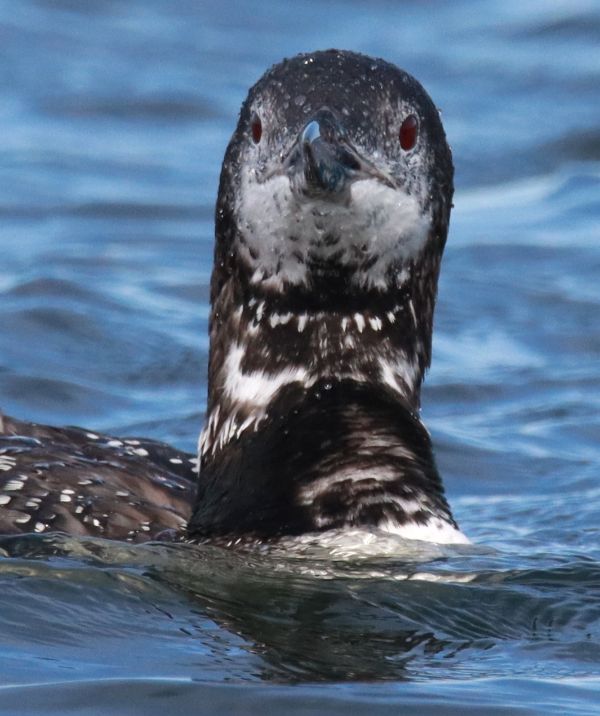
The next loon encounter was on the opposite side of the lake, where we found a young loon in about the same location as we photographed a pair with 2 young that still retained some down among first plumage feathers 5 weeks earlier. Clearly on its own now, this young loon was a diver; but at one point it surfaced within 5 feet of my slightly elevated seat for me to take a quick volley of photos. Then it disappeared underwater. We don’t know how that can happen, but loons regularly seem to vanish beneath the water without a trace; although last Thursday afternoon, all the loons we spent time with stayed below water for extended periods that seemed much longer than “normal.”
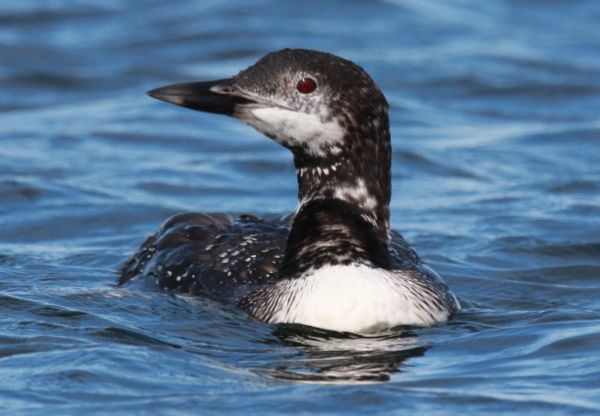
Anyway, that’s when Andy suggested we make the move to the much bigger lake – Pelican Lake – via the barely moving Pelican River that now had a high curtain of cattails on both sides of the waterway at its east end. I asked about the wind factor with the little boat and Andy figured if we followed the south side of lake, we would be fine, and so we were. In the second bay we encountered the first loon – another molting adult, but this one was more recently introduced to the molt sequence and had an overall blacker coloration – very dramatic looking. During our initial and only photo session with this adult, it provided a really special series of photo ops – it was a spectacular bird in a unique plumage combination.
Just as the molting adult was edging at an angle away from the prime sunlight, I caught sight of a young loon in the distance, seemingly headed our way. I asked Andy to focus on the young one, which seemed to be a simple matter of waiting for it to continue its approach in our direction. I heard the adult make a low call, and the young loon answered in barely discernable note that was dimmed in the wind, so it seemed they were connected and the young bird would join the older one, but they remained separate and the young bird turned up on the opposite side of the sunlight when it resurfaced, having traveled quite a distance between breaths.
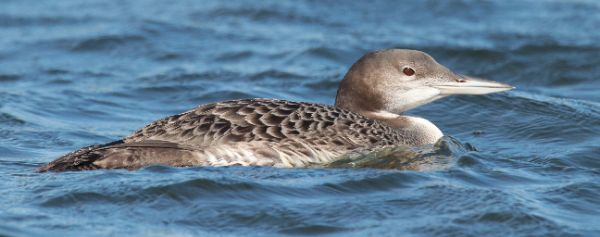
When we did get into position with the younger bird, it had a prey item in its beak and fumbled with the young crayfish as Andy angled around to take advantage of prime sunlight. After swallowing the food, the young bird began preening, and during the activity we all drifted into the middle of the big lake, windblown. As a result of the wind and wave action, it became increasingly difficult to keep focused on the young loon due to the bouncing action of the little boat. At the same time, the small waves surrounding the loon created another level of difficulty as I waited for waves to pass by the front of the loon to expose more of its body, and in the process it was interesting to see how the water color and texture changed incessantly.
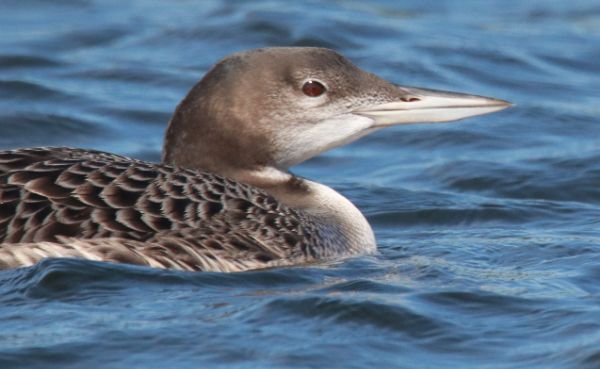
When the young loon finished preening, it flapped its wings, ruffled its feathers, leveled off, and dived; and with that, Andy and I checked the time and decided to call it a very successful loon cruise with a nice selection of photos to show varied stages of molting adults and enjoyable moments among the recent fledglings. Oh, forgot to mention: The second young loon surfaced within 2 feet of the little boat during one of its shorter dives, but was apparently surprised and likely startled to find the boat so close and quickly lunged under water again to surface a short distance away.
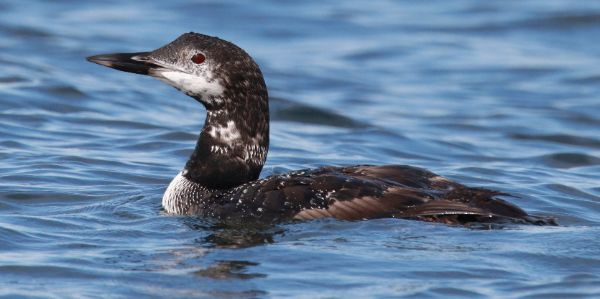
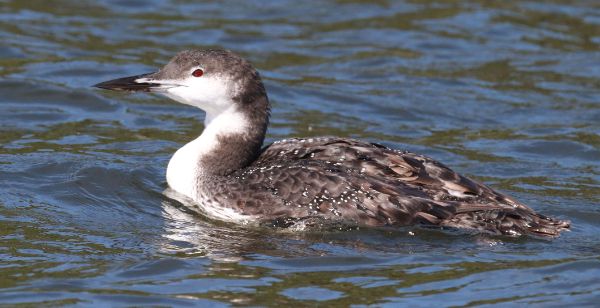
While this article might seem like more of a play by play of our afternoon loon photography boat trip, realistically, that’s what any photo adventure adds up to, hopefully with some fine photographs as a result. The activities leading up to the photos and during photo interactions is all part of the photo experiences that keep us engaged and watching for the next bird and the next time a bird makes an interesting move or takes an attractive pose. On the technical side, you can see how I changed the magnification by zooming my lens, and how the shutter speed varied in different locations in response to lighting and surrounding reflections by checking the camera data I include with each photo in this feature.
After the action on the lake, the next step is to review the photos, select some standouts and representative photos, crop them as warranted to fine tune the overall image, and save them separate from the original photos and entitled with a special name and date. With a level of enthusiasm at the outcome of the results, we can send copies of the photos to friends and associates, family, fellow birders, social media contacts, and anyone else that comes to mind, which makes the resulting photos and a short story behind them makes the birding experience all the more special. It’s not just the photos we manage to take, it’s the story behind the photographs too.
At the same time, in my office the photos become part of my fall season file of favorite bird photographs, as well as the eventual annual selection, and my total lifetime achievement files (ha) for future use and reference. In this case, I can specifically check back on Common Loon photographs I have taken during past late summer and fall loon cruises that I have enjoyed with a host of friends over the years, to refer to photos of adult loons in a variety of stages of molting, from basic to alternate plumage, from recent fledglings to seasoned adults, to compare plumages and get a running photo description of the process. It’s all part of getting a little more involved in birding, including bird photography and how you can use your camera to learn more about the birds that you encounter and interest you most. Enjoy all your birding adventures with your camera!
Article and Photographs by Paul Konrad
Share your bird photos and birding experiences at editorstbw2@gmail.com