
I had big plans for the day, with exciting birds in mind, but the tires of my car barely began moving down the road before I caught sight of a big adult female Cooper’s Hawk standing next to a rainwater puddle just 150 feet south of home. I’ve seen this scenario before and figured the hawk was preparing for an afternoon bathing session. But would it permit a quick photo before reacting to my stopped auto? I took a couple initial photographs before it took 3 steps into the shallow water to begin taking a few drinks. That was a good sign the hawk wasn’t concerned with my car or camera lens, even though she was on the ground in the open.
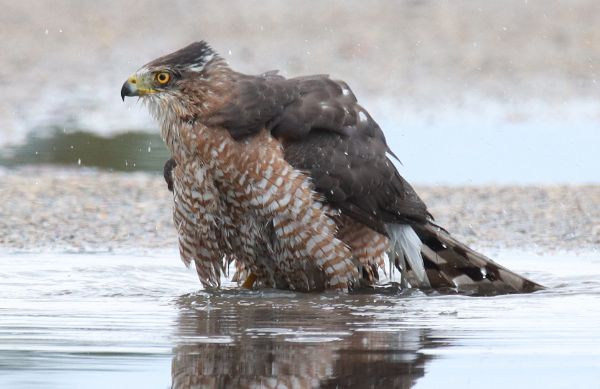
This was a treat, because a Cooper’s Hawk will occasionally stop in my wooded neighborhood, but they are not common and seeing one in this area is always exciting. After 3 sips of water, I was surprised to see the Coop dip low and begin an enthusiastic bathing episode that added loads of action to this impromptu photo session. Each time she dipped low into the water I took 2 or 3 photos to try to get a nice action series as she ruffled and flapped her wings in the water. Soon she spread her tail too, which added all the more interest to the images. I felt pretty lucky to have her so unconcerned in her bathing activities, as she provided front and side views as I photographed.
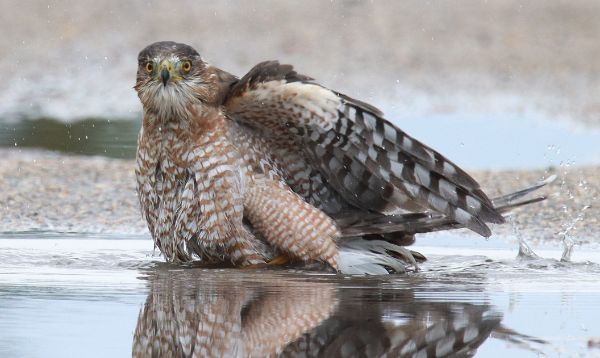
The big female engaged in at least 3 bathing sessions, some very enthusiastically. But after her last dip, she added a light feather ruffle, turned, and flew to an outer branch in the middle of the nearest tree. I repositioned my mobile blind again and managed to take 3 photos before she flew out of sight to the north. It was a great bonus to what would become an expansive birding drive thereafter. The other times I have photographed a similar bathing episode, the hawk was in a position that had a somewhat unsightly background; but this opportunity offered a fairly open scene.
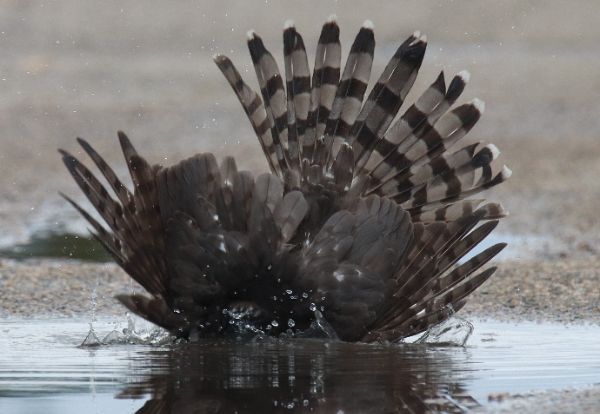
Lighting was a factor – good, bad, or in-between. Uncharacteristically, I had to make do with the light I was dealt: Shaded sunlight veiled by clouds. But in mid-afternoon, with the sun supposedly high overhead, the clouds provided a somewhat uniform light that reduced shadows, which would have been harsh under a sunny sky. As it turned out, I needed to work with the existing light, and considering the time of day, it was probably the best case scenario to document an interesting behavior that not many people get to observe, much less photograph. As a result, the colors are not bright, but they are true even if they are slightly muted; and I must add that I am very pleasantly surprised by how well the photographs turned out, all things considered.
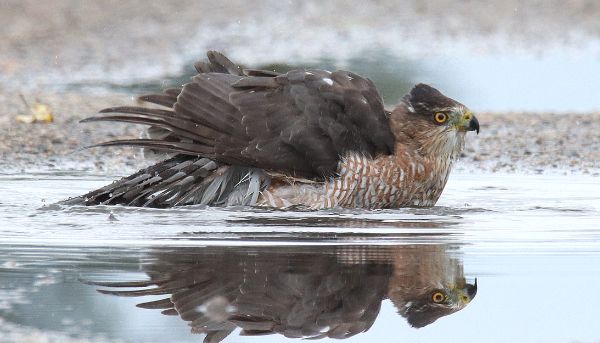
Even as I was photographing, I had the impression that the underside of the hawk would be shaded in darkness, but upon reviewing the images on the big screen of my laptop, I’m a bit baffled that almost no shadow shows in the photographs. I often emphasize the need for good sunlight, because sunlight from behind your position produces the best quality photographs with the most accurate colors – when the sun is at one side of the sky or the other (not overhead). I was also impressed with the sharpness of the photographs, because I expected some blurring due to the lower light conditions. Some blurring would be OK under the circumstances, and might even have added to the impression of movement in some ways, but by using an aperture of f-7, the resulting shutter speeds were between 1/640 and 1/1000, there was no sign of blurred movements. (Perhaps I should have tried to force some blurring by changing the aperture to f-14 or f-16 to reduce the shutter speed appreciably.)
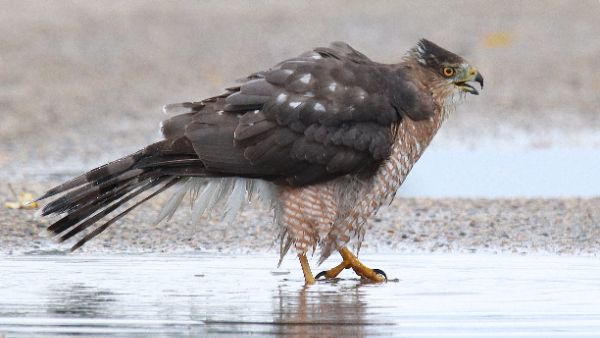
The action in the photographs shows at an excellent level in some photos, and while I simply took advantage of the opportunity the hawk provided momentarily, I couldn’t have imagined the resulting photos would turn out so well. That’s certainly fuel for taking the photos as best you can and hoping for the best. In this case, I was able to take many photos, so reviewing and selecting the photos was an important part of the process, as always. The editing the selected photographs by cropping each one to emphasize the bird in the photo frame that you create limits the extraneous background, helps to focus interest on the bird, and also serves to enlarge the image of the bird.
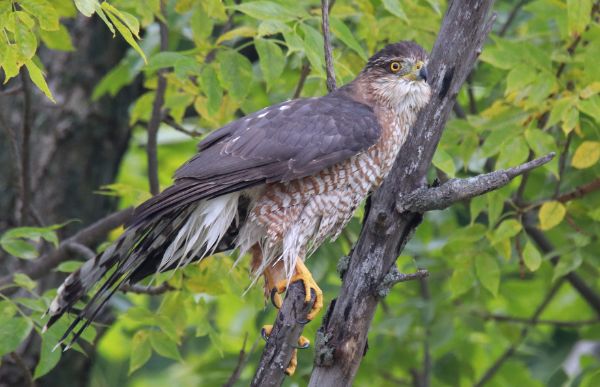
Hope this a good example of how to spend extra time with a bird that permits you to observe and photograph it from a distance. The really surprising thing about this opportunity is that it took place so close to my home, and it stands as another great example of how you never know when or where you might see a bird that permits you to photograph it – in good photo conditions, or not so perfect conditions. It also underlines the importance of timing: What if I left my house 5 minutes earlier, or 5 minutes later? “Timing is everything,” but in this case there is a whole lotta luck involved too. Good Luck as you enjoy birding with your camera in hand!
Article and Photographs by Paul Konrad
Share your bird photos and birding experiences at editorstbw2@gmail.com