
When photographing birds, one of my favorite things is when you get into position a safe distance away from the birds, conscious not to get too close or to disrupt their activities, and the birds approach closer to your position. With most loons that seems to happen over and over again, even during the same photo session. It puts me at ease and adds another level of enjoyment in the moments on the water with loons and other birds. That point came to mind time and time again last Thursday when I returned to Little Pelican Lake near Detroit Lakes, Minnesota to join my friends Andy and Linda for a follow-up mid-season loon cruise. The sunlight was ample but the wind made piloting the pontoon boat more challenging at times for Andy, but fun nonetheless.
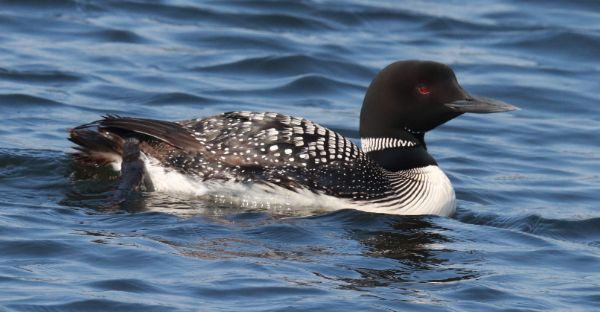
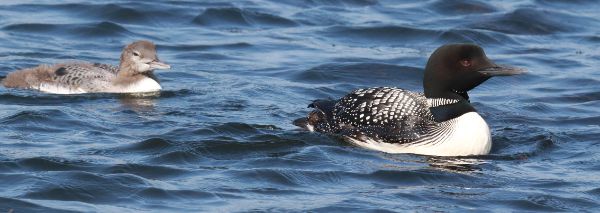
It took a while to find the first pair of Common Loons on the opposite side of the lake, but we were thrilled to see the adults were in the company of 2 nearly full-sized young loons that were partly feathered but still had at least 1/3 of their down feathers in place on their crown, neck, and rear section. This lively family group offered a variety of activities to observe, enjoy, and photograph, with the adults quite vocal to begin with and the young loons exercising their wings repeatedly. But that gave way to searching for food, with the adults diving regularly, and the young loons were diving occasionally too. At one point, an adult had a pretty good-sized fish, which it seemed to be dispatching to a point, before letting the fish go when the young loons approached, seemingly to encourage them to “catch” the fish and swallow it. This took a couple tries, but one young loon received a belly full of fish in time.
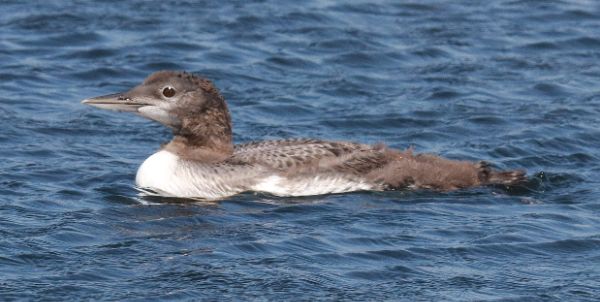
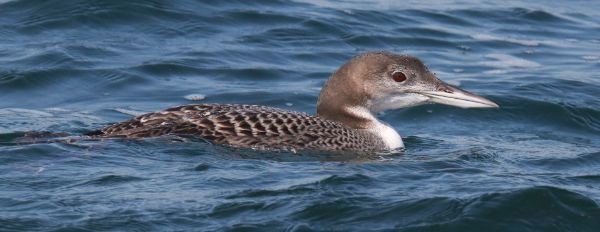
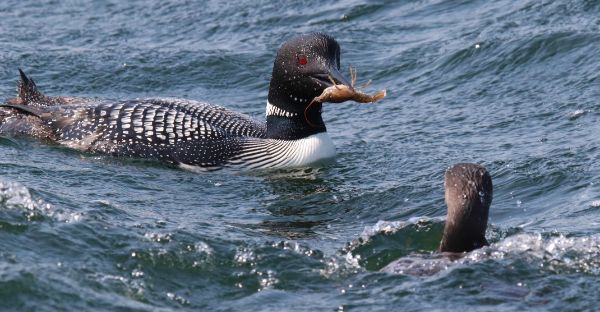
We ventured to the much larger Pelican Lake next, where we hugged the south shore beyond the wind’s reach, until we rounded a point where the full blast of the wind made it clear the rough water was not a place to find a loon family. Andy sped up as we returned toward Little Pelican Lake, but suddenly, out of the blue water an adult Common Loon popped up with a crayfish in its beak! Of course, there are no brakes on a boat, but Andy cut the engine in time for us to coast close to the loon, which was promptly joined by a young loon that popped into view from the water below. It was duly offered the crayfish and swallowed it directly. These loons were joined by another adult and newly feathered near-fledgling to show they were another family with 2 beautiful young loons.
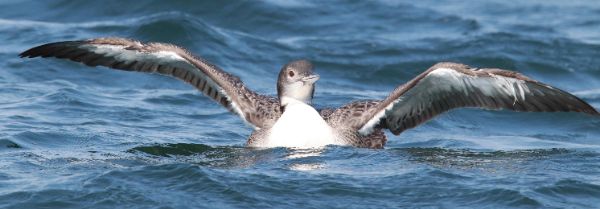
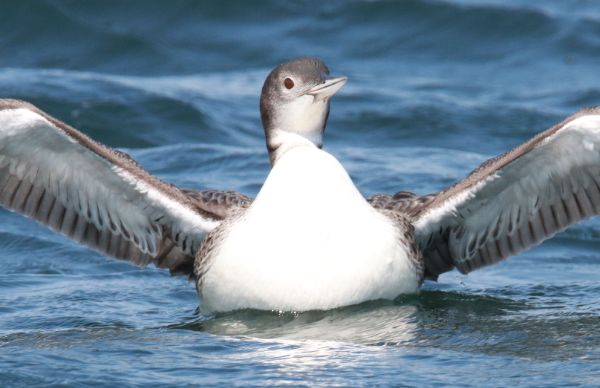
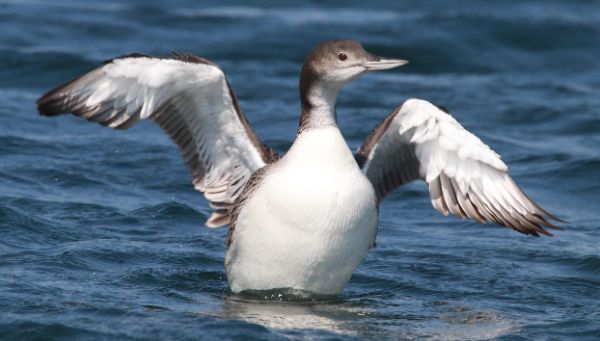
During that episode, we were rocking and rolling in the wind-driven waves, but made the most of photographing the group. But only later, after reviewing my photographs, did I realize that these young loons had no down feathers and they appeared to be well-feathered and about to fledge – if they weren’t already taking some initial flights. When one of the “fledglings” raised up and flapped its wings, the resulting photos I took showed that the wing feathers were clearly fully developed and ready the young loons were ready to take to the air. This was in stark comparison to the first 2 young loons that were about 3 weeks behind in their development toward being fully feathered and ready to fledge. But I was only able to ascertain this considerable difference via my photographs, and I was quite surprised that it wasn’t more apparent when viewing the more developed young loons on the bouncing boat as I peered through my camera lens (which again emphasizes the importance of taking photos to learn more about the birds we observe).
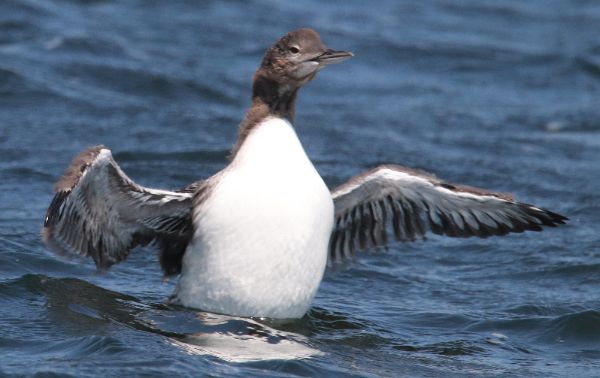
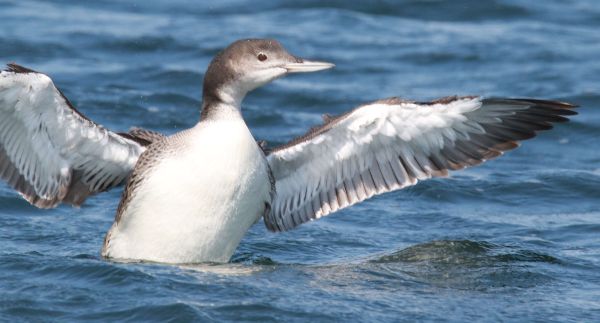
The difference in ages of the young loons at the 2 lakes fits into the premise that the loons on the big lake lay eggs almost a month earlier pairs nesting at adjacent Little Pelican. Although there has been a very small study group for us to consider the past 2 summers, the difference is very clear in the photographs I took Thursday and last year. Aside from that, Thursday the 2 lakes also offered different water conditions and photo action, as well as pontoon captaining challenges, although there was ample sunshine and blue sky throughout our 2-hour cruise. In the company of family groups I was using a wide aperture of f-11 in case a couple loons moved close together. During a photo session, I also try to take an occasional look at a couple photos on the LCD mini-screen on the back of my camera to ensure the colors are showing true and to double-check the shutter speed and anything else that stands out.
After a few years of providing excellent pontoon maneuvers, Andy is a master at getting into position with individual loons and family groups, while understanding the importance of giving them ample space so the loons remain at ease and don’t change their behavior. Keeping the sun at our backs and the birds in front of us is second nature for Andy these days, and most of the time he stops the engine while we are photographing – unless he needs to maneuver due to the wind and wave action. We are also aware not to spend too much time with the birds, just in case we are impacting their fishing luck or other factors.
While it is a 3-hour drive for me to join Andy, Linda will be returning to her Hollywood home next week, so this was a special outing for us to share on the water, and she was excited to show some scenery and loon photos from our outing with California friends and family. It’s always great fun to share time with Andy and Linda, college friends that remain among my favorite people – as well as with other friends that I get to share some birding enlightenment with as they share updates on their fruitful lives – all part of great birding experiences in Lakes Country.
Article and Photographs by Paul Konrad
Share your bird photos and birding experiences at editorstbw2@gmail.com