
The morning dew added to the freshness of the river valley an hour after sunrise as I stepped into a truly remarkable hummingbird garden. To my delight, more than 30 hummingbirds were active the evening before, which kept me actively photographing every minute of my 2½ hour visit that followed a 6½ hour pilgrimage to stand among the beauty of the flower-covered garden as the smallest birds in the eastern half of America zipped by within inches, 2 and 3 at a time as they chased one-another around territories perceived by some. Better yet, they were feeding on nectar from select flowers or one of the dozen hummingbird feeders positioned throughout the Henderson Hummingbird Garden.
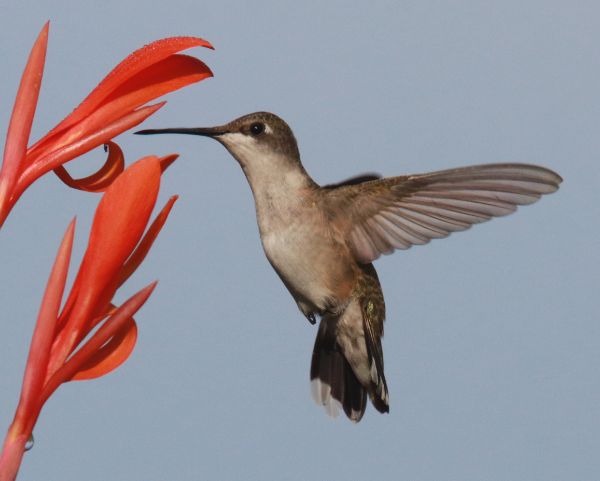
Located in south-central Minnesota’s historic town of Henderson in the midst of the beautiful woods and wetlands bordering the Minnesota River, this hummingbird hotspot was established in 2010 and has since spawned the advent of the National Ruby-throated Hummingbird Center! So there I was, photographing on hallowed ground that was literally filled with hummingbirds of the singular species. During that first visit I always had a hummingbird in sight, and often it was 3, 5, and even 7 hummingbirds at once. I preset my aperture to a tighter f-7 to emphasize a faster shutter speed, and when the sunlight faded I reduced the aperture to f-6 (the lowest setting on my zoom lens). While it would be nice to stop the action of the hummingbirds’ wings, it’s not likely to happen and when we watch hummingbirds in flight, their wings are a blur to our eyes anyway. As always, my camera’s Al Servo is always set at “continuous” to take photos at a speed of 5 per second as long as I hold the shutter button down.
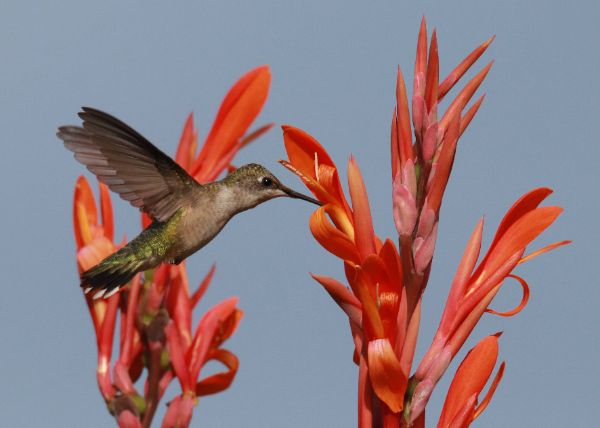
At this point, please permit me to share that hummingbird photography is not limited to advanced photographers. Believe me, anyone with a camera beyond a smartphone can take photos just as good as what you see here. So please give it a try, if it’s at your own feeder or flower garden, or at a super hummingbird garden like the one I visited in Henderson. Photographing hummingbirds is truly an underestimated fun experience and taking good photos of hummingbirds is easier than you might think.
Surrounded by the sights and sounds of hummingbirds, with my camera in hand I was constantly focusing on the next one that might provide an ultimate photo, zooming my lens in and out as needed to keep my efforts even more active. Trying to emphasize the much fewer males with their iridescent ruby-red gorget, it made the hummingbird photo challenges even more difficult, but ever more exciting. More challenging due to their scarcity, but also because their iridescent gorget requires a male to face into the sunlight in just the right angle, which frankly doesn’t happen very often. And if the gorget feathers are not irradiated, they show as an undesirable dark gray color.
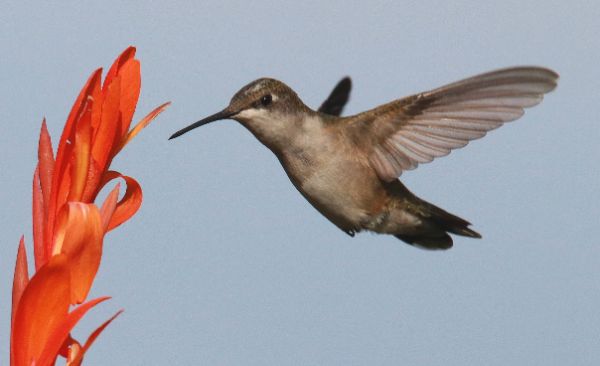
During the first hours the hummingbirds stayed low among the vegetation, feeding on flower nectar and feeder nectar, but by staying among the abundant plants and flowers, the resulting photos usually showed “busy” surroundings, but photo opportunities abounded and the resulting photos were every bit as good as I hoped for. Watching for “scenic” locations with hummingbird action within the garden, I regularly found a promising location to stand motionless at to wait for photo ops – with the sun at my back, of course.
The first and last thing you notice in the company of many hummingbirds is how fast they zip and zoom and turn! So it’s necessary to act and react with added speed and intensity, trying to anticipate a bird’s movements, trying to follow a bird through you lens and keep it in focus, reacting with a quick shutter button move, and when the situation indicates it, holding the shutter button down to take a few photos at a time. Eventually, as the sun showed lower in the west, I sat at one of the convenient chairs or benches to get lower in the line of the sunlight and the hummingbird activities. Enjoying the experience so much and being rewarded with unlimited photo ops, I would have continued longer but left when shadows covered the garden – hoping for a sunny morning to resume my hummingbird photo extravaganza.
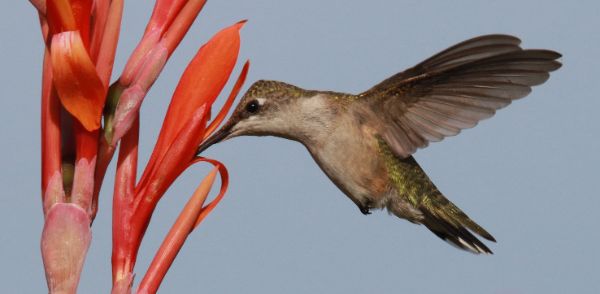
Back on site an hour after sunrise with scattered clouds kept me hoping for more breaks in the sky for sunlight to filter through, but more important: Where are the hummingbirds? It was a little on the cool side with everything covered with morning dew, so I had dialed down expectations a bit and realized this morning photo session was going to be more of a 1-on-1 activity. Single hummers appeared at feeders and flowers and I sat down on a picnic bench facing a line of Salvia flowers at ground level, some ball-shaped Cleome (spider flowers) behind them, and tall Canna lilies that had flower spikes that reached toward the sky. The cannas provided reddish flowers surrounded by blue sky – a perfect photo setting; so what were the chances of hummingbirds flying in to this perfect setup? (I had a tip from another photographer the previous afternoon who said Ruby-throats especially visit these flowers during mornings.)
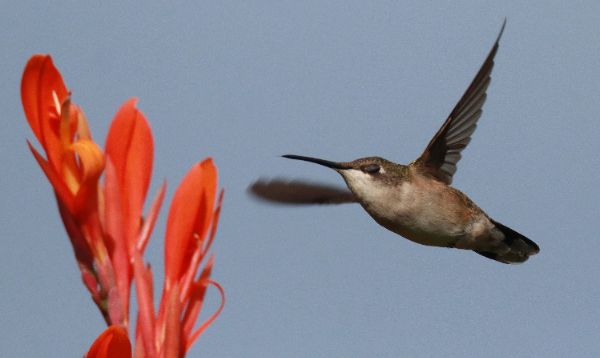
The first hour was pretty bleak from a hummingbird photography standpoint, but I already had a nice collection of hummingbird photos from Wednesday’s active photo session, so I sat tight and hoped for the best. Within minutes of the first hour mark, a female hummingbird appeared at the top of one of the canna lilies and began gingerly checking out the flowers – Wow-wow-woW! I cautiously raised my camera, focused on the hummer and began photographing when it seemed the bird was in the right positions as it flew from flower to flower, plant to plant.
What happened next really surprised me: The hummingbird slowed its movements and began hovering in open space next to the lily flowers, providing an exceptional opportunity to photograph the bird with a clear sky background – sometimes as it hovered, and sometimes as it advanced to the flowers to feed on nectar. This individual’s slower demeanor and seemingly inquisitive, interested, or trusting nature provided the best photo opportunity of my entire visit, and my demeanor soared to another level as I knew I was in the groove as long as this interaction continued.
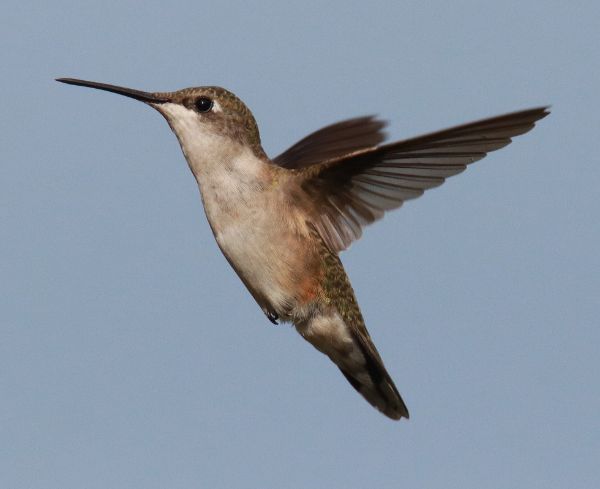
It was the highlight of my visit to the hummingbird garden, but it continued every few minutes thereafter. A hummingbird appeared at the Cannas and gave me a few more chances to photograph it in flight as it hovered to feed at the taller plants and provided more photo ops. But frankly, no other bird provided the quality photos of the first hummingbird’s visit to the cannas; the first female provided the absolute best hummingbird photographs I have ever taken – just as I was about to leave. I intended to leave by 9:30, but the action was just peaking. Even so, just before 9:30 the sun was unceremoniously covered by clouds that had been steadily moving southeast, and just like that, my morning photo session ended just when I needed to head 90 minutes north to the north edge of the Twin Cities to visit my niece Katy and her 2½ year old nature boy Anders.
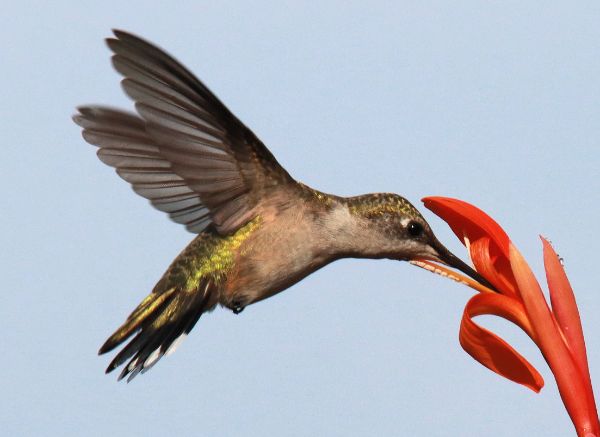
The next morning and afternoon I truly had a happy hummingbird hangover as I revered in the fun and excitement I had in the company of so many Ruby-throated Hummingbirds. Having initiated this photo trip at the drop of a hat Wednesday morning, as I reviewed and edited the best photos it seemed devoting those hours at the Henderson Hummingbird Garden was the best possible thing I could have planned for my days off. I am thrilled with the photo outcome, and buzzed by the experience among a surge of hummingbird activity; and I’m so happy to share the photos that illustrate this article. I hope you can appreciate that anyone with a camera beyond a smartphone can take photos just as good as what you see here. So please give it a try, if it’s at your own feeder or flower garden, or at a super hummingbird garden. It’s truly an underestimated experience and taking good photos of hummingbirds is easier than you might think – Good Luck!
Article and Photographs by Paul Konrad
Share your bird photos and birding experiences at editorstbw2@gmail.com