
Some of the most beautiful birds in flight, American White Pelicans are unique in their looks when you see them in close quarters (not necessarily the prettiest birds). I see these big white birds daily from early spring to fall, with groups even gliding over my house at times; and they commonly rest and fish in area marshes and lakes, sometimes in flocks, small and large. They nest in a couple huge nesting colonies 25 miles northwest and 80 miles north and search for food across a broad region – mostly fish and salamanders in this area. In fact, Chase Lake National Wildlife Refuge has long attracted the largest nesting colony of White Pelicans in North America.
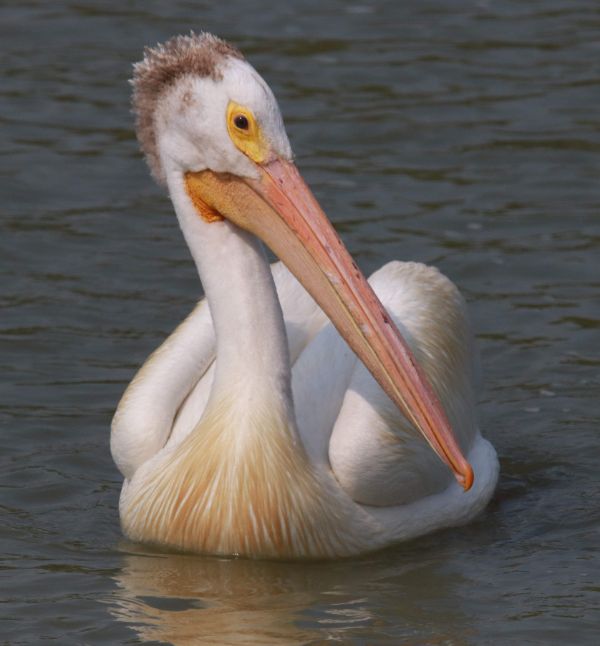
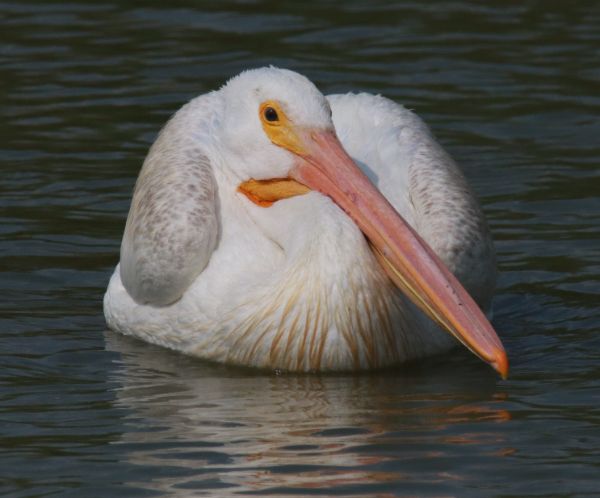
I photograph White Pelicans when the opportunity arises – in flight, swimming, fishing, resting – but when I visited a favorite bird photo stop last Wednesday, a new photo opportunity presented itself – Pelican Portraits. During this period of summer, I usually encounter Western Grebe families with downy young riding on the backs of some at this site; along with pelicans, cormorants, and ducks, so I was excited to see what birds would be present. As I neared the low bridge that provides photo access on the closed roadway, I could see many White Pelicans, and it turned out that about 40 pelicans were dominating the stream that connects 2 big lakes.
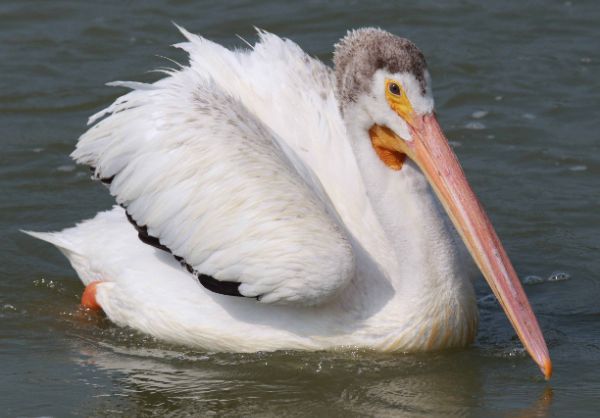
I stopped on the west side of the little one-lane bridge to get into the best position for the late afternoon sunlight to illuminate the big white birds in swimming motion. The pelicans reacted to my car’s arrival by swimming in a tight mass a few feet beyond their original position, but they quickly began spreading out again. That’s when I realized this opportunity had great potential to take portraits of individual birds as they assumed a variety of positions while floating or swimming on the water surface. I began zooming in and out to frame the photos with my 150-to-600 zoom lens, a very versatile photo lens for this kind of portrait photography.
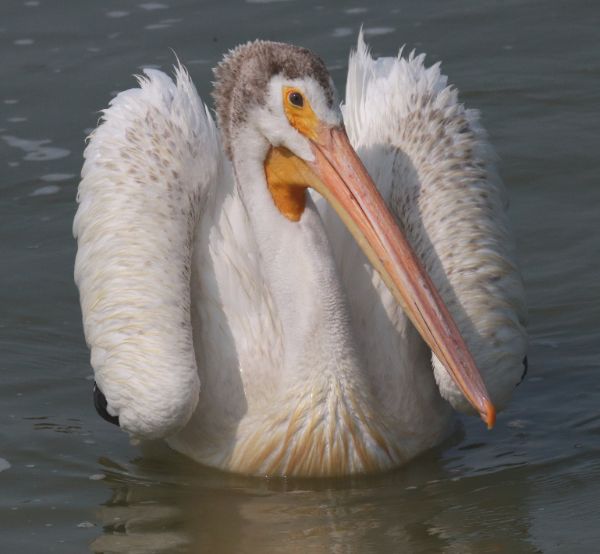
That’s when it became very clear that each pelican had an individually identifiable face, bare facial colors, and plumage accents. With these elements in mind, I began photographing individuals whose features were interesting from a portrait standpoint as they assumed in a variety of positions. Obviously, we are not talking about beautiful birds on a head and shoulders level, but they are eye-catching nonetheless and I enjoyed the photo session for about 20 minutes as other pelicans flew in and landed, and cormorants, gulls, and ducks flew by overhead. In some cases I included the entire bird in the photo frame, to show how each pelican had its own body look too.
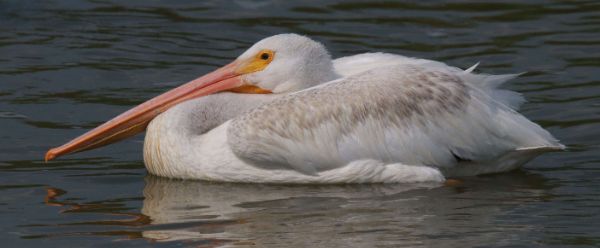
One catch was related to the large area of white plumage the birds have. In the bright light of the period when the late afternoon slipped into early evening, the white plumage could effect the light meter in such a way as to overexpose the plumage, thereby masking the details of white feathers. I have been using the center-point focus option in my camera settings when photographing birds for some time, and that works well as long as you focus on the right location on any given bird. To avoid over-exposing the white plumage, I focused on the bill of each pelican I photographed, and that seemed to work well. I think if I focused on the face, it would work similarly well, as long as I didn’t focus on the bright white plumage.
It was fun and rewarding to spend time so close to such a large group of American White Pelicans, and photographing the big birds added a nice creative angle to this encounter. In each issue I like to try to share images I take during the most recent week, and that has worked very well for an extended period of time, providing a variety of different photo insights and techniques illustrated by the photographs I select to publish in each week’s Bird Photography feature. I often start the week with a clean slate, and during almost daily birding drives I eventually seem to manage to find a chance opportunity to take a series of photos that stand out, or point to a certain way of addressing a bird photography topic. Of course, I have plenty of photographs to illustrate any photo topic in my photo files, but I like to provide a recent, seasonal photo activity to keep my presentations current – and I’ve been lucky in that way. That effectively means that birds dictate each Bird Photography topic and illustrations, and what could be more fitting. Good Luck with your camera while you enjoy birding throughout the summer.
Article and Photographs by Paul Konrad
Share your bird photos and birding experiences at editorstbw2@gmail.com