
Once we are on the water in loon country, everything changes – the mood, the colors, the freshness of the air, the joy in our voices. And when I have a chance to photograph with friends, which is actually every time I am on the water, we seem to join communally in mind and spirit. But when we see the first loon and the excitement level rises with the thrill of immediacy, we rise to the occasion to try to show the waters of a Minnesota Lake at their best – topped by a beautiful Common Loon, or 2, or a pair with 1 or 2 hatchlings. Last Thursday our Loon Photo Team included Captain Andy, our great friend Linda, and me, the insatiable loon photographer.
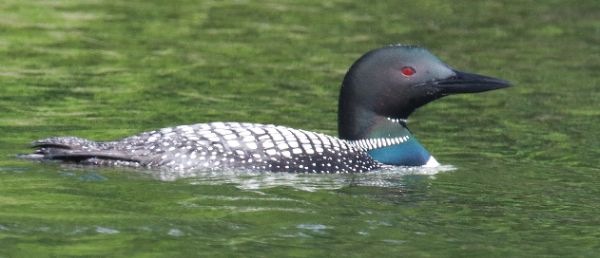
In my effort to impress the importance of lighting to get the best results in your photography, especially during bird photography opportunities, as I reviewed the photographs I took of Common Loons last Thursday I realized that I inadvertently hit the jackpot. While my amigo Andy was keeping us in the best position captaining his luxury pontoon, I had no idea of just how well the head and neck plumage of the adult loon was being illuminated, or how well the rainbow of iridescent colors was reflecting and being replicated in many of the photos I was taking.
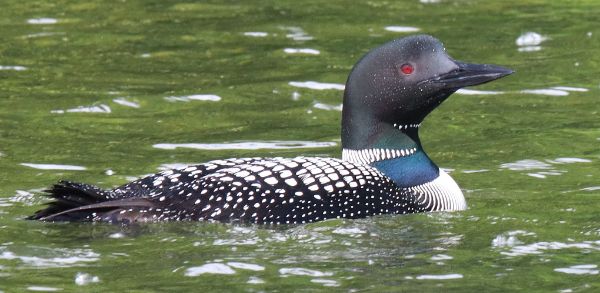
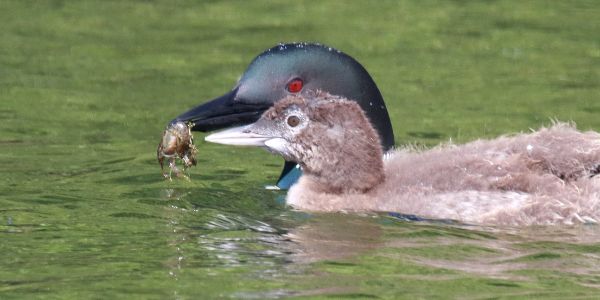
After all, most photographs of Common Loons I see are of loons showing black head and neck plumage. I certainly have many black-headed photos of loons swimming in blue water in my photo files. But with appropriate sunlight, and positioning of the photographer, the loons have much more to offer – faint yet vibrant colors reflected on their facial feathers and a bright blue-green neck band. The catch is that it is hard to judge just when the light is reflecting the mini-rainbow hues on the head and neck, or how to replicate it in photographs. With the adult loon swimming in different directions as the family group explored the area for fish and crustaceans, the effect of sunlight changed as she turned her head into and out of the iridescent cast that the sunlight and the loons’ positions created.
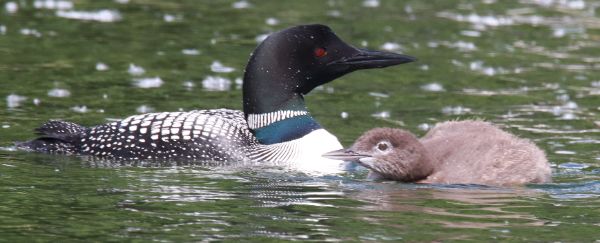
That said, my best suggestion to try to highlight the reflection of faint colors at this point is to take a lot of photos, and try to watch especially for when an adult loon’s face lights up beyond a dull black through the viewfinder. It’s not an easy thing to do, if it’s even possible in the field with everything else to consider as you look through the small camera viewfinder. The main thing is to be positioned between the birds and the sun, with the sun at your back and the loons before you, then watch for shadowing and sunlight reflecting on the loon’s face. The process is that the reflective feather surface changes color depending on the angle of your view, or your camera position in relation to the bird in cinque with the direction of the sunlight on its head and neck feathers. The colors produced depend on your viewing angle, and sometimes feathers can seem to change colors as the viewing angle changes – even slightly.
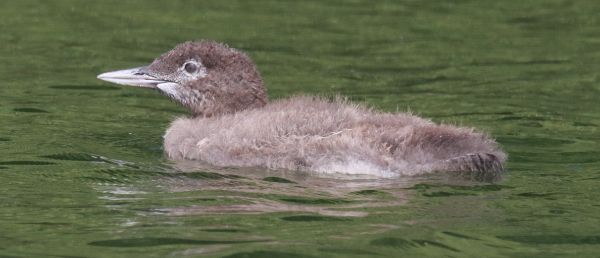
During our photo session, it was interesting to note that the 3-week-old loon twins were being fed by the adult, although the downy loons often dipped their face into the water to view the underwater scene, perhaps even watching the adult hunting underwater. It is always a thrill to be in the company of loons, especially when it includes a family group with downy young. And to share the experience with long-time friends is a blessing indeed, although the mix of friends tends to be different every time we venture onto the water to photograph loons and other wildlife. As for last Thursday’s time on the water – Thanks for everything Andy and Linda!
Article and Photographs by Paul Konrad
Share your bird photos and birding experiences at editorstbw2@gmail.com